
What is an SOP in Business? The Architecture to Escape the Founder Trap
Listen to this article

Ryan Pease
FOLLOW

Every bottleneck in your company currently leads directly back to your own inbox. You started a business to buy freedom and generate wealth. Instead, you engineered a high-stress, 80-hour-a-week job where every decision requires your immediate intervention. This is the Founder Trap. You are the operator, the ceiling, and the single point of failure.
You turn to Google in a moment of frustration. You type in what is a SOP or what does SOP stand for in business expecting a lifeline. You find academic articles and dusty corporate templates. The reality is much sharper. A Standard Operating Procedure is not a Word document. It is a highly leveraged asset that buys back your time and multiplies your enterprise value.
The Amateur Operator (Tribal Knowledge) | The Asset-Driven Enterprise (Systemization) |
|---|---|
Chaos scales with revenue | Leverage scales with revenue |
Owner acts as the chief problem solver | Owner acts as the primary capital allocator |
Vacations require a laptop and anxiety | Vacations require no (or very minimal) operational check-ins |
Valuation is tied to the founder’s brain | Valuation is tied to transferable systems |
Onboarding takes months of shadowing | Onboarding takes days of autonomous learning |
Decoding the Acronym: The Real Definition of Operations
Let's define the actual terms of the game. When operators ask what does SOP mean or What is an SOP in business, they usually picture a static, ignored binder sitting on a shelf. Forget that definition. What is a standard operating procedure in the real world? It is the exact, replicable architecture of how your company prints money without you.
Amateurs rely on human memory. Asset-driven enterprises rely on documented systems.
The goal is to transition from working in the business to working on the business. If you want the financial freedom you initially set out to capture, you must extract your brain and map it into a scalable framework. Asking What is SOP in business is just the starting line. Executing the architecture is the finish line.
When you ask what are SOPs, you must view them through the lens of capital allocation. Your time is your most expensive capital. Every hour you spend answering a question your team should already know the answer to is an hour stolen from strategic growth. An SOP is a mechanism to clone your decision-making process. It is the code that runs the machinery of your business.
Give Your Business Some
Mojo
Sign up to receive more goodness from SOP Mojo
The Pathology of Broken Operations
Most businesses fail to scale because their foundation is built on fragile dependencies. You hire smart people and hope they figure it out. This works to a million dollars in revenue. It shatters at five million. You cannot out-work a broken system.
The Single Point of Failure: Your top salesperson holds the entire CRM strategy in their head. They leave. Your pipeline collapses. You spend six months rebuilding from zero.
The Telephone Game: You train an employee. They train the next employee. By the third generation, the process is a mangled disaster of inefficiencies and bad habits. Quality control disappears.
The Innovation Chokehold: You cannot launch new products or enter new markets because your current fulfillment process requires your constant, daily supervision. Growth stops because your calendar is full.
To fix this, you have to stop managing people and start managing systems. People operate the systems. The systems run the business. This is the only way to achieve true operational freedom.
The Financial Cost of Undocumented Work
You are bleeding enterprise value every day you operate without a mapped architecture. The hidden costs of tribal knowledge destroy profit margins quietly.
The Onboarding Tax: When a new hire starts, you spend 40 hours shadowing them, fixing their mistakes, and repeating the same instructions you gave the last three hires. That is unrecoverable time.
The Error Tax: A team member misses a crucial step in client onboarding. The client churns. You lose the lifetime value of that contract because a simple checklist did not exist.
The Key-Person Risk Tax: Your operations manager demands a 30% raise. You have to pay it. You are held hostage because they are the only person who knows how the backend works.
Properly engineered SOPs eliminate these taxes. They turn volatile human variables into predictable business constants.
The Anatomy of a High-Converting System
A proper SOP is a living, breathing mechanism. It is not a textbook. It is a set of guardrails that guarantees a specific outcome regardless of who is executing the task. If your team ignores your current documentation, your documentation is the problem.
Visual Primacy: Heavy text blocks are useless. Nobody reads them. The modern SOP relies on screen recordings. You use Loom to capture the raw execution of the task. The video is the primary source of truth.
Step-by-Step Granularity: You extract the exact clicks from the video. You write commands, not suggestions. "Click the blue submit button in the top right corner" beats "Process the intake form."
The Definition of Done: A system must have a binary endpoint. The operator must know exactly what a successful execution looks like without asking for your approval. Provide visual examples of success.
Centralized Accessibility: A system hidden in a desktop folder is dead on arrival. SOPs must live exactly where the work happens. They must be linked directly inside the project management tool.
The Difference Between Policy, Process, and SOP
Operators constantly confuse these three terms. You need all three to build an autonomous company, but they serve entirely different functions.
The Policy: The absolute rule. Example: "All client invoices must be paid before work begins."
The Process: The high-level map of the workflow. Example: "The client signs the contract, pays the invoice, and receives the onboarding questionnaire."
The SOP: The granular, click-by-click instructions on how to execute the process. Example: "Open Stripe. Click 'New Invoice.' Select the client email. Set terms to Net-0. Click 'Send'."
You define the policy, map the process, and build the SOP. This creates a watertight operational environment.
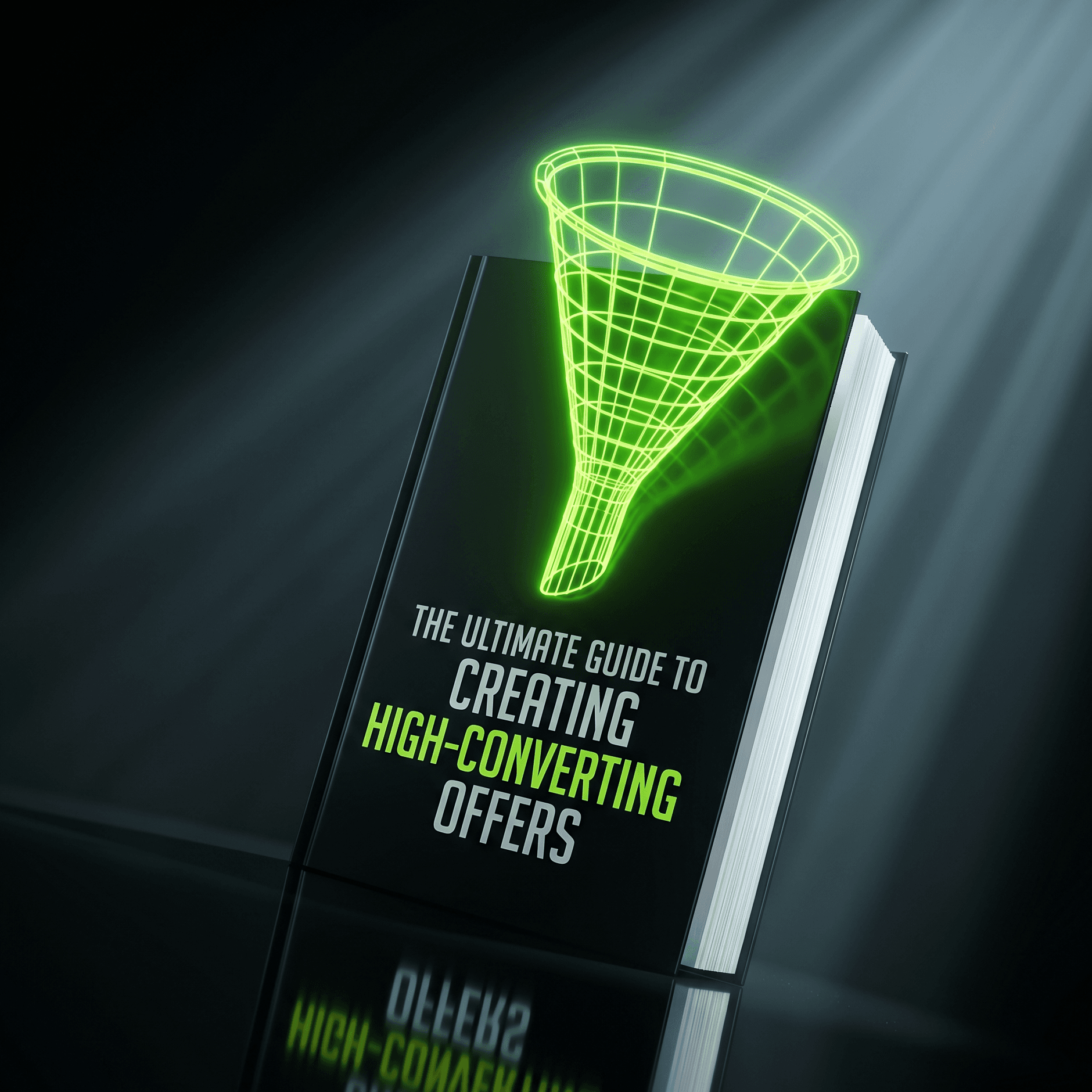
Need to kickstart your business? Check out these resources

The Tech Stack of the Asset-Driven Enterprise
Software is useless without strategy. Paying for premium tools will not save you if your underlying architecture is broken. Tools only scale the process you already have. If your process is chaotic, automation scales chaos.
Once your systems are mapped, you integrate the right technology to remove human error entirely. The modern operator builds an interconnected ecosystem.
Notion: This is your company brain. It houses the text, embeds the Loom videos, and organizes the workflows into a highly searchable database. It replaces the dusty employee handbook with an interactive wiki.
Airtable: This is your relational database. It connects your SOPs to actual client deliverables. You track the status of a project while linking directly to the specific Notion SOP on how to complete it.
Make.com: This is your invisible workforce. When a task is marked complete in Airtable, Make.com triggers the next step, sends the automated email, and updates the Slack channel. It executes the handoff without human intervention.
Loom: The visual capture tool. This is the fastest way to get your knowledge out of your head and onto a screen.
High-Multiple Exits: How SOPs Drive Valuation
Investors do not buy your 80-hour work week. They buy predictable, scalable cash flow. If your ultimate goal is a lucrative exit, the business must operate independently of your daily input. People often wonder what are SOPs good for when it comes to valuation. The answer is everything.
A buyer will audit your operations. They will conduct deep due diligence on your fulfillment, your marketing, and your financial reporting. If they find that every client outcome depends on your personal touch, the valuation plummets. They are buying a high-stress job, not a turnkey business. They will discount their offer heavily to account for the risk of replacing you.
Documented workflows, supported by high-efficiency automation, prove that the business is a standalone asset. You no longer have to explain what does SOP stand for to a buyer. You slide the Notion workspace across the table. You show them the Airtable dashboards. You prove that the revenue is detached from the founder's time. This is how you negotiate a maximum-multiple exit.
Overcoming Team Resistance to Systemization
When you introduce rigorous systems, pushback is inevitable. High-performing mavericks hate structure. They view SOPs as micromanagement. You must reframe the narrative.
Systemization is not about restricting freedom. It is about establishing baselines. You document the routine so your team can apply their brainpower to the exceptions. If a team member is spending two hours figuring out how to format a report, they are wasting company money.
Involve them in the build: Do not write the SOPs in a vacuum. Have the people doing the work record the Loom videos. You are capturing their expertise, not dictating from an ivory tower.
Tie systems to performance: Make adherence to the SOP a core metric in their quarterly review. If they find a better way to do the task, they must update the SOP. The system evolves through their input.
Fire the resisters: If a team member refuses to follow documented systems, they are a liability. They believe their tribal knowledge makes them indispensable. You cannot scale a company with employees who hold your operations hostage.
The Scale of Enterprise Systemization
Systemization is not a one-time project you do on a Friday afternoon. It is a permanent shift in how you operate. You must build a culture where undocumented work is considered incomplete work. Every single department requires a rigid architecture.
Marketing SOPs: The exact steps to launch a campaign, run the ads, qualify the leads, and track the conversions in the CRM.
Sales SOPs: The discovery script, the objection handling matrices, and the specific triggers for closing a deal and initiating the handoff.
Fulfillment SOPs: The step-by-step delivery of your core service to guarantee a five-star client experience every single time, regardless of which account manager is assigned.
Finance SOPs: The weekly reconciliation, the automated invoicing triggers, the collections process, and the payroll execution.
When every department runs on an engineered framework, the business becomes a machine. You sit in the control room. You pull the levers. You stop turning the wrenches.
The One-Hour Operational Extraction Playbook
Here is a raw, immediate strategy to extract yourself from one major operational bottleneck today. Do not attempt to systemize your entire business in one weekend. Start with the heaviest anchor.
Identify the heaviest time sink. Pick the one recurring task that drains your energy every single week. This is the low-level execution you dread doing.
Hit record. Turn on Loom. Execute the task exactly as you normally do. Speak your internal monologue out loud. Explain why you are clicking specific buttons and making specific choices.
Extract and structure. Hand that video to an assistant. Direct them to break the video down into a rigid, step-by-step checklist.
Delegate and observe. Give the new checklist to a team member. Watch them execute it. Do not help them. If they fail, the system is broken, not the person. Fix the system.
Iterate and lock it in. Add the missing steps to the document based on the failure points. Run the test again until the outcome is flawless. You never touch that task again.
If you run this playbook consistently, you stop asking what is a SOP and start asking what else you can automate. You buy back your Tuesday afternoons. You buy back your weekends. You reclaim your life.
Finalize Your Exit From The Daily Grind
Stop acting as the most expensive employee in your own company. You are hemorrhaging time and enterprise value by holding onto low-leverage tasks. The transition from operator to owner requires a ruthless commitment to architecture.]
Go to www.sopmojo.com right now to discover how our custom strategy and implementation services will build your permanent operational architecture. Book your operational audit and let us map your escape route.
Read our other guides on business systemization to continue replacing your manual effort with engineered workflows. Subscribe to the newsletter to receive our weekly teardowns on building the autonomous enterprise.
DOWNLOAD A FREE GUIDE HERE
Check out other interesting articles here 👇

Why Free Acceptable Use Policy Templates Destroy Enterprise Value
The Hidden Tax: How Operational Chaos is Bleeding Your Business Dry

The Architecture of Operational Freedom: Engineering a Business That Runs Without You
What is an SOP in Business? The Architecture to Escape the Founder Trap
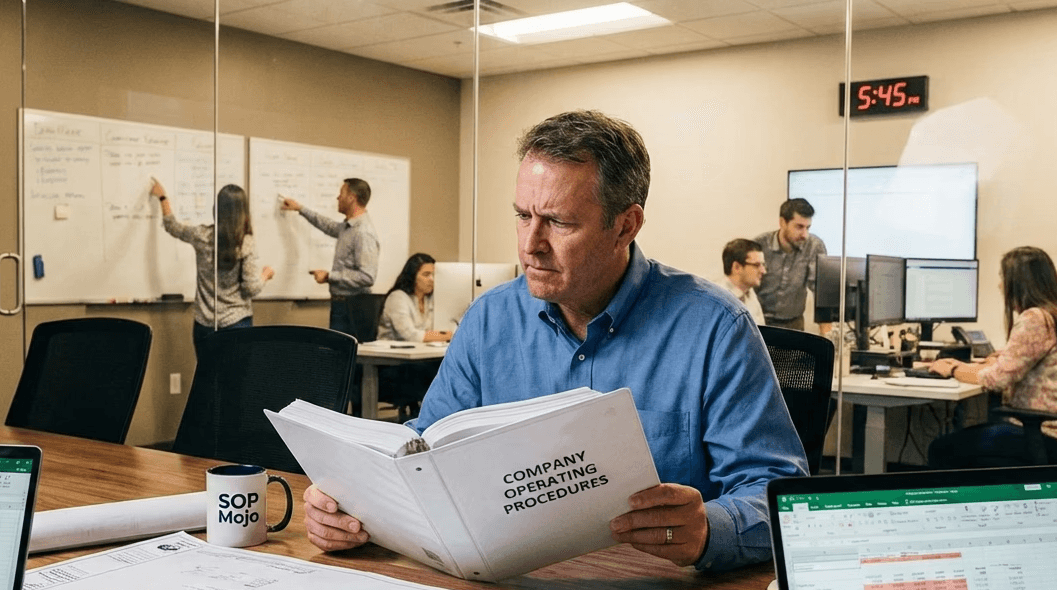
I Built a 6 Million Dollar Company That Couldn't Run Without Me
How to Build a Business That Works (Hint: Systems!)

Employee Onboarding and Training: A Practical Guide for Small and Medium Businesses

How to Write Standard Operating Procedures for Manufacturing: A Field-Proven Blueprint

Essential Quality Control Practices for Operational Excellence

How Standardized Processes Drive Operational Efficiency and Growth