
The Hidden Tax: How Operational Chaos is Bleeding Your Business Dry
Listen to this article

Ryan Pease
FOLLOW
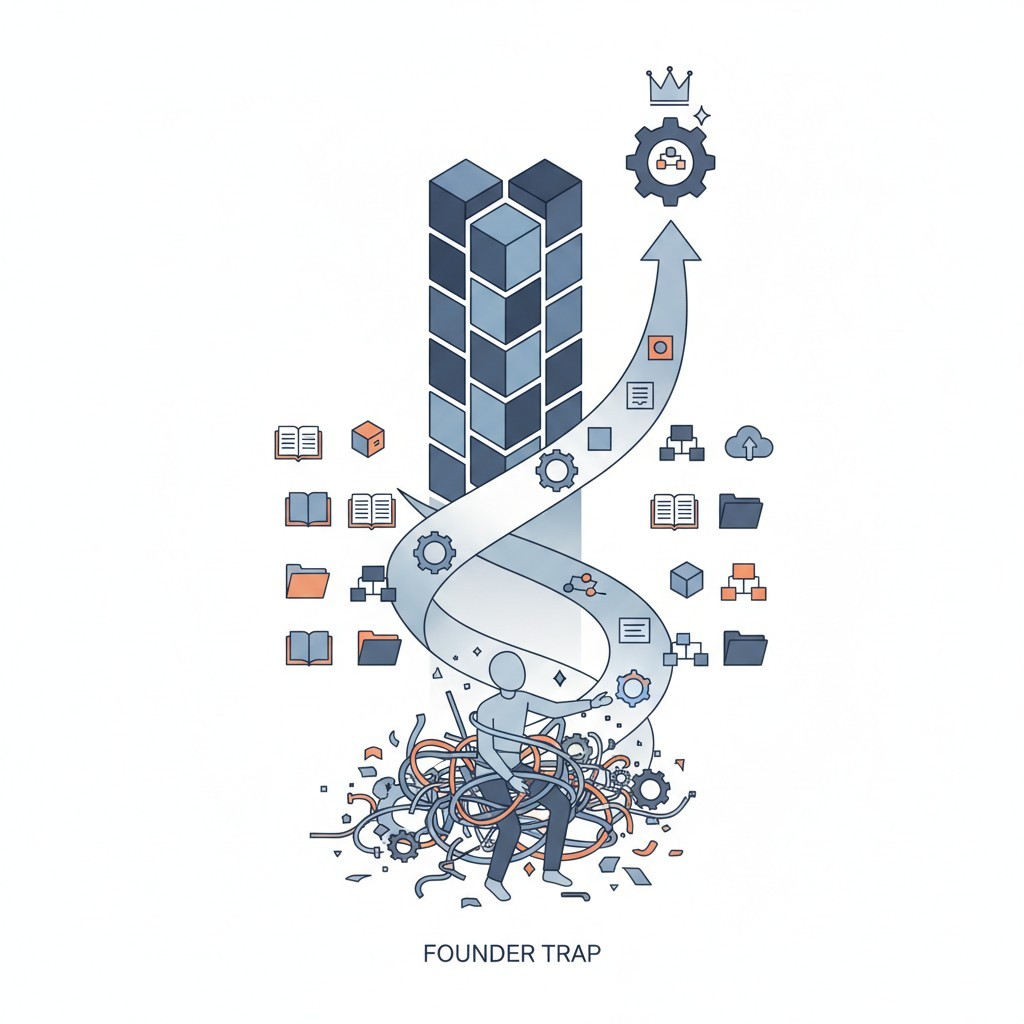
Your business is leaking money.
It is not happening in your P&L statement. It is not an expense line you can audit. It is a silent, pervasive drain on your resources, your momentum, and your sanity. This drain is operational chaos. It is the cost of inconsistent work, duplicated effort, and preventable errors. It is the tax you pay for every question an employee has to ask twice. It is the price of depending on a single person who "just knows how things work."
This is the state of most scaling businesses. They are trapped by tribal knowledge. They are held hostage by informal processes. They are slowed by the very ambiguity they once called "flexibility." Founders and operations leaders feel this acutely. They are frustrated by the constant firefighting. They are exhausted by the lack of predictability. They know there is a better way, but the path is unclear.
The market offers a confusing array of supposed solutions. You are told to create SOPs. You are sold on workflow mapping tools. You are pushed towards all-in-one "Work OS" platforms and AI-powered knowledge bases. Yet, the chaos persists.
This is not another article about the importance of documentation. This is a diagnosis of why those efforts fail. It is a brutally pragmatic look at the broken systems you have been told to trust. It exposes the fundamental disconnect between documenting work and getting work done correctly, every single time. We will dissect the failures of the current toolkit and provide a new framework for building an operational engine that actually works.
The Proof Engine: Deconstructing the Failure Points
The problem is not a lack of effort. It is a misapplication of effort. Businesses invest heavily in solutions that address symptoms, not the root cause. Let's examine the four main arenas where these investments go to die.
1. The Graveyard of Good Intentions: SOPs and Standardization
Standard Operating Procedures (SOPs) are the foundation of scalability. This is an undisputed fact. A business that cannot replicate its core functions cannot grow. It can only swell, becoming larger but weaker.
The SOP management market reflects this urgency. It is a $1.6 billion industry, projected to grow at over 11% annually. This growth is driven by a flight from static documents. Companies are moving to digital, centralized platforms. They are incorporating visuals. They are experimenting with AI to automate creation and updates.
These are logical steps. They are also insufficient.
The reality is that most SOPs are useless artifacts. They are created in a flurry of activity, uploaded to a shared drive, and then ignored until an emergency forces a frantic search for the outdated document. The core operational bottlenecks are not solved by a new software wrapper.
Failure Point: Poorly Written and Outdated Procedures. Most SOPs are written by people who are not writers. They are dense walls of text, filled with jargon and ambiguity. They describe an idealized process, not the reality of the workflow. Worse, they are instantly obsolete. The moment a tool is updated or a step is optimized, the SOP becomes a trap, documenting a process that no longer exists. This disconnect between documentation and reality breeds contempt for the system itself. Employees learn that the official SOP is wrong, so they stop trusting any of it.
Failure Point: Lack of Maintenance and Version Control. The failure to formally document changes is a critical vulnerability. An undocumented change made by one employee becomes a new piece of tribal knowledge. Soon, you have multiple "versions" of the same process running in parallel, creating inconsistent outcomes for your clients and chaos for your team. Without a ruthless system for maintenance, your SOP repository becomes a digital graveyard.
Failure Point: Inaccessible Documentation. "Centralized" does not mean "accessible." A folder in Google Drive or SharePoint is centralized. It is also where documents go to disappear. If an employee cannot find the correct procedure in under 30 seconds, at the moment they are doing the task, they will not look for it. They will guess, or they will interrupt a colleague. You lose time and introduce variance.
Founders live this pain daily. They fight employee resistance to new standards because the old way feels faster. They lack the time to create and maintain documentation properly. They are terrified of the "bus factor"—the risk of a key employee leaving and taking critical operational knowledge with them. The traditional approach to SOPs does not solve these problems. It often makes them worse by creating a false sense of security.
Give Your Business Some
Mojo
Sign up to receive more goodness from SOP Mojo
2. The Fallacy of Pretty Pictures: Process and Workflow Mapping
Process mapping is the act of visualizing how work gets done. It is the world of flowcharts, swimlane diagrams, and workflow models. The intent is noble: to create clarity. The tools in this space are sophisticated and collaborative.
Lucidchart caters to the technical user, creating detailed, data-linked diagrams. Miro excels at collaborative whiteboarding, perfect for brainstorming sessions. They are powerful tools for designing a process.
They are terrible tools for executing a process.
A flowchart is not a process. It is a picture of a process. It hangs on a virtual wall, divorced from the actual work. No employee performing a task stops to consult a complex swimlane diagram. The map is not the territory.
A newer category of tools, like Scribe and Whale, attempts to bridge this gap. They automate the creation of step-by-step guides by recording user actions. This is a significant improvement. It speeds up the capture of "how-to" knowledge. However, it often just creates a more visually appealing version of the old problem: a static document. You get a series of screenshots and text blurbs that, like any other document, become outdated and are stored separately from the workflow itself. They accelerate the creation of artifacts that will soon be ignored.
The operational bottlenecks here are fundamental.
Failure Point: Lack of Clarity and Incomplete Information. A process map often omits crucial context. It shows the "what" but not the "why" or the "what if." What happens if a step fails? Who is the backup approver? Where are the necessary credentials? This missing detail forces employees to improvise, defeating the purpose of standardization.
Failure Point: Failure to Consider the Audience. A process map created by an engineer for an operations team is often useless. It is written in the wrong language, assumes the wrong level of knowledge, and fails to address the user's real-world concerns. The documentation serves the creator, not the performer.
Failure Point: Keeping Documentation Up-to-Date. This is the universal killer of all process documentation. A visual map is even harder to update than a text document. As processes evolve organically, the beautiful diagrams become obsolete relics. The effort to keep them current is so high that no one bothers.
Founders get trapped in this cycle. They get team buy-in for a big mapping initiative. Weeks are spent in meetings creating "perfect" flowcharts. The team feels a sense of accomplishment. Then, reality hits. The maps are not used. The processes change. The expensive software becomes a glorified drawing tool. The initial momentum dies, and the team reverts to the old, chaotic ways.
3. The Empty Cathedral: Business Systems and the "Work OS" Fantasy
The next level of abstraction is the "Work OS." Platforms like monday.com promise a single, centralized system to manage all work. It is an enticing vision: one platform for projects, tasks, workflows, and automation. An operating system for your entire business.
The reality is that a Work OS is an empty cathedral. It is a magnificent structure with no prescribed way to use it. It provides a set of powerful building blocks—automations, dashboards, integrations—but it is up to you to construct a coherent system. This requires an extraordinary level of discipline, technical expertise, and, most importantly, time.
For a scaling business already struggling with chaos, a blank-canvas Work OS is not a solution. It is a new and expensive way to organize that chaos.
Failure Point: Information Overload. A fully built-out Work OS can be incredibly complex. With dozens of boards, hundreds of automations, and countless integrations, it becomes overwhelming for the average employee. Instead of clarifying the work, it obscures it behind a complex interface. Employees get lost, miss notifications, and eventually disengage.
Failure Point: The "Winging It" Mentality Persists. A Work OS does not impose process discipline. It reflects it. If your team culture is to "wing it," you will simply "wing it" inside a more structured-looking tool. Without deeply embedded, easy-to-follow procedures, the platform cannot enforce consistency. It just becomes a more colorful to-do list.
Founders are sold the dream of a single source of truth. They invest significant capital and implementation time. They then face the monumental task of architecting their entire business from scratch within the platform. The project often stalls. The initial enthusiasm wanes. The team finds workarounds outside the system because it is easier. The Work OS becomes a ghost town—an expensive testament to a good idea with flawed execution.
Need to kickstart your business? Check out these resources

4. The Knowledge Base Black Hole: The Myth of Centralized Intelligence
Knowledge management is the final piece of the puzzle. The goal is to capture your organization's collective intelligence and make it universally accessible. The market for knowledge base software is exploding, projected to reach nearly $60 billion by 2028.
Tools in this space are powerful. Helpjuice targets enterprises with customizable platforms and deep analytics. Zendesk integrates its knowledge base (Guide) with its support suite to deflect tickets. Confluence by Atlassian serves as the internal wiki for countless tech teams. They all leverage cloud technology and increasingly use AI for smarter search and content creation.
Yet, most internal knowledge bases fail. They suffer from the same fundamental flaw as the other systems: they are passive repositories. A knowledge base is a library that no one visits.
Failure Point: Content Quality and Maintenance. A knowledge base is only as good as its content. If the information is inaccurate, poorly written, or out-of-date, users will lose trust in it after one bad experience. Maintaining quality across an entire organization is a relentless, thankless job that is rarely prioritized. The knowledge base slowly decays, becoming a digital attic filled with forgotten junk.
Failure Point: User Adoption. Getting employees to change their behavior is the hardest part. Their habit is to ask a colleague or a manager. It is faster and easier than searching a database. Overcoming this inertia requires the knowledge base to be flawlessly accurate and instantly accessible. Most are not.
Failure Point: Information Silos. The knowledge base itself can become another silo. Information about a sales process lives in the CRM. Information about a project lives in the project management tool. Information about a technical procedure lives in Confluence. The knowledge is fragmented, and the employee is left to hunt for it across multiple systems.
Founders struggle to prove the ROI of these systems. They see the investment in software and the time spent writing articles. They do not see a corresponding drop in repetitive questions or a clear increase in efficiency. The knowledge base becomes a cost center, a box to be checked, but not a living, breathing part of the company's operational nervous system.
The Reciprocity Trigger: The Operational Certainty Stack
The common thread through all these failures is a disconnect. A disconnect between documentation and workflow. Between knowledge and action. Between the "how-to" guide and the "doing."
The tools are not the problem. The philosophy is. We treat documentation as a separate activity from the work itself. We write, map, and store information over there, while the work happens over here. This is the gap where chaos thrives.
To close this gap, you need a new model. You need to stop building passive repositories and start building an active operational engine. We call this the Operational Certainty Stack. It is a four-layer framework designed to integrate process directly into execution.
Layer 1: Effortless Capture This is the foundation. You must lower the barrier to documenting a process to near zero. It cannot be a chore. This means leveraging technology that watches a process being done correctly once and instantly translates it into a clear, step-by-step guide with screenshots and text. This is not about creating a perfect document. It is about capturing the raw material of the process with minimal friction. The goal is speed and accuracy of capture, not polished prose.
Layer 2: Dynamic Standardization Once captured, the raw process must be standardized. This is where you refine, edit, and add context. You clarify steps, define policies, and link to necessary resources. Crucially, this is not a static document. It is a dynamic, version-controlled asset. When a step changes, you do not create a new document. You update the master block for that step, and that change instantly propagates to every workflow that uses it. This kills the problem of outdated procedures at its source.
Layer 3: Seamless Integration This is the most critical layer and the one almost every other system misses. The standardized process cannot live in a separate library or knowledge base. It must be delivered inside the workflow itself. When an employee begins a task—be it "Onboard New Client" or "Process Monthly Invoices"—the relevant, step-by-step procedure should appear directly within their work tools. It should guide them through the task, providing the exact information they need at the exact moment they need it. This eliminates searching, guessing, and interrupting. It merges the "how-to" with the "doing."
Layer 4: Continuous Iteration No process is perfect. The final layer creates a closed-loop feedback system. As employees execute the process, they must have a frictionless way to suggest improvements. "This step is confusing." "This link is broken." "There is a faster way to do this." This feedback flows directly back to the process owner. The process is updated (Layer 2), and the improved version is instantly deployed to the team (Layer 3). The system learns and improves with every single execution. This transforms your operations from a rigid, brittle set of rules into a resilient, self-healing organism.
Your Call to Action: From Chaos to Certainty
The Operational Certainty Stack is not a theory. It is the blueprint for SOP Mojo.
We have seen the graveyards of SOPs in forgotten folders. We have seen the beautiful but useless process maps. We have navigated the empty cathedrals of Work OS platforms. We built SOP Mojo because these tools, despite their power, fail to solve the core problem. They fail to connect documentation to execution.
SOP Mojo is built on the four layers of the stack:
We make Capture effortless, turning any process into a step-by-step guide in minutes.
We make Standardization dynamic, with version control and reusable blocks that eliminate outdated information.
We make Integration seamless, delivering your processes as interactive checklists and guides directly inside the tools your team already uses.
We enable Iteration with built-in feedback loops, so your operations continuously improve.
Stop managing chaos. Stop paying the hidden tax of ambiguity and inconsistency. It is time to build an operational engine that creates predictability, empowers your team, and unlocks true scalability.
Build your operational engine. Visit www.SOPMojo.com.
Check out other interesting articles here 👇

Why Free Acceptable Use Policy Templates Destroy Enterprise Value
The Hidden Tax: How Operational Chaos is Bleeding Your Business Dry

The Architecture of Operational Freedom: Engineering a Business That Runs Without You

What is an SOP in Business? The Architecture to Escape the Founder Trap
I Built a 6 Million Dollar Company That Couldn't Run Without Me
How to Build a Business That Works (Hint: Systems!)

Employee Onboarding and Training: A Practical Guide for Small and Medium Businesses

How to Write Standard Operating Procedures for Manufacturing: A Field-Proven Blueprint

Essential Quality Control Practices for Operational Excellence

How Standardized Processes Drive Operational Efficiency and Growth