

The Architecture of Operational Freedom: Engineering a Business That Runs Without You
Listen to this article

Ryan Pease
FOLLOW

Your phone illuminates with another notification. It is late in the evening. Your top sales executive is waiting for approval on a standard contract revision. A client onboarding workflow has stalled because the account manager forgot the undocumented compliance sequence. Your entire company is waiting for you to make a decision.
This is the manifestation of decision gravity. Trivial, day-to-day operational choices inevitably sink to your desk for final approval. You spend up to 68% of your working hours engaged in low-level tactical operations, administrative firefighting, and micro-management. You have abandoned the strategic growth activities required to scale the firm. Beneath the polished executive dashboards and green metrics, the operational floor is engulfed in chaos. Workflows leak critical data. Communication breaks down. Customer escalations rise exponentially. You are forced to work grueling 14-hour days simply to hold the fragile architecture together.
You attempted to solve this with software. You bought into the software savior complex. You threw autonomous AI agents, complex Zapier integrations, and new project management tools at messy, undocumented workflows. You did not fix the business. You simply increased the velocity of your operational failure. Attempting to solve structural operational deficiencies with isolated software deployments rather than integrated system redesigns is a fundamental flaw. This is precisely why 89% of executives concede their technology investments fail to deliver the expected financial results.
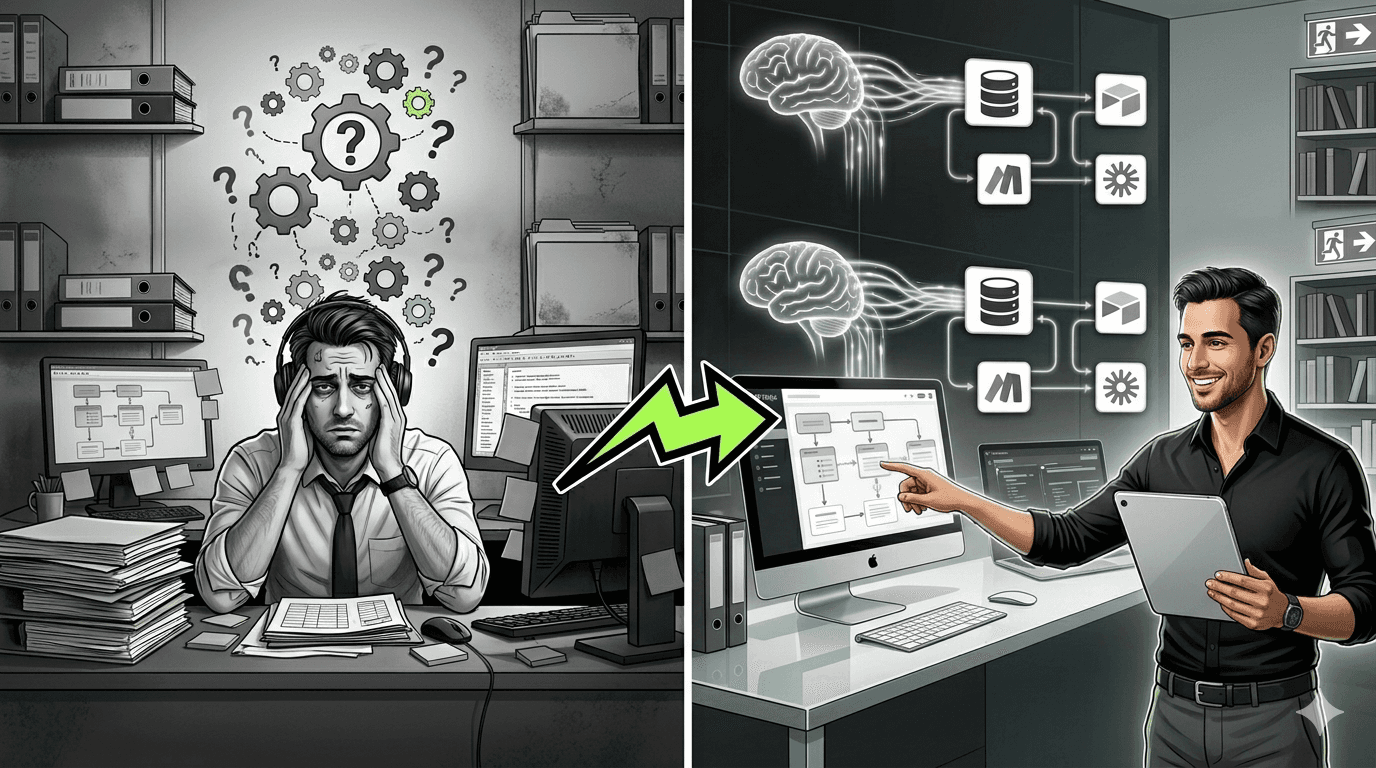
To achieve true operational freedom, you must transition from relying on human memory to relying on documented systems.
The Operational Reality Shift
The Stressed Operator | The Asset-Driven Enterprise |
Relies entirely on tribal knowledge and human memory. | Extracts implicit knowledge into explicit, documented assets. |
Views software as the ultimate savior for broken processes. | Builds a rigorous standardization layer before deploying technology. |
Functions as the primary bottleneck for all daily decisions. | Empowers agentic labor and staff with autonomous decision-making loops. |
Suffers a severe 10% to 25% Key-Person Discount during an exit. | Commands premium EBITDA multiples due to zero founder dependency. |
Reacts to chaotic inbound demand with disorganized sales motions. | Proactively targets dynamic intent signals using Account-Based Marketing. |
Give Your Business Some
Mojo
Sign up to receive more goodness from SOP Mojo
The Hero Syndrome and the Destruction of Enterprise Value
In the nascent stages of business development, centralized control is a distinct evolutionary advantage. You leveraged your deep market knowledge, forged personal client relationships, and executed rapid decisions to secure early traction.
You became the hero of your own company. As the enterprise scales and operations multiply, this extreme proximity to the work becomes a severe structural liability. Capable employees lose the autonomy to execute independently. The team simply waits for your executive approval before taking any meaningful initiative. This dynamic precipitates a crisis in talent retention. As companies scale without adequate systems, the resulting operational friction drives severe employee burnout. Current workforce surveys reveal that 51% of employees are actively seeking new employment opportunities.
This operational chaos directly destroys your enterprise value.
Sophisticated mergers and acquisitions buyers scrutinize target companies through an intensely critical lens of operational transferability. If a professional valuator or acquiring private equity sponsor determines during early diligence that customer relationships, technical expertise, or daily operations are inextricably tied to you, they will apply a severe penalty. This is known as the Key-Person Discount. It typically slashes 10% to 25% against your overall calculated valuation. This massive discount offsets the buyer's perceived integration risk and the high probability of operational disruption that will occur when you exit.
Amateurs apply generic industry multiples to raw earnings. Professional valuators aggressively utilize Adjusted EBITDA. They meticulously normalize your financial statements to reflect the true, transferable cash flow generating capacity of the business. High-quality companies boasting extremely durable recurring revenue and low founder dependency command astonishing median multiples of roughly 22.4x. Highly capital-intensive sectors vulnerable to supply chain volatility routinely command compressed multiples hovering in the 4x to 7x range.
EBITDA multiples act as a direct proxy for risk and durability. You might boast impressive top-line revenue. But if that profit is perceived by the acquirer as fragile or entirely dependent on your daily involvement, the buyer will aggressively compress the multiple. You must institutionalize your implicit knowledge to neutralize this risk entirely. Properly documented systems transform abstract, personal expertise into highly tangible, transferable corporate assets.
The Standardization Layer Pre-Requisite
The integration of artificial intelligence is now an absolute operational baseline. Enterprise focus has aggressively shifted toward the deployment of agentic labor. These are autonomous AI agents capable of reasoning, utilizing external software tools, and executing complex workflows across interconnected business systems with delegated authority.
Yet, the rapid corporate adoption of AI carries existential risk. Analysts project that the deployment of ungoverned generative AI in commercial applications could cost B2B companies over $10 billion in lost enterprise value due to unmitigated hallucinations and legal liabilities. The root cause of these costly AI failures is a profound crisis of implicit knowledge.
Large Language Models function as sophisticated pattern recognition engines. They fundamentally fail to understand the undocumented, unwritten rules of your specific business. When critical context remains locked in the minds of veteran employees rather than codified into explicit systems, the AI model is forced to guess. This guessing manifests as dangerous hallucinations.
The successful deployment of agentic labor requires a rigorous Standardization Layer. You must clean and organize your data before a single line of automation is deployed. You must explicitly document your standard operating procedures to provide the deterministic, rules-based parameters that AI agents require to function safely. Without this rigorous architecture, AI simply scales your existing disorder.
Need to kickstart your business? Check out these resources


Architecting the Tech Stack Triad
The flawless execution of robust standard operating procedures requires an underlying technological architecture capable of securely connecting vast amounts of enterprise data. The optimal organizational tech stack relies on the seamless integration of specialized relational databases, highly flexible knowledge hubs, and powerful automation middleware.
Airtable operates as a tremendously powerful relational database masked by an accessible spreadsheet interface. It is engineered from the ground up for absolute, rigid data integrity. It excels at managing complex, interconnected datasets such as vast CRM pipelines and intricate resource planning functions. Its strict formatting and granular user permissions make Airtable the definitive choice for mission-critical backend workflows that require zero data leakage.
Conversely, Notion functions as an expansive flexible workspace built entirely upon a system of interlocking pages and blocks. It excels dramatically at knowledge management, rich team wikis, and highly unstructured collaborative environments. Notion contextualizes your information. It allows qualitative narratives, detailed SOPs, embedded videos, and project guidelines to coexist dynamically on a single, human-readable canvas.
You do not have to make a binary choice between rigid databases and flexible wikis. The most resilient business architecture utilizes a sophisticated hybrid approach orchestrated by advanced automation middleware like Make.com. Make.com acts as the literal central nervous system of the enterprise. It dismantles deeply entrenched data silos by visually connecting applications via complex API triggers.
In a high-efficiency architecture, Airtable serves as the rigid backend source of truth for all numerical and status-based data. Notion serves as the collaborative frontend for daily team interaction. Make.com automates the continuous, bidirectional flow of critical information between them. When a high-ticket deal is successfully marked "Closed-Won" by a sales executive in your Airtable CRM, Make.com automatically triggers the creation of a standardized, pre-populated client onboarding portal within Notion. This completely removes hours of manual administrative toil and eliminates the risk of human data entry errors.
Elevating the Go-To-Market Engine
The rigorous systemization of internal operations must be perfectly mirrored by a radical transformation in your high-ticket sales operations. The average B2B buying cycle has elongated significantly to 10.1 months. Buying committees have ballooned in size, frequently encompassing up to 16 disparate stakeholders including risk management and the Chief Financial Officer.
This massive stakeholder expansion introduces severe friction. Industry data reveals that 86% of B2B purchases stall indefinitely in the pipeline. As deal sizes scale into the high-ticket range, statistical conversion rates predictably compress. Massive enterprise deals spanning $1M to $5M close at just 11.27%.
You must transition from traditional buyer-led targeting to signal-led architecture. Top-performing revenue teams orient their outreach strategy around real-time, dynamic intent signals such as executive leadership changes or granular product usage patterns. Buyers define a staggering 83% of their strict purchase requirements through independent digital research before they ever agree to speak with a sales representative. If you rely purely on reactive inbound demand generation, you have almost certainly already lost the deal to a more proactive competitor.
Elite sellers mitigate the severe friction of the 10.1-month sales cycle by utilizing comprehensive Digital Sales Rooms. These portals permanently replace fragmented email threads and lost PDF attachments by providing the prospect with a single, highly secure, centralized digital hub. This centralization empowers the internal champion within the target company to seamlessly sell the solution to their own buying committee asynchronously. It rapidly accelerates consensus-building and significantly shortens the overall time to signature.
Case Study: Dismantling the Logistics Bottleneck
Marcus operates a high-ticket B2B logistics and distribution firm. He scaled the company to a $12 million annual run rate entirely on his own intuition and industry relationships. The firm was incredibly profitable on paper. In reality, it was a fragile house of cards.
The entire operation was paralyzed by the Hero Syndrome. Complex supply chain routing logic, tiered pricing approvals, and international vendor compliance rules existed exclusively in Marcus's head. When major shipping exceptions occurred, the frontline team froze. They waited for Marcus to dictate the solution. He was working 14-hour days managing a profitable business that he hated. He explored a private equity buyout. The acquiring board uncovered his operational entanglements during early due diligence. They immediately applied a 20% Key-Person Discount to the valuation offer. The business was too risky to acquire.
We did not install new software first. We installed a Standardization Layer. We spent three weeks extracting his implicit tribal knowledge. We codified his shipping exception logic, pricing matrices, and vendor communication protocols into explicit text.
We then deployed the architectural triad. We built a rigid Airtable backend to house all active freight data, inventory levels, and financial metrics. We constructed a Notion workspace to serve as the daily operating frontend, embedding the newly extracted SOPs directly next to the client task boards. We utilized Make.com to connect the two. When a supplier delayed a shipment in Airtable, Make.com instantly triggered a specific escalation protocol in Notion, tagging the exact account manager with the precise SOP required to handle the delay.
Marcus was completely removed from the daily execution loop. The team possessed the autonomous authority to resolve complex issues based on his documented logic. Six months later, Marcus reapplied to the market. The private equity sponsor audited the pristine data room and the living SOP infrastructure. They removed the Key-Person Discount entirely. Marcus achieved an exit-ready valuation and regained his life.
The Reciprocity Trigger: The Four-Week Test
You must audit your organization against a brutal benchmark of operational freedom. John Warrillow, author of Built to Sell, states that a business relies on standard operating procedures to hold value. He emphasizes that if your business cannot survive your prolonged absence, you do not own a business; you own a highly stressful job. This is the foundation of the four-week vacation test.
If you completely disconnected from all company communication for thirty consecutive days, your business should grow. If client deliverables fracture and high-ticket sales pipelines collapse, your architecture is fundamentally broken. You can begin fixing this immediately by executing the following strategic shift.
Identify the Core Decision Bottleneck: Pinpoint the single daily process that currently requires your absolute approval to proceed. This is typically a pricing discount authorization, a final QA check on a client deliverable, or a custom scope of work creation. Calculate the hours you lose to this specific task every month.
Extract the Contextual Logic: Do not just record a screen-share of the administrative clicks. Write down the exact, nuanced logic you use to make the approval decision. Document the red flags you look for, the profit margins you protect, and the exact language you use to communicate the outcome.
Build the Asynchronous Guardrails: Move this process out of direct messaging channels and into a highly visible project management tool. Assign explicit ownership to a capable team member. Attach the newly documented logic directly to the task.
Delegate the Ultimate Authority: Explicitly grant the team member the authority to execute the final decision based strictly on the parameters of the document. Refuse to answer questions about the task via Slack or email. Force the team to rely on the system. If the system fails, update the document.
You must transition your executive mindset from chasing the work to managing the system.
Your Path to Enterprise Value
Amateurs rely on human memory. Asset-driven enterprises rely on documented systems. You cannot scale a high-velocity B2B operation on the back of tribal knowledge and founder burnout. You must architect an infrastructure that encodes your genius, empowers your workforce, and protects your enterprise value.
Stop throwing disjointed software at broken processes. It is time to implement the rigorous operational strategy required to achieve true operational freedom.
Reach out to me directly at www.SOPMojo.com to book your operational strategy call and transition from a stressed operator to a true business owner.
To explore our exact frameworks and see how we structure high-efficiency workflows, check out our SOP Library at www.sopmojo.com/soplibrary.
Check out other interesting articles here 👇

Why Free Acceptable Use Policy Templates Destroy Enterprise Value
The Hidden Tax: How Operational Chaos is Bleeding Your Business Dry
The Architecture of Operational Freedom: Engineering a Business That Runs Without You
What is an SOP in Business? The Architecture to Escape the Founder Trap

I Built a 6 Million Dollar Company That Couldn't Run Without Me
How to Build a Business That Works (Hint: Systems!)

Employee Onboarding and Training: A Practical Guide for Small and Medium Businesses

How to Write Standard Operating Procedures for Manufacturing: A Field-Proven Blueprint

Essential Quality Control Practices for Operational Excellence

How Standardized Processes Drive Operational Efficiency and Growth