
Why Free Acceptable Use Policy Templates Destroy Enterprise Value
Listen to this article

Ryan Pease
FOLLOW

You downloaded a free acceptable use policy template from the fourth page of Google. You swapped out the placeholder company name and saved it to a forgotten folder on your company intranet. You assume this document protects your business from data breaches, intellectual property theft, and rogue employee behavior. You are entirely unprotected.
There is a massive structural difference between downloading a generic, static PDF written by a freelance copywriter in 2018 and deploying an algorithmic, audit-ready operational boundary. Free internet templates are static placeholders. They lack jurisdictional awareness, ignore generative artificial intelligence entirely, and offer zero enforceable legal shelter. Operating a modern B2B enterprise on the back of outdated, pieced-together IT governance is a severe liability.
Business owners frequently treat compliance documentation as a low-level administrative chore. They delegate the task to an overwhelmed operations manager who inevitably relies on these outdated policy template examples. This creates a massive vulnerability. It exposes the organization to crippling audits, unmitigated legal liabilities, and brutal valuation penalties during merger and acquisition due diligence.
The market has shifted aggressively. Buyers, private equity sponsors, and enterprise clients no longer accept the illusion of security. They demand rigorous operational boundaries. They demand proof that your workforce operates within strict, highly governed digital guardrails. An organization lacking a customized, legally sound information technology policy template is operating on borrowed time.
The Operational Reality
The Vulnerable Operator | The Asset-Driven Enterprise |
Relies on outdated internet templates lacking modern legal and technological context. | Deploys a dynamically updated, audit-ready AUP customized to current technological threats. |
Treats compliance documents as a static file, ignoring them until a breach occurs. | Embeds standard operating procedures and usage policies directly into the onboarding workflow. |
Lacks any formal governance regarding generative AI, leaving client data exposed to public models. | Implements a strict ai acceptable use policy template to completely neutralize data leakage. |
Suffers massive valuation penalties during M&A due diligence for unacceptable operational risk. | Commands premium enterprise valuations by proving total operational control and compliance. |
Give Your Business Some
Mojo
Sign up to receive more goodness from SOP Mojo
The Shadow AI Challenge
Consider the reality of "Shadow AI" operating within your own company right now. Your team is under immense pressure to execute faster and scale aggressively. To meet these demands, an ambitious account executive needs to summarize a highly confidential, 50-page client financial brief before a quarterly review. To save time, the employee copies the entire document and pastes it into an unapproved, public generative AI application. The model instantly outputs a brilliant executive summary. The employee looks like a hero.
The operational reality is catastrophic. Your employee just voluntarily handed your client’s most sensitive financial intelligence to a third-party server. This data is now ingested into an external model. It will be used to train future iterations of that software. It could potentially surface in future outputs for entirely unrelated users, including your direct competitors.
There was no malicious intent. No firewall was breached. No alarms went off in your IT department. Traditional security protocols completely failed because the data was freely surrendered by an authorized user.
When the client inevitably discovers this data leakage, the fallout is devastating. Your organization faces immediate breach of contract lawsuits, massive reputational destruction, and the loss of the account.
When your legal counsel scrambles to review your internal governance, they will find your generic it acceptable use policy template entirely worthless. It offers zero legal shelter. It explicitly lacks an ai acceptable use policy template clause. It contains no guidance on data provenance, approved vendor lists, or generative model interaction. You cannot terminate the employee for cause, and you cannot shield your enterprise from the liability, because you never established the operational boundary.
This specific scenario is playing out across the B2B sector with terrifying frequency. Major global firms have already suffered catastrophic leaks of proprietary source code and executive strategy because they failed to govern artificial intelligence at the employee level. Amateurs rely on human common sense to protect sensitive data. Asset-driven enterprises rely on documented systems.
The Due Diligence Penalty
The financial ramifications of an inadequate acceptable use policy extend far beyond the immediate costs of a data breach. The absence of strict operational governance directly destroys your enterprise value. For founders and business owners considering a liquidity event, strategic merger, or private equity buyout, your internal documentation will be subjected to intense scrutiny.
In the current mergers and acquisitions market, acquiring boards audit target companies through an intensely critical lens of risk mitigation. They do not merely look at your revenue and EBITDA margins. They audit the underlying architecture that produces that revenue. During the formal diligence phase, the acquiring legal team will request access to your data room. They will specifically look for your IT governance documents and the corresponding digital signatures proving that your current workforce actually read and agreed to them.
When buyers uncover operational policies that were drafted five years ago and never signed by the current workforce, they immediately categorize your company as a high-risk asset. Confidence without clarity gets organizations breached. Buyers know this intimately. They demand evidence of governance, not just vague assurances from the founder.
If an acquiring sponsor determines your business operates without a modern email security policy template or clear digital boundaries, they will apply a severe financial penalty against your overall calculated valuation. This penalty offsets their perceived integration risk and the high probability of a post-acquisition breach. A missing or outdated aup costs you hundreds of thousands, or even millions, of dollars at the closing table.
You must transition your executive mindset. An acceptable use policy is not a box to check for an insurance underwriter. It is a fundamental driver of exit-readiness. It proves to the market that your enterprise is a mature, highly systemized, and fully controlled asset.

Audit-Ready Architecture
Deploying a robust aup requires moving beyond simple lists of forbidden websites. The architecture of a premium acceptable use policy must systematically cover every vector of modern corporate technology. It must be written in authoritative, plain language that leaves zero room for misinterpretation.
An elite acceptable use policy templates structure contains highly specific directives.
Generative AI and Large Language Models: The policy must explicitly define authorized and unauthorized AI tools. It must contain a rigid ai acceptable use policy template section that strictly forbids the input of personally identifiable information, proprietary source code, client financials, or internal strategic documents into any public model. It must separate approved, private enterprise instances from public consumer-grade tools.
Hardware and Network Access: It must outline the exact boundaries of device usage, whether company-issued or "Bring Your Own Device" (BYOD). It must define the required security protocols, mandatory multi-factor authentication, and the explicit prohibition of bypassing mobile device management software.
Communication and Electronic Transmission: It requires a comprehensive email security policy template that dictates how sensitive attachments are handled. It must outline the absolute prohibition of auto-forwarding corporate emails to personal accounts, and state strict rules against using company platforms for unauthorized solicitation or harassment.
Legal Disclaimers and Monitoring Rights: The document must clearly establish the company’s absolute right to monitor all traffic, communications, and data residing on corporate hardware or networks. It must include a specific use at your own risk disclaimer template language regarding personal data stored on company devices. This legally protects the enterprise during internal investigations or remote device wipes.
These components cannot be loosely suggested. They must be codified, distributed, and legally acknowledged by every single individual operating within your business environment.
The Cost of Tribal IT Knowledge
Organizations frequently fall into the trap of relying on tribal knowledge to manage technological behavior. The founder or the core executive team intrinsically knows that uploading client data to an unvetted software tool is dangerous. They assume the rest of the workforce shares this identical understanding. This assumption is a fatal operational error.
As a business scales, new hires enter the environment bringing their own habits, preferred tools, and completely different baseline understandings of data security. If the rules of engagement exist only in the founder’s head, or are mentioned briefly in passing during a chaotic first day on the job, the system inevitably fractures.
Standardization is the only cure for this fracture. You must extract your implicit expectations regarding technology use and codify them into an explicit aup templates structure. This removes the burden of continuous verbal enforcement from the leadership team. When the rules are clearly documented and universally applied, the system manages the behavior. The founder is finally freed from the exhausting role of micromanaging employee software choices and can return to focusing on top-line revenue growth and strategic architecture.
A properly executed acceptable use policy acts as a silent enforcer. It sets the exact parameters of acceptable corporate behavior. It provides your human resources and legal teams with the precise ammunition they need to terminate bad actors or handle negligent behavior without exposing the company to wrongful termination lawsuits. Without the signed document, your hands are tied. With the document, your enterprise is protected.
Reclaiming Enterprise Value
First, we need to get you out of the mess you are in. I speak with brilliant founders every single week who have built incredible revenue engines, only to realize their entire operation is resting on a fragile foundation of undocumented IT practices. You have worked entirely too hard to build your business to let a careless employee copy-paste your enterprise value away into a chatbot.
As your partner in business systemization, I am telling you that ignoring this vulnerability is no longer an option. We need to establish a rigid operational boundary immediately. You must move from a state of anxious vulnerability to a state of total, audit-ready confidence.
Here is the exact playbook you must execute to secure your environment, protect your data, and instantly increase the institutional maturity of your business.
Conduct an Architecture Audit: You must inventory every piece of software, every cloud application, and every AI tool currently active within your environment. Identify the shadow IT your team is using without formal approval. You cannot govern what you cannot see.
Deploy a Modern Policy: Discard your outdated internet template today. You must deploy a rigorous, legally sound AUP that specifically addresses modern threats, including generative AI, remote network access, and strict data provenance.
Force Universal Acknowledgment: An unread policy is a useless policy. You must distribute the new document to every employee, contractor, and vendor with access to your systems. Require a digital signature from every individual acknowledging they have read, understood, and agreed to the strict terms of the policy.
Integrate into the Onboarding Workflow: Never rely on human memory for compliance. Embed the signing of the AUP into the very first step of your automated new-hire onboarding sequence. Access to company email and software must be strictly gated behind the completion of this document.
You must transition your executive mindset from chasing the work to managing the system. By implementing these specific architectural changes, you instantly close the most dangerous loopholes in your business. You protect your client relationships, you secure your intellectual property, and you prove to any future buyer that your enterprise is a premium, highly governed asset.
Institutionalize Your Operations
Amateurs rely on human memory and the hope that employees will simply use good judgment. Asset-driven enterprises rely on documented, legally binding systems. You cannot scale a high-velocity B2B operation while leaving your data security to chance. You must architect an infrastructure that protects your genius, sets clear boundaries for your workforce, and fiercely guards your enterprise value.
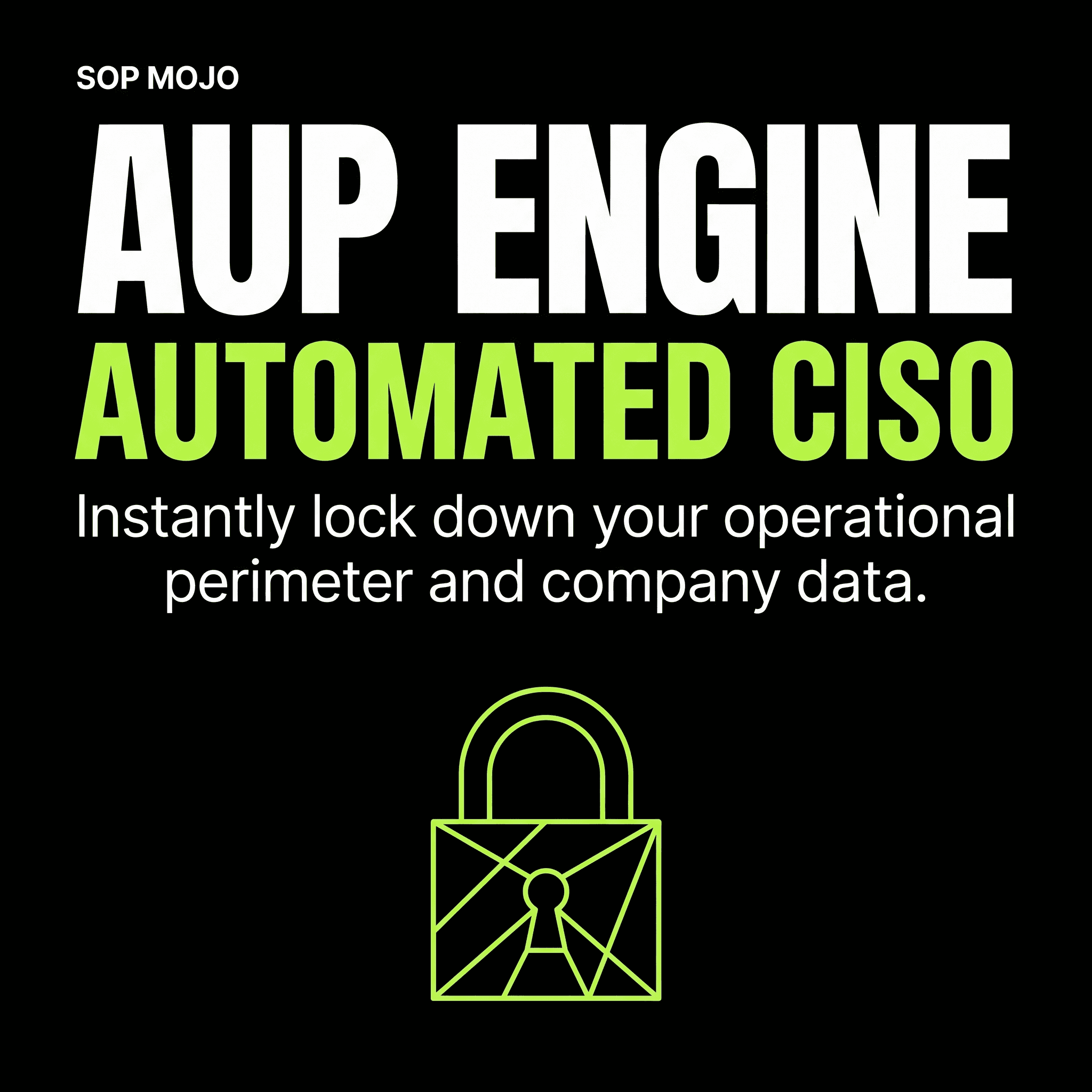
Generating a policy yourself from scratch, or trusting a static freebie from a random blog, leaves massive legal gaps in your operational armor. Our tool solves this entirely. The SOP Mojo generator is a dynamic software engine. It leverages professionally drafted, lawyer-reviewed logic that adapts to your specific inputs to instantly output a comprehensive, highly enforceable boundary tailored to modern tech threats. You get the exact protective framework of a high-end corporate legal consultation, delivered in minutes.
Generate an airtight, audit-ready policy right now. Secure your business in 60 seconds with our professionally drafted Acceptable Use Policy Generator. Click here to deploy your customized, PDF and DOCX ready policy immediately: https://www.sopmojo.com/soplibrary/acceptable-use-policy-generator
To explore our exact frameworks, master the art of business systemization, and access the tools used by elite operators to build sellable assets, visit the SOP Mojo Library at www.sopmojo.com/soplibrary.
Check out other interesting articles here 👇
Why Free Acceptable Use Policy Templates Destroy Enterprise Value
The Hidden Tax: How Operational Chaos is Bleeding Your Business Dry

The Architecture of Operational Freedom: Engineering a Business That Runs Without You

What is an SOP in Business? The Architecture to Escape the Founder Trap

I Built a 6 Million Dollar Company That Couldn't Run Without Me
How to Build a Business That Works (Hint: Systems!)

Employee Onboarding and Training: A Practical Guide for Small and Medium Businesses

How to Write Standard Operating Procedures for Manufacturing: A Field-Proven Blueprint

Essential Quality Control Practices for Operational Excellence

How Standardized Processes Drive Operational Efficiency and Growth