
Value Stream Mapping Process: A Step-by-Step Guide to Optimization
Listen to this article

Ryan Pease
FOLLOW

Most small business owners know something is slowing them down. Deliverables get stuck in someone's inbox. New hires take months to get up to speed. The founder ends up answering the same questions over and over because no one else knows how the work actually flows. The value stream mapping process is one of the most practical tools available to surface exactly where those friction points live, and more importantly, what to do about them.
Originally developed in lean manufacturing, value stream mapping (VSM) has proven just as powerful in service businesses, professional firms, and field operations. This guide walks through the full process, with examples built specifically for founder-led and growing SMBs, not factory floors.
What Is Value Stream Mapping?
Value stream mapping is a lean management tool that creates a visual picture of every step required to deliver a product or service to a customer, from the initial request all the way to fulfillment. Unlike a simple flowchart, a VSM captures both the physical steps of the work and the information flows between those steps. It records what is actually happening, not what the team assumes is happening.
The key distinction from basic process mapping is scope. A process map zooms in on a single task or workflow. A value stream map zooms out to the entire delivery cycle, revealing how all the pieces connect and where time and effort are leaking between steps.
Every activity on a VSM is categorized as either value-adding (something the customer would pay for) or non-value-adding (waste the customer would not). That distinction is where the real work begins.
Why Small and Mid-Sized Businesses Need Value Stream Mapping
In a founder-led business, most of the process knowledge lives in people's heads. The founder knows the shortcuts. A senior employee knows which clients need special handling. A project manager has a personal system that no one else understands. This is called tribal knowledge, and it is one of the most common sources of operational waste in growing SMBs.
The value stream mapping process forces that invisible knowledge onto paper. When a team maps how work actually moves from intake to delivery, hidden bottlenecks become impossible to ignore. Handoffs that everyone assumed were smooth turn out to have two-day gaps. Steps that feel productive turn out to be redundant. Time that should be spent delivering value is being consumed by unnecessary back-and-forth.
For businesses trying to scale, this matters enormously. Scalable operations require documented, repeatable systems. VSM is the diagnostic step that tells a business exactly which systems need to be built first.
Value Stream Mapping for Service and Founder-Led Businesses: A Practical Reframe
Most VSM guides use manufacturing examples: widgets moving through a production line, raw materials being converted into finished goods. That framing makes it hard for a marketing agency owner, a specialty contractor, or an IT managed service provider to see themselves in the process.
The reframe is straightforward. In a service business, the "product" is the client outcome. The "raw material" is the incoming request, inquiry, or job order. The "production line" is the sequence of steps the team takes to deliver that outcome. Every concept in VSM translates directly.
For example, a consulting firm mapping its client onboarding process would treat the signed contract as the starting trigger and the first delivered milestone as the output. Every step in between, including kickoff scheduling, data collection, internal briefings, and document preparation, is part of the value stream. Mapping it reveals exactly where clients wait, where team members duplicate effort, and where the founder is the only person who knows what happens next.
The 4 Core Steps of the Value Stream Mapping Process
Step 1: Define the Service Line or Value Stream
Start by selecting a specific service or delivery process to map. Trying to map everything at once produces a diagram too complex to act on. Choose one repeatable service line, such as client onboarding, project delivery, or field job fulfillment. This becomes the scope of the mapping exercise.
Step 2: Draw the Current-State Map
Document how the work actually flows today, not how it is supposed to flow. Walk through each step with the people who do the work. Capture process steps, the teams or individuals responsible, how information moves between steps, and key time metrics including cycle time, wait time, and lead time. Use standard VSM symbols: process boxes for each step, push arrows to show work moving forward, data boxes to capture metrics, and a timeline at the bottom to show value-added versus non-value-added time.
Step 3: Analyze and Identify Waste
With the current-state map complete, the team reviews it to identify where waste is accumulating. Kaizen bursts, small starburst symbols drawn directly on the map, are used to flag improvement opportunities. Prioritize waste by impact versus effort: address the bottlenecks that slow delivery the most and are relatively straightforward to fix before tackling complex systemic issues.
Step 4: Design the Future-State Map and Action Plan
The future-state map shows what the value stream should look like after waste is removed. It is not a wish list. It is a realistic, achievable version of the process built on the findings from the current-state analysis. The gap between the current-state and future-state maps becomes the improvement roadmap, with specific actions, owners, and timelines assigned to each change.
Key Metrics to Capture in a Value Stream Map
Numbers are what separate a VSM from a simple diagram. The essential metrics to record for each process step include:
Cycle time: How long it takes to complete one unit of work from start to finish within a single step.
Lead time: The total elapsed time from the customer request to delivery, including wait time between steps.
Process time: The actual hands-on time spent working on a task, excluding waiting.
Wait time: Time the work sits idle between steps, often the largest source of hidden waste.
Takt time: The rate at which work needs to be completed to meet customer demand.
In many SMB service businesses, the ratio of process time to lead time is startlingly low. A project that takes 10 hours of actual work might have a lead time of two weeks because of wait time between handoffs. VSM makes that gap visible and quantifiable.
The 7 Wastes Value Stream Mapping Uncovers
Lean methodology identifies seven categories of waste, known as muda, that VSM is designed to expose. Each one shows up in service businesses just as clearly as in manufacturing:
Overproduction: Preparing deliverables or reports before the client is ready to use them, creating rework when requirements change.
Waiting: Work sitting in someone's queue because of approval bottlenecks, missing information, or unclear handoffs.
Transport: Unnecessary movement of information, such as files being emailed back and forth when a shared system would eliminate the step.
Over-processing: Adding more detail, review rounds, or formatting to a deliverable than the client actually needs.
Inventory: Partially completed work piling up, such as proposals drafted but not sent, or jobs scheduled but not started.
Motion: Team members spending time searching for information, switching between tools, or tracking down approvals.
Defects: Errors that require rework, corrections, or client callbacks, all of which consume time without adding value.
When prioritizing which wastes to eliminate first, focus on waiting and defects. They tend to have the highest impact on both client experience and team capacity in service-based SMBs.
VSM vs. Process Mapping: Which Does a Growing Business Need?
Value stream mapping and process mapping are related but serve different purposes. VSM covers the entire delivery cycle end-to-end, including information flows, time metrics, and the connection between steps. Process mapping zooms in on a single task or workflow, documenting the detailed steps within that task.
For an SMB trying to understand where time is being lost across a full service delivery cycle, VSM is the right starting tool. Once the high-impact areas are identified, process mapping becomes the right tool to document the detailed steps within each problem area. Used together, they provide both the strategic view and the operational detail needed to build a complete set of SOPs.
Value Stream Mapping Examples for Service Businesses
Client onboarding at a professional services firm: The value stream starts when a contract is signed and ends when the client completes their first working session. Mapping typically reveals that the majority of lead time is consumed by scheduling delays, incomplete intake forms, and internal briefings that happen too late in the process.
Job fulfillment at a specialty contractor: The value stream starts with a customer inquiry and ends with a completed and invoiced job. Common waste includes multiple phone calls to confirm scheduling, technicians arriving without full job details, and invoices sitting unsent for days after completion.
Order-to-delivery at a small distributor: The value stream starts with a purchase order and ends with confirmed delivery. Typical waste includes manual re-entry of order data across systems, inventory checks done by phone rather than in a shared system, and shipping delays caused by unclear handoff between sales and fulfillment.
How Value Stream Mapping Reduces Founder Dependency and Key-Person Risk
One of the most underappreciated benefits of the VSM process is what it does to institutional knowledge. When the current-state map is built collaboratively, the tacit knowledge that lives in the founder's head, or in a senior employee's habits, gets externalized onto a diagram that the whole team can see and discuss.
This is the first step toward removing key-person dependency. If only one person knows how to handle a particular client situation, that shows up on the map as a single-point bottleneck. If the founder is the only one who knows which vendor to call, that is a process gap, not a personality quirk. Making it visible transforms it from an invisible risk into a solvable operational problem.
For businesses preparing to scale, this is critical. Growth amplifies every bottleneck. A process that works when the founder is involved in every step breaks down the moment volume increases or the founder steps back.
From Future-State Map to Standard Operating Procedures: Closing the Loop
The future-state map is not the end of the process. It is the beginning of implementation. Each process box on the future-state map represents a step that needs a documented owner, a defined standard, and a clear handoff protocol. In other words, each box is the foundation for a standard operating procedure.
The translation works like this: the process box becomes the SOP title and scope. The data box metrics become the performance standards. The information flows become the input and output requirements. The team member assigned to that step becomes the SOP owner.
This is the bridge that most VSM guides skip entirely. Drawing the map is valuable. Building the SOPs from the map is what actually changes how the business operates day to day. A future-state map without corresponding documented procedures is just a vision. SOPs built from a future-state map are an operating system the team can run without the founder in every conversation.
5 Value Stream Mapping Mistakes Small Businesses Make (and How to Avoid Them)
Mapping the ideal process instead of the real one: Teams often describe how work is supposed to flow rather than how it actually flows. Fix this by walking the process step by step with the people who do the work, not just the people who manage it.
Trying to map everything at once: Scoping too broadly produces an unwieldy diagram with no clear action path. Start with one service line and one delivery cycle.
Skipping the metrics: A VSM without time data is just a flowchart. Capturing cycle time and wait time for each step is what makes the waste visible and quantifiable.
Building the future-state map without a team: The founder or a single manager designing the future state without input from the people doing the work creates a plan that looks good on paper but fails in practice. Involve the team in designing the solution.
Stopping at the map: The most common mistake is treating the completed map as the deliverable. The map is a diagnostic tool. The deliverable is the set of improved processes and documented SOPs that come from acting on what the map reveals.
Value Stream Mapping Checklist: What to Prepare Before Your First Mapping Session
Before gathering the team, use this checklist to make sure the session is set up for success:
Select one specific service line or delivery process to map (not the whole business)
Identify the start trigger (the moment work enters the system) and the end point (the moment value is delivered to the customer)
Assemble a cross-functional team that includes at least one person from each stage of the delivery process
Designate a facilitator whose job is to keep the session moving and objective
Gather any existing data on cycle times, error rates, or common delays before the session
Prepare a whiteboard or large paper and sticky notes (or a digital VSM tool if the team is remote)
Block two to four hours for the current-state mapping session, with a separate session for future-state design
Agree in advance that the goal is to map reality, not to defend existing processes
Plan a follow-up session within two weeks to assign action items from the future-state map
Identify which process boxes will become SOPs and assign a first draft owner for each
Frequently Asked Questions
What are the 4 steps of value stream mapping?
The four core steps are: (1) define the service line or value stream to map, (2) draw the current-state map documenting how work actually flows today, (3) analyze the current state to identify and prioritize waste, and (4) design the future-state map and create a concrete action plan to close the gap between the two.
What are the 7 wastes in value stream mapping?
The seven wastes, drawn from lean methodology, are overproduction, waiting, transport, over-processing, inventory, motion, and defects. In service businesses, waiting and defects (rework) are typically the highest-impact categories.
What is the difference between value stream mapping and process mapping?
Value stream mapping covers the entire delivery cycle end-to-end, including information flows and time metrics across all steps. Process mapping zooms in on a single workflow or task in detail. VSM is better for diagnosing system-wide waste; process mapping is better for documenting the specifics of an individual procedure.
Is VSM a lean or Six Sigma tool?
VSM originated in lean manufacturing and is primarily a lean tool. It is also used within Lean Six Sigma frameworks, where it complements data-driven analysis methods. For most SMBs, a lean-focused application is sufficient and more practical to implement.
How does value stream mapping help small businesses scale?
VSM surfaces the bottlenecks, tribal knowledge, and founder dependencies that prevent a business from growing beyond its current constraints. By making the current delivery process visible and measurable, it gives business owners a clear roadmap for which processes to document, standardize, and hand off, which are the foundational steps for sustainable scaling.
Check out other interesting articles here 👇

Why Free Acceptable Use Policy Templates Destroy Enterprise Value
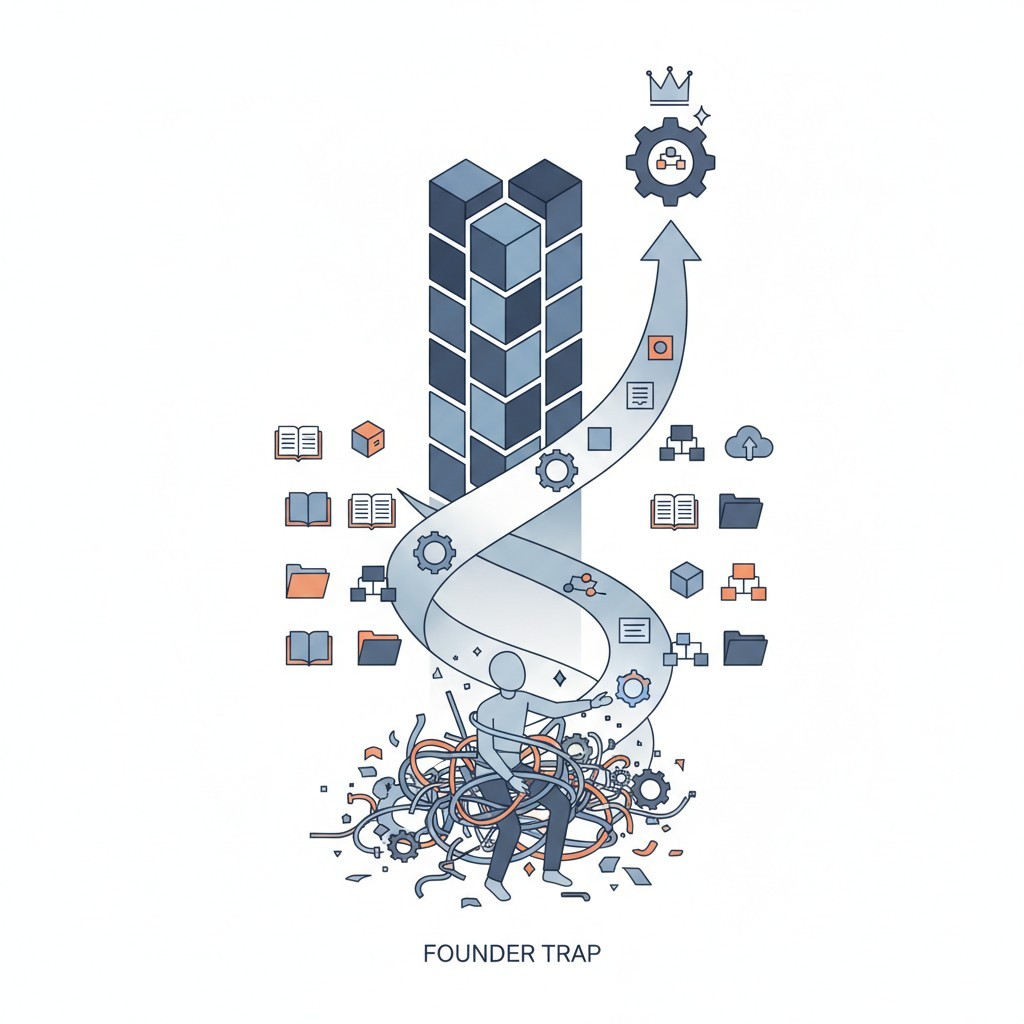
The Hidden Tax: How Operational Chaos is Bleeding Your Business Dry

The Architecture of Operational Freedom: Engineering a Business That Runs Without You

What is an SOP in Business? The Architecture to Escape the Founder Trap
I Built a 6 Million Dollar Company That Couldn't Run Without Me
How to Build a Business That Works (Hint: Systems!)

Employee Onboarding and Training: A Practical Guide for Small and Medium Businesses

How to Write Standard Operating Procedures for Manufacturing: A Field-Proven Blueprint

Essential Quality Control Practices for Operational Excellence

How Standardized Processes Drive Operational Efficiency and Growth