
Exploring the Types of Operational Risks: What You Need to Know
Listen to this article

Ryan Pease
FOLLOW

Most small business owners understand financial risk. They track cash flow, watch margins, and plan for slow seasons. But operational risk? That one tends to sneak up on people. It hides in the gaps between how a business thinks it runs and how it actually runs day to day. And for founder-led businesses with 10 to 50 employees, operational risk is often the single biggest threat to sustainable growth.
This guide breaks down the types of operational risks in plain language, with real examples drawn from service businesses, agencies, contractors, and other founder-led operations. No banking jargon. No enterprise frameworks that assume you have a dedicated risk department. Just a practical look at where things go wrong operationally and what to do about it.
What Is Operational Risk? (And Why SMBs Can't Ignore It)
Operational risk is the risk of loss or disruption resulting from failures in internal processes, people, systems, or external events. In simpler terms: it is what goes wrong when the day-to-day execution of your business breaks down.
The formal definition comes from the banking world (Basel II, specifically), but the concept applies to every business that delivers a product or service through a team of people using some kind of process. A marketing agency that loses a client because a campaign was set up incorrectly by a new hire. A bookkeeping firm where the senior accountant quits and takes the client-billing process with her. A specialty contractor whose crew completes jobs inconsistently because no one ever wrote down the right way to do them. These are all operational risk events.
It helps to understand what operational risk is not. Strategic risk involves making the wrong big-picture decisions, like entering the wrong market or pricing a service incorrectly. Financial risk is about capital structure, credit exposure, and liquidity. Compliance risk is about violating laws or regulations. Operational risk is specifically about execution: the internal machinery of how work gets done.
For founder-led businesses, operational risk is especially acute for one straightforward reason: most of the "how" lives in people's heads. Processes are informal. Tribal knowledge is everywhere. The founder is often the single point of contact, approval, and expertise for too many things at once. When any one of those people-shaped pillars wobbles, the whole operation feels it.
The Core Types of Operational Risk
While there are several ways to categorize operational risk, most frameworks converge on four primary types:
Process risk: Failures in how work is designed, documented, and executed
People risk: Failures tied to human behavior, knowledge gaps, or dependency on specific individuals
Systems and technology risk: Failures in the tools, software, and infrastructure that support operations
External risk: Disruptions originating outside the business that affect operations
These four categories are sometimes called the "4 Ps" framework (People, Processes, Systems/Technology, and External events), though the most commonly cited shorthand is the "3 Ps": People, Processes, and Systems. More on that in the FAQ section below.
What is worth noting for SMB owners is how these risks show up differently at smaller scale. A large enterprise has redundancy built in. It has backup systems, cross-trained teams, documented playbooks, and dedicated departments to manage risk. A 15-person service firm typically has none of that. The same risk category lands much harder when there is no buffer.
Quick-Reference: Risk Type to Common SMB Trigger
Risk Type | Common SMB Trigger | Typical Impact |
|---|---|---|
Process Risk | No written procedure for a recurring task | Inconsistent output, rework, client complaints |
People Risk | Key employee leaves or is unavailable | Delivery gaps, knowledge loss, founder bottleneck |
Systems Risk | Software failure or unapproved workaround | Data loss, billing errors, missed deadlines |
External Risk | Vendor failure, regulatory change, or weather event | Delayed delivery, compliance exposure, revenue loss |
Process Risk: When How You Work Becomes the Hazard
Process risk is the most pervasive type of operational risk in founder-led businesses, and it is almost entirely self-inflicted. It arises when workflows are undocumented, inconsistently followed, or designed around one person's individual approach rather than a repeatable system.
Consider what happens when a growing IT managed service provider onboards a new client. If the onboarding steps exist only in the senior technician's head, every new client gets a slightly different experience depending on who handles the work that week. Some steps get skipped. Others get duplicated. The client notices inconsistency. The team wastes time figuring out what was done and what still needs doing. The founder gets pulled in to fix it. That is process risk materializing in real time.
Undocumented workflows create single-point-of-failure steps. If only one person knows how to run the monthly billing reconciliation, that step fails the moment that person is sick, on vacation, or gone. The absence of a written procedure turns a routine task into a recurring fire drill.
Quality variance is another hallmark of process risk. When 10 team members each do the same task 10 different ways, the output varies. Clients who expect consistency get surprises instead. And because there is no documented standard to reference, it is nearly impossible to diagnose where the variation is coming from or how to fix it systematically.
The good news is that process risk is the most directly solvable type of operational risk. A well-written standard operating procedure eliminates ambiguity, creates a shared standard, and gives managers a baseline against which to measure performance. This is precisely why SOP development is not just an administrative task but a core risk management activity.
Give Your Business Some
Mojo
Sign up to receive more goodness from SOP Mojo
People Risk: The Hidden Cost of Key-Person Dependency
People risk covers a broad range of operational vulnerabilities tied to human factors: turnover, human error, skill gaps, and the concentration of critical knowledge in too few individuals. For most SMBs, the dominant form of people risk is key-person dependency.
Key-person dependency occurs when a business cannot function normally without a specific individual present. In many founder-led businesses, that person is the founder. They know the clients personally. They hold the vendor relationships. They approve the deliverables. They handle the escalations. When they are unavailable for any reason, the business slows down or stops. This is not just a people management problem. It is an operational risk with real financial consequences.
But founders are not the only key people. In a 20-person marketing agency, the account director who manages the top three clients might be equally irreplaceable. In a specialty contractor, the lead technician who knows how to configure a particular system might be the single point of failure for an entire service line. When that person leaves, the knowledge walks out the door with them.
Human error is another significant driver of people risk. Errors happen in every business. The question is whether the process around the human is designed to catch and correct them, or whether everything depends on the individual getting it right every single time. Absent procedures, checklists, and review steps, errors compound quietly until they surface as a client complaint or a costly mistake.
Onboarding gaps amplify people risk significantly. When a new hire joins and there is no documented training process, they learn by shadowing, asking questions, and making educated guesses. They absorb the habits and workarounds of whoever trained them, not a standardized approach. This is how inconsistency propagates through a growing team.
Founder and Key-Person Dependency: The Operational Risk Most SMBs Overlook
This topic deserves its own section because it is the most common and most underacknowledged operational risk in small and medium-sized businesses. No major risk framework names it explicitly, but any operator who has tried to take a two-week vacation without their phone knows exactly what it feels like.
Founder dependency is not a leadership problem. It is a documentation problem. The founder knows how to do things. The business has not yet captured that knowledge in a form the team can use without the founder present. The result is a business that scales the founder's time rather than scaling a system.
The risks compound as the business grows. At five employees, the founder can stay close to every function. At 20 employees, that is no longer possible, but if nothing has been documented, the founder becomes a bottleneck rather than a leader. Decisions pile up. Delivery slows. Good employees leave because they feel unsupported. The business hits a ceiling that has nothing to do with market demand and everything to do with operational fragility.
Senior-employee dependency creates similar dynamics. The operations manager who has been with the company for eight years and knows everything about how the business runs is an asset until the day they leave. At that point, they become a liability that was never properly managed. The knowledge they held should have been systematically extracted and documented long before their departure.
Mitigating this risk requires intentional knowledge transfer: structured interviews, process walkthroughs, and the conversion of tacit knowledge into written procedures. This is not a one-time project. It is an ongoing operational discipline.
Systems and Technology Risk: When Tools Fail or Aren't Followed
Systems risk encompasses the operational disruptions that arise from technology failures, software limitations, data vulnerabilities, and the human behaviors that work around formal systems. For lean SMB teams, this category is growing in importance as more business functions depend on software platforms.
Software failures are the most obvious form of systems risk. A project management tool goes down during a critical deadline week. A billing system corrupts a month's worth of invoices. A cloud storage service experiences an outage and the team cannot access shared files. These events are largely outside the business's control, but their impact can be significantly reduced by having documented contingency procedures in place before they happen.
Data loss is a related risk that many small businesses underestimate. Without documented backup procedures and clear ownership of data management tasks, a single hardware failure or accidental deletion can result in the permanent loss of client records, financial data, or operational files that took years to build.
Shadow systems are a subtler but equally damaging form of systems risk. A shadow system is any unofficial tool or workaround that team members use instead of the approved system. A salesperson who tracks their pipeline in a personal spreadsheet instead of the CRM. A project manager who communicates client updates through personal email instead of the project platform. These workarounds fragment information, create version-control problems, and make it impossible to get an accurate picture of what is happening in the business.
Cybersecurity and access-control gaps are particularly relevant for small businesses. Shared passwords, former employees retaining system access, and the absence of documented security protocols all create exposure. Many SMBs assume they are too small to be targeted by cyber threats. In reality, lean teams with minimal security infrastructure are often easier targets than large enterprises with dedicated IT departments.
External Risk: What You Can't Control but Can Prepare For
External risk refers to operational disruptions caused by forces outside the business. These include regulatory changes, supply chain failures, economic shifts, natural disasters, and the failure of key vendors or partners. While businesses cannot prevent these events, they can significantly reduce their operational impact through preparation and documentation.
Regulatory changes are a particularly relevant external risk for service businesses. A new data privacy regulation affects how a marketing agency handles client data. A change in licensing requirements affects a specialty contractor's ability to operate in certain jurisdictions. Businesses that have documented their compliance procedures can adapt more quickly. Those that have not are left scrambling to figure out what they do, let alone whether it meets the new standard.
Vendor and third-party dependency is an often-overlooked external risk. If a key supplier raises prices, changes terms, or goes out of business, how does the operation respond? If a subcontractor fails to deliver, what is the fallback? Businesses with documented vendor management procedures and alternative-sourcing protocols are far more resilient than those that handle these situations ad hoc.
Natural disasters and other force-majeure events expose operational fragility quickly. A flood that takes out the office. A power outage that lasts three days. A regional emergency that prevents staff from coming in. Businesses with documented remote-work protocols, data backup procedures, and client communication templates can maintain continuity. Those without documentation are entirely dependent on individual judgment in high-stress moments when judgment is least reliable.
Operational Risk in Small and Medium Businesses: Real-World Examples by Industry
Most operational risk literature uses banking examples. Here are examples from the kinds of businesses that actually face these risks day to day.
Marketing and Creative Agency
A 12-person agency loses its creative director. She was the only person who knew the brand guidelines for three major clients, the file-naming conventions used across all campaigns, and the approval workflow for client sign-offs. Within two weeks, the team is producing inconsistent work, missing deadlines, and frustrating clients. This is a people risk and process risk event occurring simultaneously, triggered by the absence of documented procedures.
IT Managed Service Provider
A 25-person MSP relies on a single senior technician to handle all escalated client issues. When he takes medical leave, the support queue backs up, clients escalate to the owner, and two clients threaten to leave. The business had no escalation SOP, no documented troubleshooting tree, and no backup coverage plan. That is process risk, people risk, and key-person dependency in a single scenario.
Specialty Contractor

A commercial HVAC company with 18 field technicians completes jobs inconsistently because each technician was trained differently. Callbacks are high. Client satisfaction scores vary widely by crew. The owner spends 30 percent of his time handling complaints and re-dispatching crews. The root cause is the absence of a documented installation and quality-check procedure. That is process risk with a direct financial cost.
Accounting and Bookkeeping Firm
A bookkeeping firm's project management software goes down two days before a major client reporting deadline. No one has documented the manual backup process. The team spends half a day trying to reconstruct the workflow from memory and email threads. Some data has to be re-entered. The deadline is missed. That is systems risk amplified by the absence of a contingency procedure.
Staffing and Recruiting Firm
A recruiting firm's top biller leaves and takes her candidate pipeline notes with her. They were stored in a personal spreadsheet she never shared with the team. The firm loses visibility into dozens of active placements. That is people risk combined with a shadow system problem, both of which a documented CRM usage SOP would have prevented.
How to Identify Operational Risks in Your Business
Identifying operational risks is the prerequisite to managing them. The goal is to surface risks before they materialize as incidents, not after. Here are practical methods suited to SMB scale.
Process Walkthroughs
Walk through every core process in the business from start to finish. Ask the people who actually do the work to narrate each step. Look for steps that depend on a single person, steps that are done differently by different team members, and steps that have no documented reference. These are your highest-priority process risks.
Team Interviews and Incident Logs
Ask team members directly: "What breaks when you're not here?" and "What do you wish was written down?" These conversations surface tribal knowledge and single points of failure faster than any formal audit. Reviewing recent incidents, client complaints, and rework events also reveals where risks have already materialized.
Risk and Control Self-Assessment (RCSA)
An RCSA is a structured exercise in which a business identifies its key processes, assesses the risks within each, and evaluates the controls currently in place. At SMB scale, this does not need to be a complex exercise. A simple spreadsheet listing processes, their associated risks, and the current mitigation status is sufficient to create meaningful visibility.
Signals That a Risk Has Already Materialized
Recurring rework, client complaints about inconsistency, missed deadlines, and founder involvement in tasks that should be handled by the team are all lagging indicators of operational risk. If these patterns are present, the underlying risk has already materialized. The question is whether it has been recognized as a systemic issue or attributed to individual performance.
Operational Risk Mitigation: Turning Risk Into Documented Process
Once risks are identified, the next step is prioritization and mitigation. Not every risk requires the same response, and SMB owners have limited time and resources. The goal is to focus effort where it will have the greatest impact.
Prioritizing Risks by Likelihood and Impact
A simple risk matrix scores each identified risk on two dimensions: how likely it is to occur and how significant the impact would be if it did. High-likelihood, high-impact risks get addressed first. Low-likelihood, low-impact risks can be monitored rather than actively mitigated. This keeps the effort proportional to the actual exposure.
SOPs as the Primary Mitigation Tool
For process risk and people risk, which together represent the majority of operational risk in founder-led businesses, the primary mitigation tool is documentation. A well-written SOP converts tacit knowledge into a shared, repeatable standard. It reduces dependency on specific individuals, creates a training baseline for new hires, and provides a reference point for quality control.
The SOP does not need to be a 50-page manual. A clear, step-by-step procedure for a specific task, written in plain language, accessible to the people who need it, and reviewed periodically to stay current, is enough to dramatically reduce the associated risk.
Monitoring, Review Cadence, and Accountability Ownership
Risk mitigation is not a one-time project. Risks evolve as the business grows, the team changes, and the market shifts. Assign ownership of each significant risk to a specific person. Set a review cadence, quarterly at minimum, to assess whether the risk profile has changed and whether existing controls are still effective. Track incidents and near-misses as inputs to that review.
Which SOP Fixes Which Risk? A Type-by-Type Mitigation Map
One of the most practical things an SMB owner can do is connect each type of operational risk to a specific documentation solution. Here is a direct map.
Process Risk: Core Workflow SOPs
Every recurring task that has a right way to be done should have a written procedure. Client onboarding SOPs, service delivery checklists, quality review procedures, and handoff protocols directly address process risk by eliminating ambiguity and creating a consistent standard.
People Risk: Role-Based SOPs and Training Playbooks
Documenting what each role does, how they do it, and what they are responsible for creates a foundation for training new hires and cross-training existing staff. A role playbook for each key position reduces key-person dependency by making the knowledge transferable rather than personal.
Key-Person Dependency: Knowledge Transfer Procedures
Structured knowledge transfer SOPs, including process documentation sessions, recorded walkthroughs, and decision trees, extract institutional knowledge from founders and senior employees and convert it into organizational assets. This is the single most impactful documentation investment a founder-led business can make.
Systems Risk: Technology Usage and Contingency SOPs
Documented procedures for how approved systems should be used, who has access to what, how data is backed up, and what to do when a system goes down directly address systems risk. These procedures also reduce shadow systems by making the approved workflow clear and easy to follow.
External Risk: Contingency and Business Continuity SOPs
Documented contingency procedures for vendor failure, regulatory changes, and operational disruptions allow the business to respond quickly and consistently rather than improvising under pressure. A simple business continuity SOP covering remote work, client communication, and data access can make a significant difference during an external disruption.
Operational Risk Self-Assessment Checklist for SMB Owners
Use this checklist to quickly assess where your operational risk exposure is highest. A "no" answer to any of these questions indicates a risk that deserves attention.
Process Risk
Are your core service delivery steps documented in writing?
Do all team members follow the same process for recurring tasks?
Is there a quality review step built into your delivery workflow?
Can a new hire complete key tasks by following written procedures alone?
People Risk
Could your business operate normally if your top performer was unavailable for two weeks?
Is there a documented onboarding process for every key role?
Are critical client relationships and account details stored in a shared system, not in a personal email or spreadsheet?
Do you have cross-trained backups for your highest-risk roles?
Founder and Key-Person Dependency
Are there tasks only you can approve or complete?
Have you documented the processes you personally handle?
Could the business run for 30 days without your daily involvement?
Is your institutional knowledge stored somewhere the team can access it?
Systems and Technology Risk
Do you have a documented data backup procedure that is tested regularly?
Is there a written protocol for what to do when a critical system goes down?
Are all team members using approved systems rather than personal workarounds?
Have you reviewed access permissions for former employees in the past six months?
External Risk
Do you have a documented plan for operating if a key vendor fails?
Is there a written client communication procedure for service disruptions?
Have you reviewed your compliance obligations in the past 12 months?
Do you have a remote-work or business continuity procedure in writing?
If you answered "no" to five or more of these questions, your business has significant undocumented operational risk. The good news is that every one of these gaps is addressable through systematic documentation.
How Operational Risk Grows as Your Team Scales (and What to Document First)
Operational risk does not stay constant as a business grows. It changes in character and intensity at different stages. Understanding this progression helps SMB owners prioritize documentation investment at the right time.
At 10 to 15 Employees
At this stage, the founder is still close to most functions. The primary risks are founder dependency and the absence of documented processes for the handful of core workflows that drive revenue. The priority is to document the top three to five delivery processes that the founder is currently the only person who can perform correctly. These are the highest-impact SOPs to write first.
At 15 to 25 Employees
As the team grows, the founder can no longer stay close to every function. Handoffs between roles multiply. New hires are onboarded by existing employees rather than the founder directly. At this stage, people risk and process risk both intensify. The priority shifts to role-based playbooks, onboarding procedures, and handoff protocols. Inconsistency becomes the dominant operational risk symptom.
At 25 to 50 Employees
By this point, the business has enough complexity that informal coordination no longer works. Multiple departments or service lines exist. Middle managers are making decisions without always knowing the right standard. Systems risk increases as more tools are adopted and integration points multiply. The priority at this stage is a comprehensive operating system: documented processes for every major function, clear ownership, and a review cadence to keep documentation current.
The businesses that scale successfully through these stages are not necessarily smarter or better resourced. They are the ones that treated documentation as infrastructure rather than overhead, building it progressively rather than trying to catch up after a crisis.
Frequently Asked Questions About Operational Risk Types
What are the 3 Ps of operational risk?
The 3 Ps of operational risk are People, Processes, and Systems (sometimes referred to as Technology). These three categories represent the internal sources of operational risk in any business. People risk covers human error, turnover, and key-person dependency. Process risk covers undocumented, inconsistent, or poorly designed workflows. Systems risk covers technology failures, data vulnerabilities, and unapproved workarounds. Some frameworks add a fourth category, External Events, to account for risks originating outside the business.
What are the 7 operational risk categories?
The 7 Basel operational risk categories, originally defined for the banking industry under the Basel II regulatory framework, are: internal fraud, external fraud, employment practices and workplace safety, clients/products and business practices, damage to physical assets, business disruption and system failures, and execution/delivery/process management. While these categories were designed for financial institutions, they translate reasonably well to any business. For SMBs, the most relevant are execution and process management failures, business disruption, and employment practices, all of which are directly addressable through documented procedures.
What are four types of operational risk?
The four primary types of operational risk are process risk, people risk, systems and technology risk, and external risk. Each represents a distinct source of operational failure. Process risk arises from how work is designed and executed. People risk arises from human factors including dependency, error, and turnover. Systems risk arises from technology failures and workarounds. External risk arises from events outside the business's control, such as regulatory changes, vendor failures, or natural disasters.
What is the difference between operational risk and strategic risk?
Operational risk is about execution failures: things going wrong in how the business delivers its products or services day to day. Strategic risk is about directional decisions: choosing the wrong market, mispricing a service, or failing to adapt to a competitive shift. A business can have a sound strategy and still suffer significant operational risk if its internal processes are fragile. Conversely, a business with excellent operations can still face strategic risk if it is pursuing the wrong direction. Both matter, but they require different management approaches.
What are the types of operational risks in small businesses?
In small businesses, the most common operational risks are founder and key-person dependency, undocumented processes, inconsistent service delivery, employee turnover and onboarding gaps, technology failures without contingency plans, and external disruptions from vendors or regulatory changes. These risks are amplified in small businesses because there is less redundancy, fewer formal systems, and a greater concentration of knowledge in a small number of individuals.
What are the 8 categories of risk?
A common business risk taxonomy identifies eight broad categories: strategic risk, operational risk, financial risk, compliance and regulatory risk, reputational risk, people risk, technology risk, and environmental or external risk. Some frameworks combine people and operational risk, or separate cybersecurity as its own category. For most SMB owners, the most immediately actionable categories are operational risk (process and execution), people risk (dependency and turnover), and technology risk (systems and data).
Putting It All Together: Operational Risk as a Documentation Problem
The through-line across every type of operational risk discussed in this guide is the same: most operational risk in founder-led businesses is a documentation problem. Not a people problem. Not a technology problem. A documentation problem.
When processes are written down, people risk is reduced because the knowledge is no longer locked in one person's head. When procedures are clear, process risk is reduced because there is a standard to follow and a baseline against which to measure quality. When technology usage is documented, systems risk is reduced because people know what to use, how to use it, and what to do when it fails. When contingency procedures exist, external risk is reduced because the team has a playbook rather than a panic.
Identifying operational risks is the first step. Prioritizing them by likelihood and impact is the second. Building the documentation that eliminates or reduces each risk is the third. And maintaining that documentation as the business evolves is the ongoing discipline that separates businesses that scale from those that stall.
For founder-led businesses between $1 million and $10 million in revenue, this is not a nice-to-have. It is the operational infrastructure that makes growth possible without the founder being the single point of failure for everything that matters.
If any of the risks described in this guide sound familiar, the next step is not a complex enterprise risk management framework. It is a clear-eyed look at what is undocumented in your business right now and a commitment to starting there.
Check out other interesting articles here 👇

Why Free Acceptable Use Policy Templates Destroy Enterprise Value
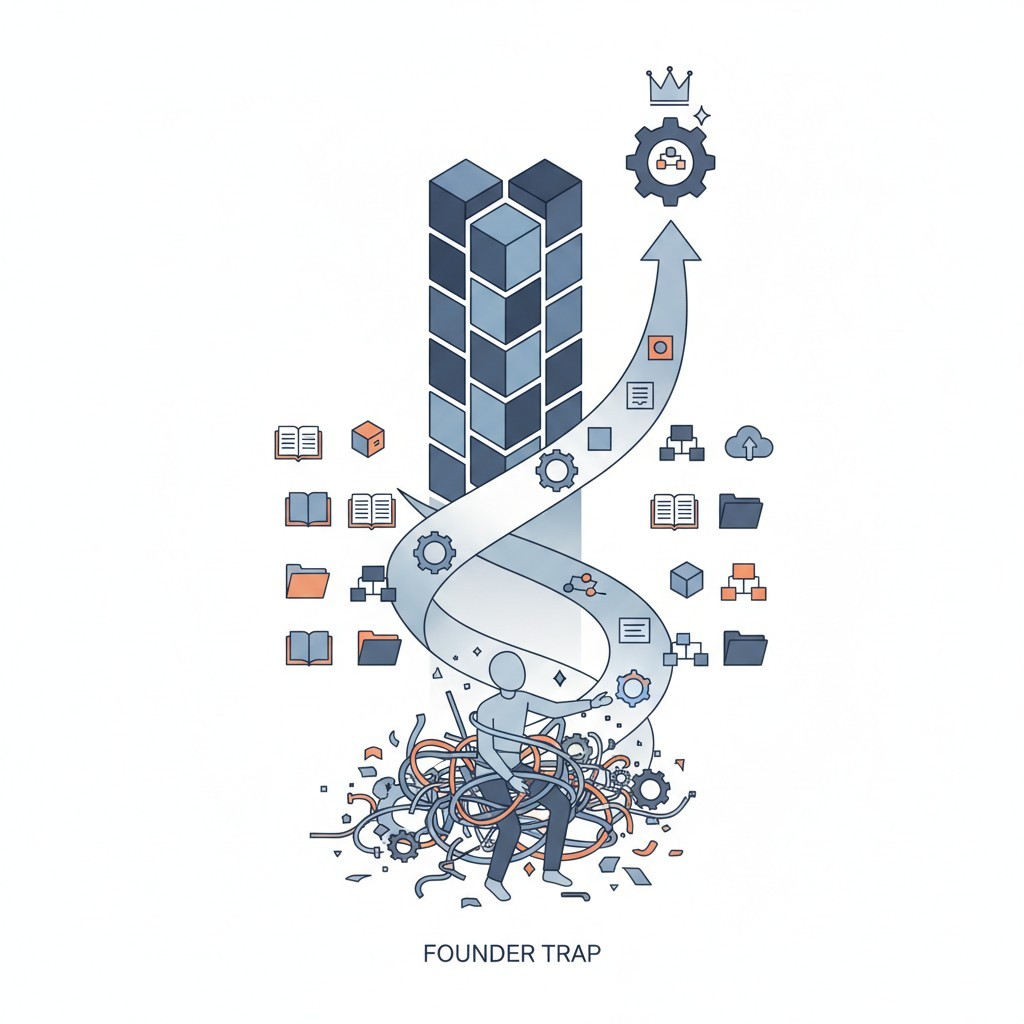
The Hidden Tax: How Operational Chaos is Bleeding Your Business Dry

The Architecture of Operational Freedom: Engineering a Business That Runs Without You

What is an SOP in Business? The Architecture to Escape the Founder Trap
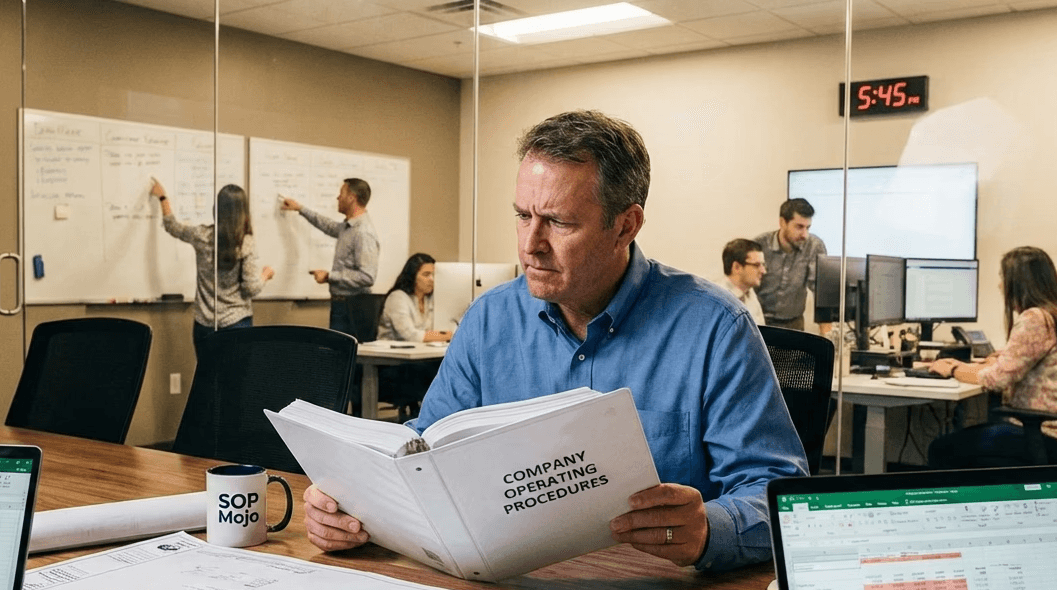
I Built a 6 Million Dollar Company That Couldn't Run Without Me
How to Build a Business That Works (Hint: Systems!)
Employee Onboarding and Training: A Practical Guide for Small and Medium Businesses

How to Write Standard Operating Procedures for Manufacturing: A Field-Proven Blueprint

Essential Quality Control Practices for Operational Excellence

How Standardized Processes Drive Operational Efficiency and Growth