
Effective Time Management Techniques to Boost Your Small Business
Listen to this article

Ryan Pease
FOLLOW

Most articles about time management techniques were written for students cramming for exams or solo professionals trying to hit their inbox zero. They talk about 25-minute focus sessions and morning routines as if the biggest challenge facing a business owner is personal willpower. For founders running a team of 10 to 50 people, that advice misses the point entirely.
The real time management problem in a growing small business is not that the founder lacks discipline. It is that the business has no system. Work lives in people's heads. Decisions flow through the owner. Processes are repeated differently every time they run. The result is a business where time is constantly wasted not because individuals are lazy, but because the operating structure demands it.
This guide covers the core time management techniques worth knowing, explains how to choose the right one for your situation, and then goes further than most resources ever do: it connects individual techniques to the team-wide systems that make them actually stick. If you are ready to stop managing your own calendar and start designing a business that manages itself, keep reading.
What Are Time Management Techniques (and Why Most Advice Misses the Point for Business Owners)?
Time management techniques are structured methods for deciding how to allocate time across competing tasks, responsibilities, and goals. At their core, they help answer a deceptively simple question: what should I be doing right now, and what should I stop doing altogether?
For an individual contributor, that question is relatively straightforward. For a small business owner with employees, clients, vendors, and growth goals all competing for attention simultaneously, the question becomes exponentially more complex. And yet most published advice still treats time management as a personal productivity problem, something you fix by changing your morning habits or downloading a new app.
The shift that actually matters for business owners is moving from managing your own time to designing how your entire business uses its time. That means looking at workflows, handoffs, recurring decisions, and role clarity, not just your personal to-do list. When the business has a reliable operating structure, every person on the team benefits from better time allocation, not just the person who read the productivity book.
That distinction is what separates effective time management strategies for business operators from the generic advice that fills most search results. And it is the lens through which every technique in this guide should be understood.
The Real Cost of Poor Time Management in a Growing Business
Poor time management in a small business is not just an inconvenience. It compounds. Every hour lost to unclear processes, repeated decisions, and founder bottlenecks is an hour that could have been spent serving clients, developing the team, or building capacity for growth.
The most common and costly symptom is founder dependency. When the owner is the single point of contact for every important decision, the entire business slows to the pace of one person's availability. Employees wait for approval. Clients wait for responses. Projects stall. The founder becomes a bottleneck not because they are ineffective, but because the business was never designed to run without their direct involvement.
Missed handoffs and inconsistent delivery create a second layer of cost. When processes are not documented, each team member executes tasks differently. That inconsistency produces rework, client complaints, and internal confusion, all of which consume time that was never budgeted. A client onboarding that should take two hours ends up taking six because no one is sure who does what in what order.
Underneath all of these problems is a missing operating system. Time chaos in a growing business is almost always a signal that the business lacks documented, repeatable processes. No time management technique can fix a structural problem. Before choosing a method, it helps to understand what is actually causing the waste.
Time Waste Diagnostic: Find the Root Cause Before Picking a Technique
Choosing a time management technique without understanding the root cause of your time waste is like prescribing medication without a diagnosis. The following diagnostic questions help identify which category of problem is actually driving the loss.
Category 1: Personal Prioritization Problems
Do you regularly end the day having worked hard but not finished what mattered most?
Do you frequently react to urgent requests at the expense of important work?
Do you struggle to say no to low-value tasks or meetings?
If yes, prioritization frameworks like the Eisenhower Matrix or Eat the Frog are the right starting point.
Category 2: Focus and Execution Problems
Do you frequently switch between tasks without completing them?
Do interruptions regularly derail your most productive hours?
Does deep, concentrated work feel rare or impossible?
If yes, time blocking, timeboxing, or the Pomodoro Technique will deliver the most immediate improvement.
Category 3: Delegation and Handoff Problems
Do team members regularly come to you for answers that should be available without you?
Do tasks get dropped or done inconsistently when you are not watching?
Are you doing work that someone else on your team could handle with the right guidance?
If yes, the problem is not personal productivity. It is a systems and documentation problem. Delegation frameworks and standard operating procedures are the fix.
Category 4: Structural and Process Problems
Does your team repeat the same mistakes or questions across different projects?
Do recurring processes take different amounts of time depending on who runs them?
Is institutional knowledge concentrated in one or two people?
If yes, no individual time management technique will solve the problem. The business needs documented processes and a reliable operating system before individual techniques can take hold.
Run through this diagnostic honestly before investing time in any single technique. The sections below cover the techniques themselves, followed by the systems layer that makes them work at scale.
Core Time Management Techniques Every Business Owner Should Know
These are the most widely used and most practically applicable time management techniques for small business operators. Each one is summarized with a business-context application, not a student or solo-worker example.
The Eisenhower Matrix
The Eisenhower Matrix divides tasks into four quadrants based on two dimensions: urgency and importance. The four categories are urgent and important (do now), important but not urgent (schedule), urgent but not important (delegate), and neither urgent nor important (eliminate).
For a business owner, this framework is most powerful as a decision-triage tool. When a marketing agency owner sits down on Monday morning with 30 items on her plate, the matrix helps her see that writing the client strategy deck is important but not urgent (schedule it for focused time), answering a client's billing question is urgent but not important (delegate to account management), reviewing a vendor contract is both urgent and important (do it first), and cleaning up the shared drive is neither (remove it from the list entirely).
The Eisenhower Matrix also clarifies where delegation is appropriate. Most founders spend too much time in the urgent-but-not-important quadrant because they have not built the team capacity or documented the processes needed to hand those tasks off reliably. Fixing that structural problem is a time management act in itself.
Time Blocking and Timeboxing
Time blocking means scheduling specific types of work into dedicated calendar slots rather than working from an open-ended to-do list. Timeboxing is a related technique where a fixed amount of time is assigned to a task regardless of whether it is finished, which prevents perfectionism and scope creep from consuming entire days.
For individual owners, time blocking protects deep work from meeting creep and reactive email. For businesses with teams, the more powerful application is establishing shared calendar norms. An IT managed service provider might establish a firm rule that all client delivery work happens between 9 a.m. and noon, all internal meetings happen between 1 p.m. and 3 p.m., and administrative work is batched on Friday afternoons. When the whole team operates on the same rhythm, the cognitive overhead of constant context-switching drops significantly.
Time blocking also makes it easier to protect leadership time for strategic work. If the founder's calendar does not have protected blocks for high-value thinking, those hours will be consumed by reactive tasks every single day.
The Pomodoro Technique
Developed by Francesco Cirillo, the Pomodoro Technique involves working in 25-minute focused intervals (called Pomodoros) separated by 5-minute breaks, with a longer break after every four intervals. The structure prevents mental fatigue and makes large tasks feel less overwhelming by breaking them into manageable sprints.
For individual contributors doing focused work, such as a consultant drafting a client report or a developer writing code, the Pomodoro method is genuinely effective. It creates natural checkpoints and prevents the kind of unbroken, exhausting effort that leads to burnout and poor output quality.
At the team level, however, the Pomodoro Technique needs supplementing. A team cannot run on synchronized 25-minute sprints. What it can do is establish a culture that respects focused work time, reduces unnecessary interruptions, and batches communication into designated windows rather than treating every message as requiring an immediate response.
The 80/20 Rule (Pareto Principle)
The Pareto Principle states that roughly 80 percent of results come from 20 percent of efforts. For business owners, this is one of the most clarifying lenses available. It prompts a simple but powerful audit: which clients generate 80 percent of revenue? Which services produce 80 percent of margin? Which internal processes create 80 percent of operational headaches?
A staffing firm owner applying Pareto analysis might discover that three of her twelve client accounts generate 75 percent of billings. That insight changes how she allocates her sales team's time, which client relationships get proactive attention, and which service lines deserve investment in documented delivery systems.
The 80/20 rule is most useful as a filter applied before any other time management technique. It ensures that the time being managed is time spent on the right things in the first place.
Eat the Frog
Popularized by Brian Tracy, Eat the Frog is the practice of tackling the most important or most dreaded task first thing in the morning, before anything else competes for attention. The logic is that willpower and focus are highest early in the day, and that starting with the hardest task eliminates the procrastination drag that slows everything else down.
For founders, the frog is often the strategic work they keep postponing because the day fills up with reactive tasks. The business owner who spends every morning responding to emails before doing anything else is letting the inbox eat the frog. Reversing that order, even for 60 to 90 minutes, can dramatically change what actually gets done over the course of a week.
The technique also applies at the team level. When managers encourage their teams to front-load the highest-priority deliverable before opening communication channels, throughput improves and deadline pressure decreases.
Getting Things Done (GTD)
David Allen's Getting Things Done methodology is built around five steps: capture, clarify, organize, reflect, and engage. The core premise is that the human brain is better at processing information than storing it, so every commitment and task should be captured in a trusted external system rather than held in memory.
For small business owners managing multiple roles simultaneously, GTD offers a way to achieve reliable follow-through without constant mental juggling. A consulting firm principal using GTD maintains a single capture inbox, processes it daily into categorized next actions, and reviews the full system weekly to ensure nothing falls through the cracks.
GTD scales naturally into team-wide task management when the capture and organize steps are built into shared project management tools. When everyone uses the same system and the same language for tracking work, handoffs become cleaner and accountability improves without requiring the founder to chase updates.
How to Choose the Right Technique for Your Business Stage
No single time management technique is right for every situation. The right choice depends on team size, operational complexity, and whether the core problem is personal productivity or systemic inefficiency.
A solo founder in the early stages of building a business benefits most from prioritization frameworks like the Eisenhower Matrix and habit-level techniques like Eat the Frog. The goal is to establish personal discipline and protect time for high-leverage work before the business grows complex enough to demand more.
A founder managing a team of 5 to 15 employees needs to layer in delegation frameworks and time blocking at the team level. The problem is no longer just personal focus; it is ensuring that work flows reliably through the team without everything funneling back to the owner.
A business with 15 to 50 employees operating across multiple roles, service lines, or locations needs documented systems more than it needs any individual technique. At that stage, the 80/20 rule helps identify which processes deserve documentation first, and GTD-style capture systems help the leadership team stay coordinated without constant meetings.
The most effective approach at every stage is to combine techniques rather than choose one. A business owner might use the Eisenhower Matrix to triage priorities each morning, time blocking to protect execution time, and Pareto analysis quarterly to evaluate where the team's effort is actually going. Techniques are tools, not religions.
Why Individual Time Management Techniques Break Down Without Business Systems
Here is the gap that almost no time management resource acknowledges: personal productivity habits do not scale across a team. A founder who masters time blocking and Eat the Frog will still run a chaotic business if the team around them is operating without clear processes, documented roles, and reliable handoff systems.
Consider what happens when a well-organized founder delegates a task to a team member for the first time. If the process for completing that task is undocumented, the team member will either do it wrong, do it differently every time, or come back to the founder with questions that consume more time than doing the task directly would have. The delegation fails not because the founder lacked the intention to delegate, but because the business lacked the infrastructure to support it.
Undocumented processes create time waste that no individual technique can fix. Every time a recurring task is performed without a documented process, someone has to reinvent the approach from scratch. Every time a new employee joins without a structured onboarding system, experienced team members lose hours answering the same questions. Every time a client escalation occurs without a defined resolution process, the founder gets pulled back into execution.
The missing layer is a documented operating system: the collection of standard processes, role definitions, and decision frameworks that allow the team to function consistently without relying on any single person's memory or availability.
How Standard Operating Procedures Turn Time Management Into a Team-Wide System
Standard operating procedures (SOPs) are the infrastructure that makes time management techniques sustainable at the team level. They are not bureaucratic documents. They are the mechanism by which a business captures how work actually gets done and makes that knowledge available to everyone, not just the person who figured it out first.
When a recurring process is documented as an SOP, several time management benefits activate simultaneously. First, the person executing the process no longer has to think through the steps from scratch. Decision fatigue drops. Execution speed increases. Second, the founder no longer has to supervise or answer questions about that process. That reclaimed time compounds across every documented process in the business. Third, new team members can be onboarded into the process without requiring a senior employee to shadow them through every step.
Think of SOPs as the team-level equivalent of the personal habits that time management gurus recommend. Just as Eat the Frog is a habit that ensures the most important personal task gets done first, an SOP is a habit embedded into the organization that ensures the most important business processes run consistently, regardless of who is in the room.
For a bookkeeping firm, an SOP for monthly client close might save each accountant 45 minutes per client by eliminating the need to re-decide the sequence of steps each time. Across 30 clients and 5 accountants, that is a significant weekly time recovery, achieved not by changing anyone's personal habits but by documenting what was already working and making it repeatable.
The Founder Time Trap: How to Stop Being the Bottleneck in Your Own Business
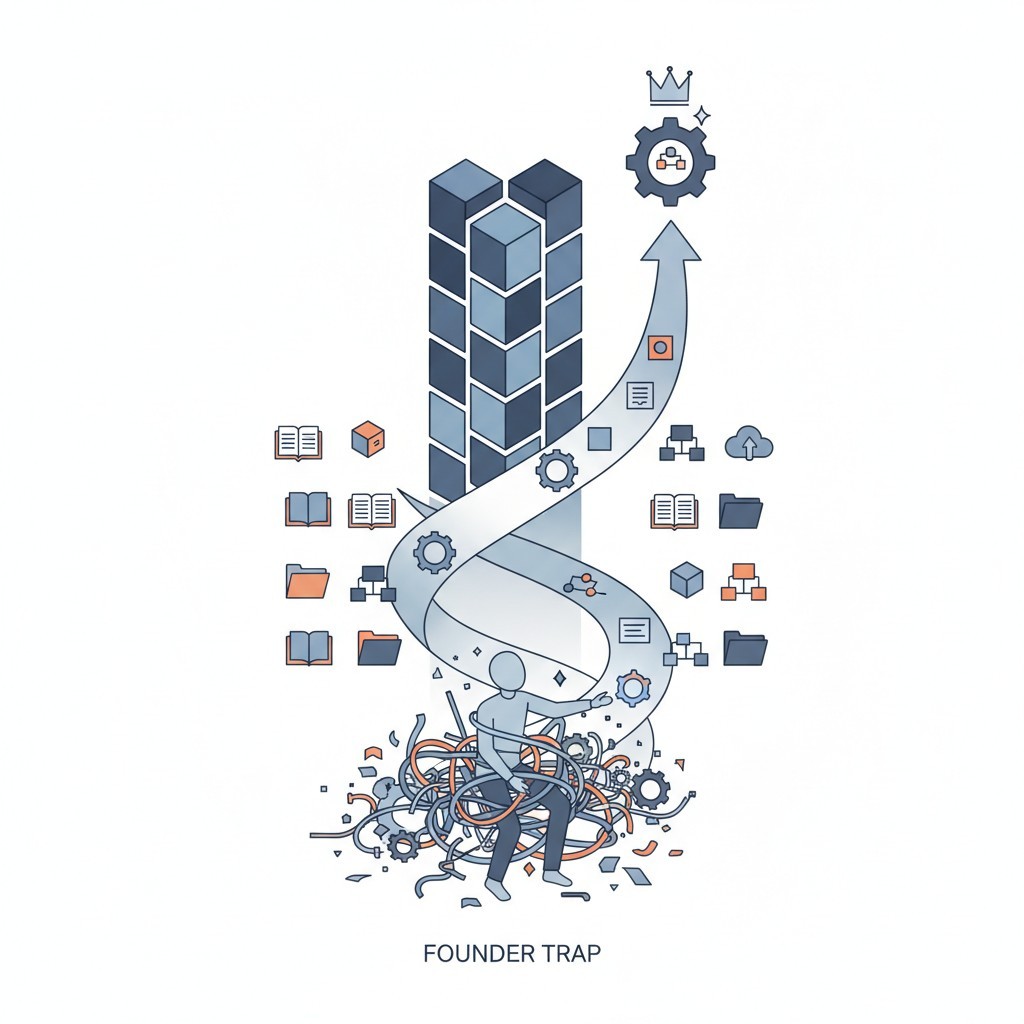
One of the most common and least discussed time management problems for small business owners is the founder time trap: the situation where the business's operational capacity is limited by the founder's personal availability. It is a problem that no amount of personal productivity improvement can solve, because the constraint is structural, not behavioral.
The founder time trap typically develops gradually. In the early days, the founder does everything because there is no one else. As the business grows and employees are added, the founder continues to be involved in every significant decision because the team lacks the context, authority, or documented processes to act independently. The founder becomes a permanent approval layer, and the business cannot move faster than one person can respond.
Escaping the trap requires three things working together. First, role clarity: every team member needs to know exactly what decisions they are empowered to make without escalating. Second, documented processes: the steps for executing recurring work need to be written down so that team members can act without asking. Third, a deliberate withdrawal from daily execution: the founder needs to consciously step back from tasks that the team can handle, even when stepping back feels slower at first.
This is not about working less. It is about working on the right things. A founder who spends 20 hours a week answering operational questions that a documented process would eliminate is not managing their time effectively, regardless of how many productivity techniques they use. The leverage is in building the system, not in optimizing the personal workflow within a broken one.
Time Management at the Team Level: Turning Techniques Into Operating Procedures
Embedding time management principles into the way a team operates requires translating individual techniques into shared norms and documented workflows. This is where the two worlds, personal productivity and organizational systems, meet.
Delegation Frameworks That Actually Work
Effective delegation is one of the highest-leverage time management techniques available to a business owner. But delegation only works when the person receiving the task has three things: clarity on what the outcome should look like, access to the process for achieving it, and the authority to make decisions along the way without constantly checking in.
Without documented processes, delegation creates more work for the founder, not less. The founder has to explain the task, answer questions during execution, and review the output because there is no shared standard for what good looks like. With documented processes, the founder hands off the task once and trusts the system to guide execution.
Meeting Cadences as a Time Management Tool
Unstructured, reactive communication is one of the biggest time drains in a small business. Establishing a documented meeting cadence, including who attends, what is covered, how long it runs, and what decisions are made versus tabled, eliminates the need for ad-hoc conversations that interrupt focused work throughout the day.
A weekly leadership sync, a daily 15-minute team standup, and a monthly operational review can replace dozens of unplanned interruptions per week when they are well-designed and consistently run.
Standardize Recurring Decisions to Reclaim Hours Every Week
One of the most overlooked time management opportunities in a small business is the recurring decision. These are choices that get made over and over again, such as how to handle a client who misses a payment, which vendor to use for a specific service category, or what the policy is when a project scope creeps beyond the original agreement. Without a documented decision framework, each instance requires the founder or a senior manager to think through the situation from scratch, consuming time and creating inconsistency.
A decision-making SOP standardizes the answer to recurring questions so that team members can resolve them without escalating. It is not a rigid rulebook. It is a documented set of criteria and outcomes that allows the team to act consistently and confidently.
For example, a marketing agency might document the following: if a client requests work outside the agreed scope, the account manager is empowered to offer a change order up to a defined dollar threshold without leadership approval. Above that threshold, the process specifies who to notify and within what timeframe. That single documented decision framework eliminates a category of interruption that might otherwise consume 30 to 60 minutes of leadership time per week across multiple clients.
Multiply that across 10 or 15 recurring decision categories, and the time reclaimed is substantial. More importantly, the quality and consistency of those decisions improves because they are no longer dependent on whoever happens to be available when the situation arises.
Practical Time Management Quick Wins for SMB Operators
Before overhauling the entire business, there are several high-impact actions that produce immediate time savings without requiring a major systems project.
Conduct a Time Audit First
Before applying any technique, spend one to two weeks tracking where time actually goes. Use a simple time log, a spreadsheet, or a time-tracking tool to record activities in 30-minute blocks. Most business owners are surprised by the results. The audit typically reveals that a significant portion of time goes to tasks that could be delegated, eliminated, or batched, and that the highest-priority work is getting far less time than assumed.
A time audit is not about judgment. It is about data. The diagnostic questions from earlier in this guide become much easier to answer when there is actual evidence to work from.
Batch Similar Tasks Together
Context-switching between different types of work carries a cognitive cost. Every time the brain shifts from deep analytical work to a quick administrative task and back again, it loses momentum. Batching similar tasks into dedicated blocks, such as all email responses in one window, all client calls on specific days, and all financial review in a single weekly session, reduces that switching cost significantly.
For a team, batching can be built into the operational calendar as a shared norm rather than a personal habit. When the whole team knows that Tuesday and Thursday afternoons are for client calls and Monday mornings are protected for project work, everyone benefits from the reduced interruption load.
Protect Deep Work Blocks
Strategic thinking, process design, and high-stakes client work all require sustained, uninterrupted focus. These activities cannot be done effectively in 10-minute windows between meetings. Protecting at least two to three hours of uninterrupted deep work per day, for both the founder and key team members, is one of the highest-return time management investments available.
This requires a cultural commitment as much as a scheduling one. If the team norm is that anyone can be interrupted at any time for any reason, deep work blocks will not survive. Establishing communication norms, such as a defined window for non-urgent messages and a clear escalation path for genuine emergencies, makes the deep work protection sustainable.
Time Management in Practice: Examples for Service-Based Businesses
Generic time management advice rarely translates directly to the operational realities of service businesses. Here are industry-specific examples of how these techniques apply in practice.
Marketing and Creative Agencies
Agencies face a constant tension between client-facing responsiveness and the deep creative work that produces the output clients are paying for. A common and effective approach is to designate specific days for client communication and account management, with other days protected for production work. Time blocking at the team level, combined with a documented client communication SOP that sets response time expectations, allows creative teams to do their best work without being constantly interrupted by account questions.
The 80/20 rule applied to client accounts often reveals that a small number of clients generate most of the revenue and most of the operational complexity. Agencies that document their delivery process for their highest-value service lines first recover the most time in the shortest period.
IT and Managed Service Providers
MSPs deal with a high volume of recurring, time-sensitive tasks: ticket triage, scheduled maintenance, client onboarding, and incident response. Without documented processes for each of these, every technician handles them differently, response times vary, and the founder gets pulled in to resolve inconsistencies.
Time management for an MSP is almost entirely a systems problem. Documented escalation paths, ticket handling SOPs, and standardized onboarding checklists are more valuable than any individual productivity technique. When the process is clear, technicians can work independently at full speed without waiting for direction.
Professional Services and Consulting Firms
Consulting firms often struggle with the founder-as-expert problem: clients want access to the senior person, and the senior person has not built the systems to deliver consistently through junior staff. Time management here means documenting the methodology, creating repeatable engagement frameworks, and training team members to deliver at the standard clients expect.
The GTD methodology maps well to consulting environments because it provides a reliable capture and follow-through system for the high volume of client commitments, research tasks, and deliverable milestones that characterize project-based work.
Frequently Asked Questions About Time Management Techniques
What is the most powerful time management technique?
For individual productivity, most practitioners and researchers point to time blocking combined with the Eisenhower Matrix as the most consistently effective combination. Time blocking protects execution time, while the Eisenhower Matrix ensures that the time being protected is spent on the right work. For business owners specifically, however, the most powerful time management move is building documented systems that allow the team to operate without constant founder involvement. No personal productivity technique matches the leverage of a well-designed operating system.
What is the 3-3-3 rule for time management?
The 3-3-3 rule, popularized by productivity writer Oliver Burkeman, suggests structuring the workday around three hours of deep work on the most important project, three shorter urgent tasks, and three maintenance activities such as email, meetings, or administrative work. It is a practical daily template that prevents the common pattern of spending all day on maintenance while strategic work never gets done. For business owners, the principle translates well: protect three hours daily for high-leverage leadership work before allowing reactive tasks to take over.
What are the 5 P's of time management?
The 5 P's of time management are Planning, Prioritizing, Performing, Pausing, and Persevering. Planning involves mapping out work before beginning. Prioritizing means identifying what matters most. Performing is focused execution without distraction. Pausing refers to scheduled breaks that maintain cognitive performance. Persevering is maintaining consistent effort across time rather than relying on bursts of motivation. Together, they form a cycle that supports sustainable productivity rather than short-term output spikes.
What are the four time management styles?
Time management researchers have identified four broad styles: the Prioritizer (analytical, focused on logic and data), the Planner (organized, detail-oriented, deadline-driven), the Arranger (relationship-focused, collaborative), and the Visualizer (big-picture thinker, creative, future-oriented). Understanding which style dominates in a leadership team helps explain where time management friction comes from. A team of Arrangers may struggle with hard prioritization. A team of Prioritizers may underinvest in the relationship maintenance that keeps clients and employees engaged.
What are the five time management techniques?
Five foundational techniques that consistently appear in both research and practice are: the Eisenhower Matrix (prioritization), time blocking (scheduled execution), the Pomodoro Technique (focused intervals), the 80/20 rule (effort-to-output analysis), and Getting Things Done (capture-and-organize system). Each addresses a different dimension of time management, which is why combining them based on the specific problem being solved produces better results than relying on any single method.
What is the golden rule of time management?
The most widely cited golden rule of time management is to plan before you act. Specifically, research consistently shows that spending 10 to 15 minutes planning the day before beginning work saves 60 to 90 minutes of execution time by reducing false starts, task-switching, and forgotten priorities. For business owners, the golden rule extends further: design the system before you delegate. Handing off work without a documented process wastes more time than it saves. Planning the process is as important as planning the day.
The Benefits of Strong Time Management Extend Across the Entire Business
The benefits of time management for a small business go well beyond personal productivity gains. When time is managed effectively at the organizational level, the compounding effects touch every dimension of business performance.
Founder dependency decreases as documented processes allow team members to act independently. Delivery consistency improves as repeatable workflows replace improvised execution. Onboarding accelerates as new employees have access to documented processes rather than relying on tribal knowledge from senior staff. Client satisfaction increases as handoffs happen on time and to a consistent standard. And the founder recovers time for the strategic work that actually drives growth.
Conversely, poor time management at the organizational level creates key-person risk, missed deadlines, client churn, and the compounding cost of rework. These are not soft, hard-to-measure problems. They show up in revenue, margin, and employee retention data. Addressing them through better systems is one of the highest-return investments a growing business can make.
Putting It All Together: Time Management as a Business Design Problem
The most important reframe in this entire guide is this: for a small business owner with a team, time management is not a personal productivity problem. It is a business design problem. The question is not how to squeeze more out of each hour. The question is how to build a business where time is allocated intelligently by design, not just by whoever is loudest or most urgent at any given moment.
That means starting with a time audit to understand where time actually goes. It means applying the right technique to the right problem, whether that is the Eisenhower Matrix for prioritization, time blocking for focus, or the 80/20 rule for strategic clarity. And it means building the documented systems, the SOPs, the decision frameworks, the delegation structures, that allow those techniques to operate at the team level rather than just in the founder's personal workflow.
The businesses that achieve genuine operational leverage are not the ones where the founder works harder or smarter. They are the ones where the founder has built a system that works reliably without them. That is the destination that effective time management techniques, combined with a well-documented operating system, can actually get a small business to.
If your business is ready to move from informal habits to a documented operating system that removes founder dependency and enables your team to run reliably, that is exactly the work SOP Mojo was built to support.
Check out other interesting articles here 👇

Why Free Acceptable Use Policy Templates Destroy Enterprise Value
The Hidden Tax: How Operational Chaos is Bleeding Your Business Dry

The Architecture of Operational Freedom: Engineering a Business That Runs Without You

What is an SOP in Business? The Architecture to Escape the Founder Trap

I Built a 6 Million Dollar Company That Couldn't Run Without Me

How to Build a Business That Works (Hint: Systems!)

Employee Onboarding and Training: A Practical Guide for Small and Medium Businesses

How to Write Standard Operating Procedures for Manufacturing: A Field-Proven Blueprint

Essential Quality Control Practices for Operational Excellence

How Standardized Processes Drive Operational Efficiency and Growth