
The Role of Leadership in Effective Change Management
Listen to this article

Most small business owners understand that change is necessary. What they underestimate is how much of that change lives or dies based on their own leadership. You can have the right software, the right process map, and the right intentions, but if the people leading the initiative are unclear, inconsistent, or too deep in the weeds to see the bigger picture, the change stalls. It reverts. The team goes back to doing things the way they always did.
This guide is written specifically for founders and operators of growing businesses who need to lead change without becoming the permanent bottleneck that holds it together. Leadership in change management is not just about setting direction. It is about building systems and behaviors that outlast your direct involvement.
What Is Leadership in Change Management?
Change management refers to the structured approach of moving an organization from its current state to a desired future state. It covers timelines, tools, communication plans, and milestones. Change leadership, on the other hand, is the human side of that equation. It is about inspiring people to move, helping them understand why the change matters, and creating the conditions where new behaviors can take root.
The distinction matters enormously for small business owners. In enterprise organizations, change management and change leadership are often handled by separate teams. In a founder-led business with 15 to 50 employees, the same person is usually doing both. That means you need to understand where each begins and ends, because confusing the two leads to either over-engineering the process or under-investing in people.
Change Leadership vs. Change Management: What SMB Owners Need to Know
Here is a simple way to think about the difference:
Change management asks: What needs to happen, in what order, by when?
Change leadership asks: Why does this matter, who needs to believe in it, and how do we bring them with us?
Change management is the project plan. Change leadership is the culture work that makes people want to follow the plan. Neglecting either one creates predictable failure. A beautifully documented change initiative with no leadership buy-in sits on a shelf. A passionate leader with no documented process creates chaos that evaporates the moment their attention shifts.
For SMB owners, the most common mistake is assuming that because they care deeply about the change, the team will automatically follow. Caring is not the same as leading. Successful change management leadership requires deliberate communication, visible commitment, and structured follow-through.
The 5 Core Roles of a Leader in Change Management
Regardless of the size of your business, effective change leaders operate in five distinct roles throughout any significant initiative:
Sponsor: The person who owns the change at the organizational level, provides resources, and signals to the team that this initiative is real and prioritized.
Communicator: The voice that explains the why, the what, and the what-is-in-it-for-you at every stage of the initiative.
Barrier-remover: The leader who actively clears obstacles, whether those are conflicting priorities, missing tools, or resistant stakeholders.
Coach: The person who helps team members build the skills and confidence to operate in the new way.
Decision-maker: The one who resolves ambiguity quickly so momentum does not stall while people wait for direction.
In founder-led businesses, the founder often defaults to communicator and decision-maker while neglecting the coaching and barrier-removing roles. Those gaps are where change initiatives quietly break down.
Key Skills Every Change Leader Needs
The competencies that separate effective change leaders from ineffective ones are not exotic. They are disciplines that require consistent practice:
Communication: Clear, honest, and frequent. Not just announcing the change once but revisiting it at every team touchpoint.
Collaboration: Involving the people most affected by the change in shaping how it gets implemented, not just informing them after decisions are made.
Commitment: Staying visibly engaged with the initiative even when competing priorities pull your attention.
Empathy: Understanding that change feels threatening to people who have built routines around the current way of doing things.
Resilience: Maintaining direction and energy when early implementation is messy, which it always is.
The role of leaders in change is not to have all the answers. It is to stay steady and consistent while the team finds its footing in a new operating reality.
The 3 Mistakes That Derail Change Initiatives in Small Businesses
Three leadership errors account for the majority of failed change efforts in growing businesses:
Scope Naivety
Leaders underestimate how much work is actually involved. Switching to a new project management system sounds like a two-week project. In reality, it requires data migration, retraining, process redesign, and months of reinforcement. When the scope reveals itself, leaders who are not prepared often abandon the initiative halfway through, which is worse than never starting.
Change Laziness
Leaders overestimate how much capacity their team has to absorb change while still doing their regular jobs. Piling a major operational shift on top of an already stretched team without adjusting workloads or timelines is a reliable way to generate resentment and half-hearted adoption.
The Pet-Project Trap
The leader is deeply invested in the change. The team is not. When a founder sees a new system as transformational and the team sees it as another thing the boss is excited about this month, the initiative is already in trouble. Misjudging how others perceive the urgency and importance of the change is one of the most common and most correctable leadership errors.
The 5 C's and 5 Pillars of Change Management: What They Mean for Growing Businesses
Two frameworks come up frequently in conversations about change leadership, and both are worth understanding in a small business context.
The 5 C's of Change Leadership are: Clarity, Communication, Commitment, Collaboration, and Courage. For an SMB owner, these translate practically:
Clarity: Your team cannot follow a vision they cannot describe. Define the change in plain language.
Communication: Repeat the message more than feels necessary. People need to hear it multiple times before it registers.
Commitment: Model the new behavior yourself before expecting it from others.
Collaboration: Bring key employees into the design, not just the rollout.
Courage: Make the hard calls, address resistance directly, and hold the line when the change gets uncomfortable.
The 5 Pillars of Change Management provide the structural backbone: Leadership and Sponsorship, Communication, Stakeholder Engagement, Training and Development, and Sustainment. For a business with 20 employees, "stakeholder engagement" might mean a 30-minute conversation with your three senior team members. The principle scales down. The discipline does not.
How to Build a Change Leadership Strategy That Sticks
Successful change management leadership follows a sequence, not a checklist you can complete in any order:
Establish the vision: What does success look like? Be specific. "Better processes" is not a vision. "Every client onboarding completed within 48 hours with zero founder involvement" is.
Communicate early and often: Share the why before the how. People accept change more readily when they understand the reason behind it.
Document the new process: Before you launch, capture what the new way of working actually looks like in writing. This becomes the reference point everyone can return to.
Remove barriers actively: Ask your team weekly what is slowing them down. Then fix it.
Track milestones: Define what progress looks like at 30, 60, and 90 days. Celebrate early wins publicly.
Reinforce new behaviors: Recognize people who adopt the change. Address backsliding quickly and without blame.
Why Change Doesn't Stick Without SOPs (And How to Fix That)
Here is the pattern that plays out in almost every small business that attempts a significant operational change: the leader drives the initiative hard for six to eight weeks, the team shifts behavior while the attention is on them, and then the leader moves on to the next priority. Within 90 days, the team has drifted back to the old way of doing things. Not out of defiance. Out of habit and the absence of anything telling them otherwise.
The fix is documentation. Specifically, converting new behaviors into standard operating procedures that exist independently of the leader's presence. When a new process lives only in someone's memory, or in the founder's head, it is not a process. It is a preference. SOPs transform preferences into organizational standards.
Embedding change into documented procedures means a new hire can learn the correct way without asking the founder. It means a manager can hold the team accountable to something written, not something remembered. It means the change outlasts the initiative that created it. This is what makes change durable, and it is the step most change leadership frameworks skip entirely.
The Founder's Dilemma: Leading Change When You're Also the Biggest Obstacle
Enterprise change management literature assumes a clear separation between the change sponsor and the people being asked to change. In a founder-led business, that separation rarely exists. The founder is often the sponsor, the communicator, the decision-maker, and also the person whose habits, preferences, and informal approvals are the primary thing blocking the new system from taking hold.
This is the founder's dilemma. You are trying to lead a change that requires your team to operate more independently, while simultaneously being the person everyone still looks to for every decision. The change cannot succeed if you are the bottleneck it has to route around.
Effective change leadership for founders means deliberately stepping out of the execution path. It means building the documentation and the decision-making authority into the process itself, so the team can move without waiting for you. It means recognizing that your involvement in every detail is not a sign of good leadership. It is the primary thing preventing the change from sticking.
How Strong Change Leadership Eliminates Key-Person Dependency
One of the most underappreciated goals of change leadership is reducing reliance on any single individual, including the founder. When institutional knowledge lives in one person's head, every change initiative is fragile. If that person leaves, gets sick, or simply gets busy, the new way of operating collapses.
Removing key-person dependency is not just a risk management strategy. It is a prerequisite for scale. Businesses that grow past $3 million or $5 million in revenue without addressing this problem hit a ceiling. The founder cannot be in every conversation, every handoff, and every decision. Neither can any single senior employee.
Strong change leadership addresses this by making knowledge transferable. That means documenting processes, cross-training team members, and building accountability structures that do not require a specific person to function. When a change initiative is led with this goal in mind, it produces something more valuable than a new process. It produces an organization that can run without its most critical people doing everything manually.
Common Barriers to Change and How SMB Leaders Overcome Them
Resistance from long-tenured employees is the most common barrier in small businesses. These are the people who built the current way of doing things. Asking them to change is, in some ways, asking them to accept that the old way was not good enough. Effective leaders acknowledge this directly, involve these employees early, and frame the change as building on what they created, not replacing it.
Competing priorities and limited bandwidth are structural problems. The team is already at capacity. Adding a change initiative without reducing something else is a recipe for poor adoption. Leaders who are serious about change protect time for it, even if that means temporarily reducing scope elsewhere.
Lack of visible sponsorship is the silent killer. When the leader announces a change and then disappears back into client work or sales, the team reads that as a signal that it is not really a priority. Active sponsorship means showing up consistently, asking about progress, and making the change visible in every team interaction.
Change Leadership Checklist for SMB Owners: 12 Actions Before, During, and After
Before the Change
Define the change in one clear sentence that any team member could repeat.
Identify who will be most affected and involve them in planning before the rollout.
Document the current process so you have a clear baseline to compare against.
Assess your team's current capacity honestly before adding this initiative.
During the Change
Communicate the why at every team meeting for the duration of the initiative.
Create a written SOP for the new process before expecting the team to follow it.
Remove at least one competing priority to protect team bandwidth.
Check in weekly on barriers and resolve them within 48 hours.
Recognize early adopters publicly and specifically.
After the Change
Audit compliance with the new process at 30 and 60 days.
Update the SOP based on what actually worked versus what was planned.
Transfer ownership of the process to a team member so it no longer requires your involvement to function.
Frequently Asked Questions About Leadership in Change Management
What are the 5 roles of a leader in change management?
The five core roles are sponsor, communicator, barrier-remover, coach, and decision-maker. In small businesses, the founder or senior leader typically holds all five roles simultaneously, which requires deliberate time allocation to avoid neglecting any of them.
What are the 5 C's of change leadership?
The 5 C's are Clarity, Communication, Commitment, Collaboration, and Courage. Each one addresses a different dimension of the human side of change, from making the vision understandable to staying the course when adoption is slow.
What are the 5 pillars of change management?
The 5 pillars are Leadership and Sponsorship, Communication, Stakeholder Engagement, Training and Development, and Sustainment. For SMBs, sustainment is the most frequently skipped pillar and the one most responsible for change reversals.
How do leaders affect change management?
Leaders set the tone, pace, and perceived importance of any change initiative. Research consistently shows that active, visible sponsorship from senior leadership is the single strongest predictor of change success. When leaders disengage, adoption stalls regardless of how well the change was planned.
What are the key competencies for effective change leadership?
The core competencies are communication, empathy, resilience, strategic thinking, and collaboration. For founders specifically, the ability to delegate and build systems that do not depend on their direct involvement is an additional critical competency.
What is the difference between change leadership and change management?
Change management focuses on the process, tools, timelines, and structure of a transition. Change leadership focuses on the vision, culture, people, and adoption side. Effective change requires both, but they address different problems and require different skills.
Building a Business That Can Change Without Falling Apart
The goal of leadership in change management is not just to get through the current initiative. It is to build an organization that can absorb, adapt to, and sustain change as a core operating capability. For small and mid-sized businesses, that means creating documented systems, reducing dependency on any single person, and developing a team that understands not just what to do but why it matters.
Founders who lead change well do not just transform their operations. They transform themselves, from the person the business cannot function without to the person who built a business that functions without them. That shift is the real measure of successful change management leadership, and it starts with the decision to lead deliberately rather than simply react.
Check out other interesting articles here 👇

Why Free Acceptable Use Policy Templates Destroy Enterprise Value
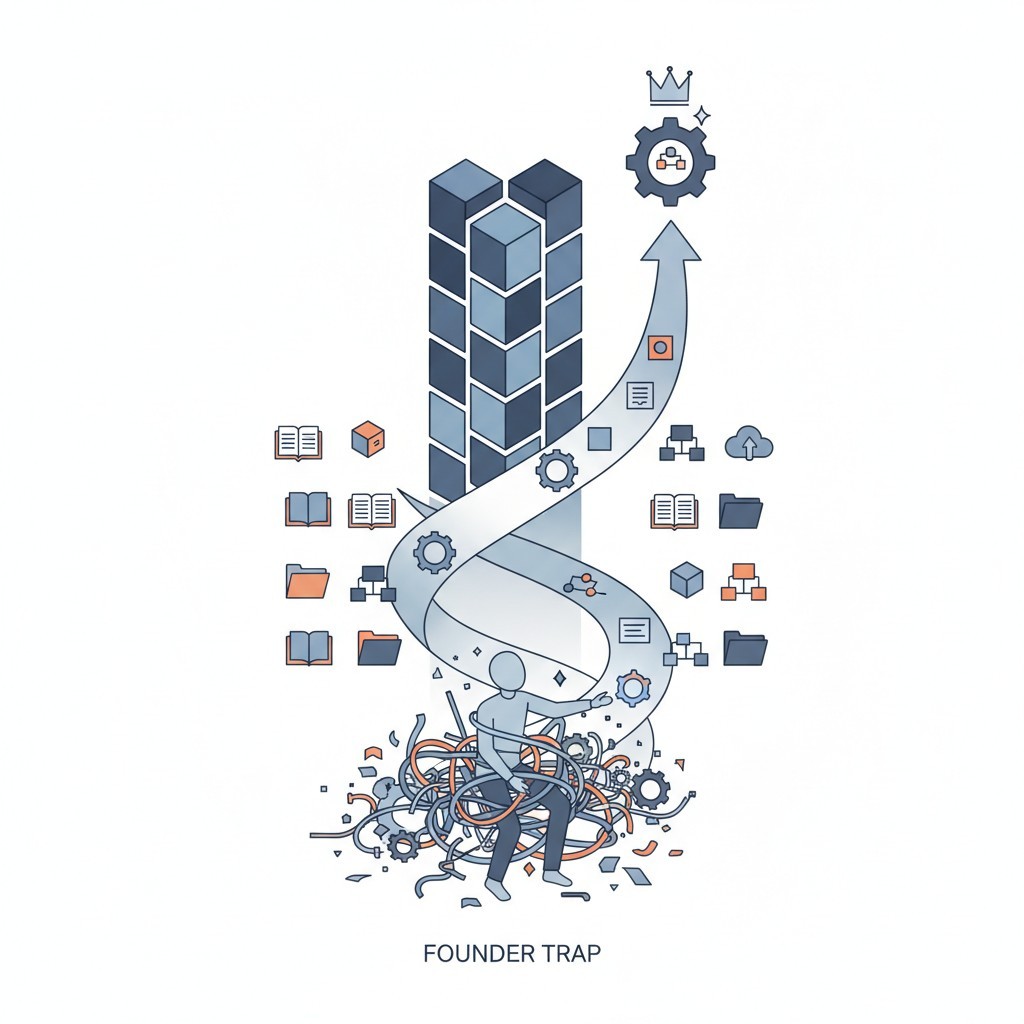
The Hidden Tax: How Operational Chaos is Bleeding Your Business Dry

The Architecture of Operational Freedom: Engineering a Business That Runs Without You

What is an SOP in Business? The Architecture to Escape the Founder Trap

I Built a 6 Million Dollar Company That Couldn't Run Without Me
How to Build a Business That Works (Hint: Systems!)

Employee Onboarding and Training: A Practical Guide for Small and Medium Businesses

How to Write Standard Operating Procedures for Manufacturing: A Field-Proven Blueprint

Essential Quality Control Practices for Operational Excellence

How Standardized Processes Drive Operational Efficiency and Growth