The Importance of SOPs in Achieving Sustainable Business Growth
Listen to this article

Ryan Pease
FOLLOW

There is a moment that almost every founder of a growing service business knows well. The team is larger than it used to be, revenue is climbing, and yet somehow the owner is still the one answering the urgent questions, fixing the client escalations, and holding the entire operation together with their own memory. The business has grown, but the founder has not gotten any freer. If anything, they feel more trapped than when they started.
That is not a people problem or a strategy problem. It is a systems problem, and standard operating procedures (SOPs) are the solution. The importance of SOPs goes far beyond tidy documentation. For founder-led businesses in the $1 million to $10 million revenue range, SOPs are the operating system that makes sustainable growth possible. This guide breaks down exactly why, with practical guidance on building SOPs that your team will actually use.
What Are Standard Operating Procedures (SOPs)?
An SOP is a documented, step-by-step set of instructions that describes how a specific task or process should be performed. The goal is simple: anyone with the right role and basic training should be able to follow the SOP and produce a consistent, acceptable result, without needing to ask the founder or the most experienced employee for guidance.
It helps to distinguish SOPs from two related but different documents:
Policies define rules and expectations (for example, "all client proposals must be approved before sending"). They tell people what to do, not how to do it.
Checklists confirm that steps were completed. They are often derived from SOPs but do not explain the reasoning or detail behind each step.
SOPs sit in the middle. They provide the full how-to: the sequence of actions, the decision points, the tools involved, the person responsible, and the standard the output should meet.
For a founder-led service business, an SOP is not just a document. It is a piece of institutional knowledge extracted from someone's head and installed into the organization where it can be used, updated, and scaled.
Why SOPs Matter: The Core Case for Standardization
The fundamental argument for SOPs is consistency. In a service business, inconsistency is not just an operational inconvenience. It is a direct threat to client relationships, reputation, and revenue. When the quality of delivery depends on which employee handles the work, or whether the founder is available to supervise, the business has a fragility problem.
SOPs solve this by transferring knowledge from individuals to the organization. When the best way to onboard a new client, handle a billing dispute, or complete a project handoff is written down and accessible, that knowledge no longer lives exclusively in one person's head. The business becomes less vulnerable to turnover, sick days, and the founder's limited bandwidth.
This is the deeper importance of SOPs: they convert a people-dependent operation into a system-dependent one. And systems, unlike people, scale.
7 Tangible Benefits of SOPs for Growing Businesses
Understanding the importance of SOPs for business growth becomes concrete when the benefits are examined individually.
Faster onboarding and training: New hires reach competency faster when the process is written down rather than demonstrated once and then forgotten. SOPs reduce the burden on senior staff and compress ramp-up time significantly.
Consistent quality across the team: When every team member follows the same documented process, the output quality stops depending on individual experience or memory.
Fewer costly errors: Undocumented handoffs are where mistakes happen. SOPs create checkpoints that catch problems before they reach the client.
Scalability without proportional overhead: A business with documented processes can add headcount without the founder needing to personally train, supervise, and correct each new person.
Easier delegation: Founders can only delegate confidently when there is a documented standard to hand off. Without SOPs, delegation means hoping someone does it the right way.
Reduced decision fatigue: When the process is documented, employees stop asking the same questions repeatedly. The SOP becomes the answer, freeing mental energy for higher-value decisions.
Stronger accountability: When expectations are written down, performance conversations become objective. Managers can point to the documented standard rather than relying on subjective judgment.
SOP Readiness Check: 8 Signs Your Business Needs Documented Processes Now
Most SMB owners know their operations are not as documented as they should be. But it can be hard to know when the problem has become urgent. Here is a practical self-assessment. If three or more of these apply, the business is overdue for a serious SOP initiative.
The founder is still the go-to person for questions that should have obvious answers.
New hires take longer than expected to become productive, and training is inconsistent depending on who delivers it.
The same mistakes keep happening, often at handoff points between team members or departments.
Client experience varies noticeably depending on which employee handles the account.
The business struggles to hire because there is no clear way to explain how the work gets done.
Key employees would take significant operational knowledge with them if they left tomorrow.
The founder cannot take a two-week vacation without the business suffering or requiring remote check-ins.
Growth has stalled not because of lack of demand, but because the team cannot handle more volume without quality dropping.
What Undocumented Processes Are Actually Costing Your Business
Competitors in this space often mention the risks of missing SOPs in vague terms. The reality for a service business in the $1 million to $10 million range is far more concrete.
Consider what happens when a client onboarding process lives entirely in one account manager's head. When that person is sick, on vacation, or leaves the company, the next client onboarding either gets delayed, gets done inconsistently, or falls on the founder to manage personally. At a billing rate of $150 to $300 per hour for founder time, a single poorly handled onboarding can cost the business $1,000 to $3,000 in lost productive time, not counting the reputational risk of a poor first impression.
Multiply that across every undocumented process in the business: project handoffs, quality reviews, client reporting, billing cycles, and employee check-ins. The cumulative cost is not a minor inefficiency. For many SMBs, it represents 10 to 20 percent of total capacity being consumed by rework, repeated explanations, and error correction.
There is also the cost of turnover. When a five-year employee leaves a business with no documented processes, they take years of institutional knowledge with them. Replacing that knowledge through trial and error is expensive, slow, and damaging to client relationships in the interim.
How SOPs Free the Founder: Removing Yourself as the Bottleneck
This is the angle that most articles about the importance of SOPs miss entirely, and it is arguably the most important one for the audience this guide is written for.
In a founder-led service business, the owner is typically the best salesperson, the most experienced deliverer, the final quality check, and the person everyone calls when something goes wrong. That is not a sustainable position. It means the business cannot grow beyond the founder's personal capacity, and it means the founder is perpetually stuck in execution rather than strategy.
SOPs are the mechanism for changing that. When the way the business delivers its service is documented clearly enough for a trained employee to execute it, the founder can step back from that execution. When the client escalation process is written down, the founder does not need to be the first call. When the hiring and onboarding process is documented, the founder does not need to personally shepherd every new employee through their first 90 days.
The goal is not to remove the founder from the business. It is to remove the founder as the bottleneck in the business. SOPs for business growth are, at their core, a tool for building an organization that can operate at a high standard without the owner's constant involvement.
Why SOPs Make You a Better Employer: Clarity, Confidence, and Retention
Here is a benefit that almost no one talks about: SOPs make a business a better place to work, and that matters for hiring and retention in a competitive labor market.
When employees join a business with clear, documented processes, they know what is expected of them from day one. They are not left to figure things out through trial and error or to rely on informal knowledge passed down from whoever happens to be available. That clarity reduces anxiety, accelerates confidence, and creates a sense of professional structure that employees value.
Businesses with strong SOPs also tend to promote more fairly. When advancement is tied to documented competencies rather than the subjective impression of a manager, employees trust the process. They can see a path forward.
For SMBs competing against larger employers for talent, a well-documented, well-run operation signals that the business is serious and professional. It tells candidates that they are joining an organization, not just a job held together by one person's heroics. That distinction matters, particularly for skilled professionals who have options.
Which Businesses Benefit Most from SOPs?
While every business benefits from documented processes, some see the impact more immediately than others. The sweet spot for SOP implementation is the founder-led service or operational business with repeatable delivery, multiple employees, and meaningful institutional knowledge sitting in people's heads rather than in documented systems.
Specifically, the businesses that gain the most include:
Professional services firms: Marketing agencies, consulting firms, accounting practices, and IT service providers where delivery is highly people-dependent and client expectations are high.
Specialty healthcare and therapy practices: Where consistency of patient experience and compliance with protocols are both operationally and legally important.
Field-service and operational businesses: Specialty contractors, maintenance companies, and property-service businesses where missed handoffs have visible and sometimes costly consequences.
Staffing and recruiting firms: Where the intake, placement, and follow-up process must be consistent across a large volume of candidates and clients.
Multi-location service businesses: Where replicating a consistent experience across locations is impossible without documented standards.
The common thread is repeatable delivery. If the business does the same type of work for multiple clients or customers, there is a process to document, and that process should be documented before the next phase of growth begins.
How to Write SOPs That Your Team Will Actually Use
The importance of SOPs is only realized when they are actually used. A binder of procedures gathering dust on a shelf is not an operating system. It is a liability. Here is how to build SOPs that stick.
Extract Knowledge from the People Doing the Work
The biggest mistake in SOP creation is writing procedures from the top down, with a manager or founder describing how they think the work gets done. The most accurate and useful SOPs are built by interviewing or observing the people who actually perform the task. They know the real steps, the real decision points, and the real edge cases.
Choose the Right Format for the Task
Not every process needs a ten-page document. Simple, linear tasks work well as numbered step lists. Complex processes with multiple decision points may need flowcharts. Video walkthroughs work well for physical or software-based tasks. The format should serve the user, not the creator.
Include the Five Core Components
A well-structured SOP should always include: a clear purpose statement (why this process exists), the scope (which situations and roles it applies to), roles and responsibilities (who does what), the step-by-step procedure itself, and a review date so the document stays current. Missing any of these components creates ambiguity that undermines adoption.
Build Review Cycles into the System
SOPs that are written once and never updated become inaccurate quickly, especially in growing businesses where processes evolve. Assign ownership for each SOP and schedule quarterly or annual reviews to ensure the documentation reflects how the work is actually being done.
Why Most SOPs Fail (And How to Build Ones Your Team Will Actually Follow)
Creating SOPs is only half the challenge. The more common failure point is implementation. Here are the mistakes that cause teams to ignore even well-written procedures.
SOPs written in isolation: When employees are not involved in creating or reviewing the procedures that govern their work, they do not feel ownership over them. Involvement drives adoption.
Overly complex language: SOPs written in formal or technical language that does not match how the team communicates get skimmed and ignored. Plain, direct language works better.
No clear home: If employees cannot find the SOP quickly when they need it, they will default to asking a colleague or guessing. SOPs need to live in an accessible, organized system.
No accountability for following them: If managers never reference SOPs in performance conversations, employees learn quickly that they are optional. The SOP must be the standard against which work is measured.
Too many SOPs launched at once: Rolling out dozens of procedures simultaneously overwhelms teams. Start with the highest-impact processes and build from there.
No feedback mechanism: Employees often identify gaps or inaccuracies in SOPs but have no way to flag them. A simple process for suggesting updates keeps SOPs relevant and builds team buy-in.
SOPs as a Growth Lever: From Operational Chaos to Scalable Systems
Ultimately, the importance of SOPs for business growth comes down to one thing: the ability to replicate. A business that delivers excellent results because of one exceptional person is not scalable. A business that delivers excellent results because of a documented, well-managed system can grow, hire, and expand without the founder becoming the ceiling.
SOPs connect directly to hiring (because clear processes make it possible to define what a role actually requires), to delegation (because documented standards give managers something to hand off), and to performance management (because expectations are no longer subjective). They are the foundation on which every other growth initiative rests.
For SMBs in the $1 million to $10 million range that have proven their model and are ready to scale, the missing piece is almost always systems. Not more salespeople, not a new marketing strategy, but a documented operating system that the team can run without the founder's constant involvement.
Frequently Asked Questions About the Importance of SOPs
Why is SOP important in the workplace?
SOPs create consistency, reduce errors, and give employees a clear standard to follow. In the workplace, they eliminate the guesswork that leads to mistakes and free up time previously spent on repeated questions and corrections. They also create a foundation for fair accountability and performance management.
What is the main purpose of an SOP?
The main purpose of an SOP is to document the correct way to perform a task so that the output is consistent regardless of who performs it. In a service business, this means clients receive the same quality of experience whether they are working with the founder, a senior employee, or a new hire following a documented process.
Are SOPs a legal requirement?
In some industries, yes. Healthcare, financial services, food production, and certain regulated professional services have compliance requirements that mandate documented procedures. For most service businesses, SOPs are not legally required but serve as evidence of due diligence and professional standards, which can be valuable in disputes, audits, or regulatory reviews.
What are the 5 components of an SOP?
A complete SOP includes: (1) a purpose statement explaining why the process exists, (2) the scope defining which situations and roles the SOP applies to, (3) roles and responsibilities identifying who is accountable for each step, (4) the step-by-step procedure itself, and (5) a review date to ensure the document stays accurate over time.
What are the three types of SOP?
The three most common formats are: step-by-step SOPs (a numbered list of sequential actions, best for simple linear tasks), hierarchical SOPs (which break complex processes into phases and sub-steps), and flowchart SOPs (which use visual decision trees for processes with multiple conditional paths). The right format depends on the complexity and nature of the task being documented.
Why is SOP so important for scaling a business?
Scaling requires replication. When the way a business delivers its service is documented, it can be taught, measured, and improved systematically. Without SOPs, growth depends on the founder's personal bandwidth and the institutional knowledge of individual employees, both of which are finite. SOPs convert that knowledge into organizational infrastructure that scales.
Building the Operating System Your Business Deserves
The importance of SOPs is not theoretical. For founder-led service businesses navigating the gap between early-stage hustle and sustainable scale, documented processes are the single most leveraged investment available. They free the founder from daily execution, protect the business from key-person risk, accelerate hiring and training, and create the consistent client experience that drives retention and referrals.
The businesses that scale successfully are not the ones with the most talented founders. They are the ones that figured out how to build systems that work without the founder being in the room. SOPs are how that happens.
If three or more items on the readiness checklist above apply to your business, the time to act is not after the next hire or the next growth push. It is now, before the next phase of growth makes the chaos harder to untangle.
Check out other interesting articles here 👇

Why Free Acceptable Use Policy Templates Destroy Enterprise Value
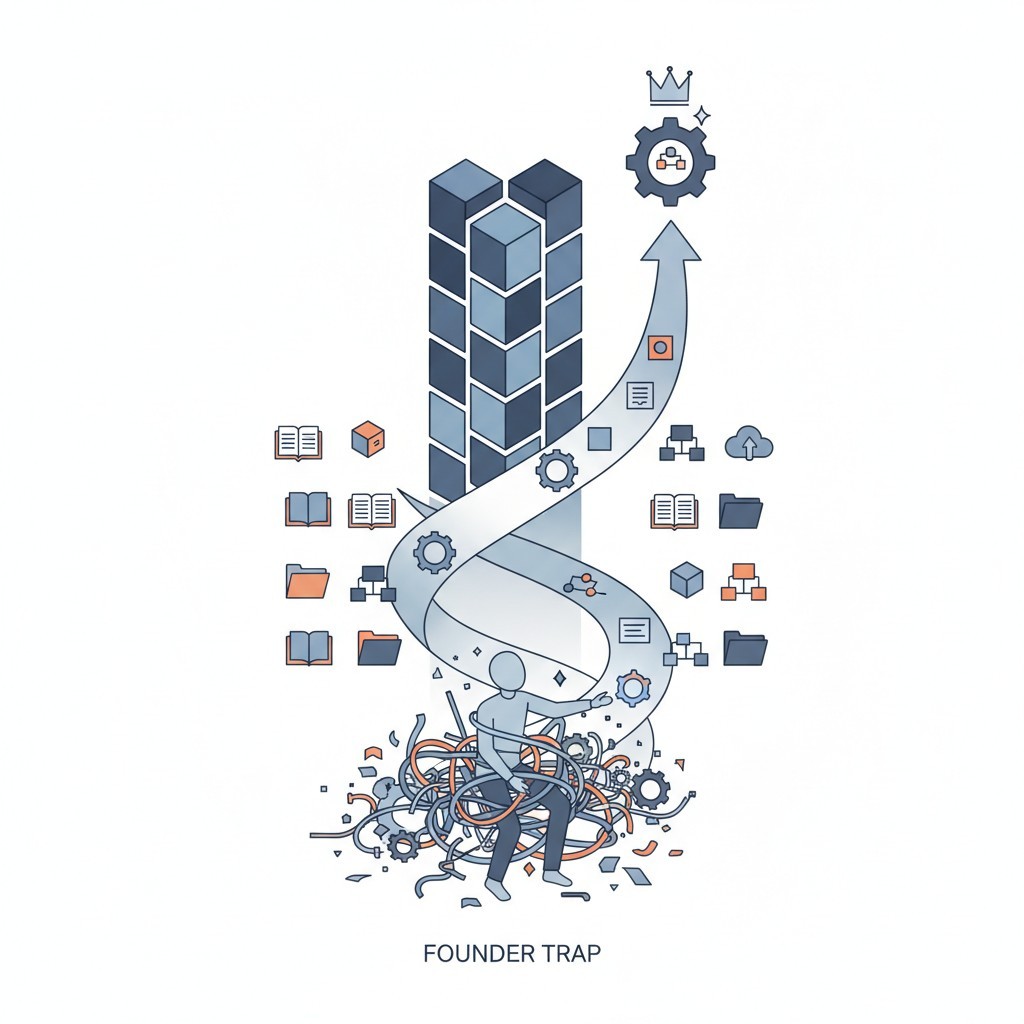
The Hidden Tax: How Operational Chaos is Bleeding Your Business Dry

The Architecture of Operational Freedom: Engineering a Business That Runs Without You

What is an SOP in Business? The Architecture to Escape the Founder Trap
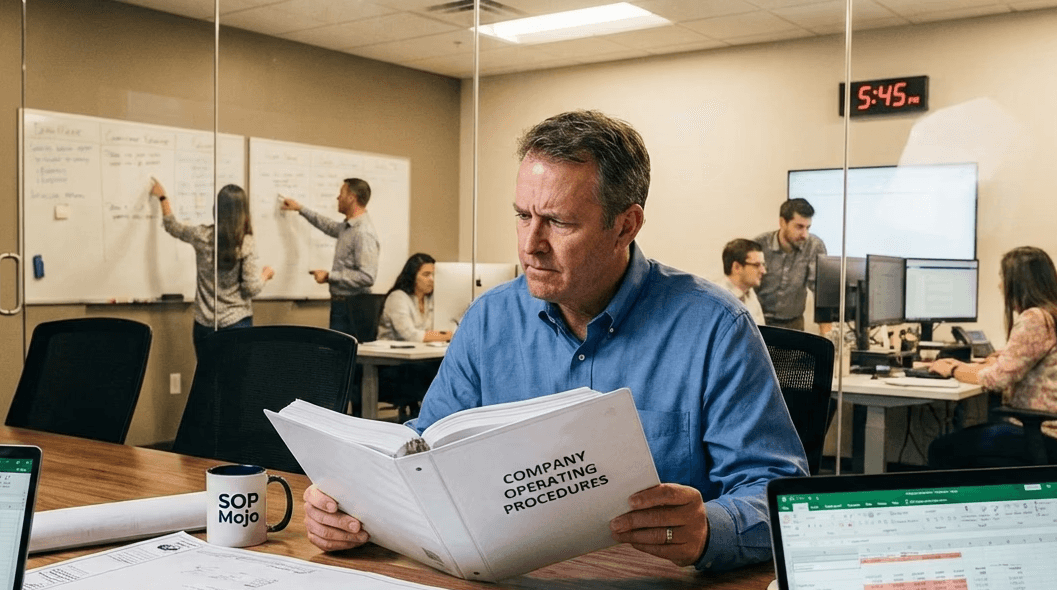
I Built a 6 Million Dollar Company That Couldn't Run Without Me
How to Build a Business That Works (Hint: Systems!)

Employee Onboarding and Training: A Practical Guide for Small and Medium Businesses

How to Write Standard Operating Procedures for Manufacturing: A Field-Proven Blueprint

Essential Quality Control Practices for Operational Excellence

How Standardized Processes Drive Operational Efficiency and Growth