
Understanding the Importance of Quality Control in Business
Listen to this article

Ryan Pease
FOLLOW

Most small business owners believe they deliver quality work. The problem is that belief alone does not protect a client relationship when a deliverable ships with errors, a new team member onboards inconsistently, or a key employee leaves and takes half the institutional knowledge with them. Quality is not just an attitude. It is a system, and without that system, it is impossible to enforce, measure, or scale.
This guide breaks down what quality control actually means for service-based and operational businesses, why it matters more as a company grows, and how documented standard operating procedures (SOPs) are the foundation that makes quality control enforceable rather than aspirational.
What Is Quality Control (and Why It Matters for Small Businesses)?
Quality control, at its core, is the systematic process of checking outputs against a defined standard to determine whether they meet expectations before they reach the client or end user. That is the plain-language definition of quality control, and it applies just as much to a marketing agency reviewing a campaign brief as it does to a manufacturer inspecting a finished product.
Many small business owners assume quality control is a manufacturing concept. It is not. Every service business that delivers a repeatable output, whether that is an IT onboarding, a bookkeeping report, a consulting deliverable, or a client intake process, has quality to control. The question is whether that quality is being managed systematically or left to the judgment of whoever happens to be handling the work that day.
For businesses in the $1 million to $10 million revenue range with 10 to 50 employees, quality control is often the invisible line between a business that scales and one that stalls. When every output depends on a specific person's memory or judgment, quality is fragile. When outputs are measured against a documented standard, quality becomes transferable and scalable.
Quality Control vs. Quality Assurance: What Is the Difference?
These two terms are frequently used interchangeably, but they serve different functions and both matter for a growing business.
Quality control (QC) is reactive. It involves inspecting outputs after they have been produced to catch defects, errors, or deviations from the standard before they reach the client. Think of a peer review step before a proposal goes out, or a checklist completed before a project is marked complete.
Quality assurance (QA) is proactive. It focuses on building processes that prevent defects from occurring in the first place. QA is the upstream investment: designing workflows, training staff, and documenting procedures so that errors are less likely to happen at all.
The most common misconception among SMB owners is that they need to choose one or the other. In reality, QC and QA work together. QA reduces the frequency of errors; QC catches the ones that still slip through. For a founder-led service business, QA often looks like a well-documented SOP, while QC looks like a review checkpoint built into that same process.
Why Quality Control Is Important: The Real Business Case
The importance of quality control is not abstract. It shows up directly in revenue, retention, and reputation.
Customer satisfaction and retention: Clients who consistently receive work that meets or exceeds their expectations stay longer and refer more. Inconsistency, even occasional inconsistency, erodes trust faster than most business owners realize.
Brand reputation: In service industries, reputation is a primary growth driver. One pattern of quality failures can generate negative reviews or word-of-mouth that takes years to reverse.
Cost reduction: Catching errors before they reach clients is significantly cheaper than fixing them after. Rework, refunds, and recovery conversations are all avoidable costs that compound over time.
Competitive differentiation: Most competitors in a given service market are not operating with formal quality systems. A business that consistently delivers to a documented standard has a structural advantage, not just a reputational one.
The Hidden Cost of Poor Quality Control
When quality control is informal or nonexistent, the costs are rarely visible on a single invoice. They accumulate quietly across the business.
Consider a professional services firm with 20 employees and $3 million in annual revenue. If just 10 percent of client deliverables require meaningful rework, and each rework cycle consumes three to four hours of staff time, the firm is absorbing hundreds of hours of unbillable labor every year. Add the cost of client churn from dissatisfied customers, the management time spent resolving complaints, and the occasional refund or discount offered to retain a relationship, and the financial impact becomes significant.
As a business scales, these costs compound. What is manageable at 10 employees becomes operationally disruptive at 30. The errors do not just cost more money; they consume founder attention, damage team morale, and slow growth. Poor quality control is not just a client problem. It is a scaling problem.
How Quality Control Works in Service-Based Businesses
Quality control in service industries looks different from a factory floor inspection, but the underlying logic is the same: define the standard, check against it, and correct deviations before they reach the customer.
For a marketing agency, QC might mean a senior account manager reviews every deliverable against a client brief before it is sent. For a managed service provider, it might mean a technician completes a documented checklist before closing a support ticket. For a consulting firm, it might mean every client report passes through a peer review step before delivery.
The key insight is that quality checkpoints should be built into the delivery process, not bolted on at the end. End-of-process inspection catches errors late, after significant time has already been invested. Mid-process checkpoints catch deviations earlier, when they are cheaper and faster to correct.
7 Warning Signs Your Business Has a Quality Control Problem
Before a business can fix a quality problem, it needs to recognize one. Here are seven indicators that quality control is not working as well as it should:
The same types of errors keep recurring across different team members or projects, suggesting no documented standard exists to prevent them.
The founder or a senior employee reviews everything before it goes out, because no one else can be trusted to catch mistakes independently.
Client feedback is inconsistent with some clients reporting great experiences and others reporting frustrating ones, with no clear explanation for the gap.
New hires take a long time to reach full productivity because quality expectations are communicated verbally rather than documented.
Rework is treated as normal and is not tracked as a cost or measured as a performance indicator.
Quality drops noticeably when a specific person is absent, which signals that quality is person-dependent rather than process-dependent.
There is no formal review step in the delivery workflow. Work goes from creation to client without a defined checkpoint in between.
If three or more of these apply, the business has a quality control problem that will become more expensive to ignore as it grows.
The Hidden Quality Risk: When Your Standards Live Only in One Person's Head
Key-person dependency is one of the most common and underappreciated quality control failure modes in founder-led businesses. When the standard for what "good" looks like exists only in the mind of the founder, a senior employee, or a long-tenured team member, quality becomes fragile in several ways.
First, that person becomes a bottleneck. Every output that requires quality judgment flows through them, limiting throughput and creating delays. Second, their absence, whether due to vacation, illness, or departure, creates an immediate quality gap. Third, their standard cannot be taught, measured, or improved because it has never been written down.
This is not a hypothetical risk. It is one of the most common operational crises that growing service businesses face. The solution is not to find a more reliable person. It is to extract the standard from that person's head and document it in a format the entire team can use.
Why Quality Control Starts with Documented SOPs (Not Just Good Intentions)
Here is the fundamental truth about quality control that most resources overlook: quality control is only enforceable when there is a documented standard to measure against. Without that documentation, QC is just a feeling.
Standard operating procedures are the foundation that makes quality control real. An SOP defines exactly how a task or process should be executed, what the output should look like, and what checks should be performed before it is considered complete. It transforms the quality standard from something that lives in one person's judgment into something the entire team can follow, inspect against, and improve over time.
For a founder-led service business, this connection between SOPs and quality control is particularly important. The founder's instinct for quality, built over years of experience, is genuinely valuable. But that instinct cannot be delegated, taught, or scaled until it is documented. SOPs are the mechanism that transfers quality standards from individuals to the organization itself.
This is exactly what SOP Mojo does for growing businesses: extract the way the business actually operates, document it in usable processes, and install a system the team can run without the founder in every decision. The result is not just better documentation. It is enforceable, measurable, scalable quality control.
Common Quality Control Methods and Techniques for SMBs
Service businesses do not need complex statistical models or enterprise software to implement effective quality control. These practical quality control methods work for businesses at almost any size:
Checklists: A simple, role-specific checklist embedded in a workflow ensures that no step is skipped and that the output meets the defined standard before moving forward.
Peer review and approval workflows: Requiring a second set of eyes on deliverables before they reach the client catches errors that the original creator is likely to miss.
Approval gates: Defined points in a project or process where work must be reviewed and approved before the next phase begins. These are particularly effective in client onboarding and delivery workflows.
Client feedback loops: Structured post-delivery or post-project surveys that capture satisfaction data and surface recurring issues before they become patterns.
Error and rework tracking: Logging every instance of rework, who identified it, and what caused it creates data that reveals systemic problems rather than one-off mistakes.
How Quality Control Lets Your Business Scale Without You in Every Decision
Most business owners think of quality control as a way to reduce errors. That is true, but it misses the larger strategic value. Quality control, when built on documented processes, is the mechanism that allows a business to grow without the founder becoming an operational ceiling.
When quality standards are documented and review steps are built into workflows, team members can execute and self-check independently. New hires can be onboarded to a defined standard rather than an approximation of what they think the founder expects. Managers can monitor quality through metrics rather than by reviewing every output personally.
This is the difference between a business that scales and one that hits a wall. The wall is not usually a market problem or a sales problem. It is an operational problem: the founder cannot be everywhere, and without documented quality systems, quality degrades as the team grows. Documented QC processes remove that ceiling by making the standard transferable and the enforcement systematic.
How to Implement Quality Control in Your Business: A Step-by-Step Approach
Implementing quality control does not require a dedicated quality department. For most SMBs, it requires four focused steps:
Define your quality standards for each key deliverable. What does "done well" look like for each output your business produces? Be specific. Vague standards like "professional quality" are unenforceable. Specific standards like "proposal reviewed against client brief, formatted to template, and approved by account lead" are not.
Document the process and build in checkpoints. Create SOPs for each repeatable process that include explicit quality review steps. Assign ownership for each checkpoint so accountability is clear.
Train the team to the documented standard. Documentation only works if the team knows it exists and understands how to use it. Build SOP review into onboarding and ongoing training.
Review, measure, and improve continuously. Track quality metrics over time, review what is not working, update SOPs when gaps are identified, and raise the standard incrementally. Quality control is not a one-time project. It is an ongoing cycle.
A Simple Quality Control Checklist for Service-Based Businesses (Use This Today)
This checklist can be adapted for most service delivery workflows. It is designed to be embedded as a final review step before any client-facing output is delivered:
Does this output match the client brief or original scope of work?
Has it been reviewed by someone other than the person who created it?
Are all required sections, components, or deliverables present and complete?
Does it meet the formatting, branding, or presentation standards defined in the SOP?
Have all known client preferences or sensitivities been accounted for?
Has the output been reviewed for errors, inconsistencies, or missing information?
Has the review been documented (signed off, logged, or marked complete in the project management system)?
Is the delivery method, timing, and accompanying communication aligned with the defined process?
This checklist is a starting point. The most effective version will be specific to the business's services, clients, and delivery standards, which is exactly what a documented SOP captures.
Measuring and Monitoring Quality Over Time
Quality control is not a set-it-and-forget-it exercise. It requires ongoing measurement to identify trends, catch recurring issues, and drive continuous improvement. For service businesses, useful quality metrics include:
Rework rate: The percentage of deliverables that require correction before or after delivery.
Client satisfaction scores: Collected through post-project surveys or Net Promoter Score (NPS) tracking.
On-time delivery rate: The percentage of deliverables completed within the agreed timeline.
Error frequency by process: Tracking which specific workflows generate the most quality issues reveals where SOPs need improvement.
Churn rate by cohort: Monitoring whether client retention correlates with delivery quality provides a revenue-linked view of quality performance.
These metrics do not require sophisticated software. A simple spreadsheet reviewed monthly by a manager is enough to spot patterns and drive meaningful improvement.
Frequently Asked Questions About Quality Control
What is quality control and why is it important?
Quality control is the systematic process of reviewing outputs against a defined standard to ensure they meet expectations before reaching the client or end user. It is important because it protects customer satisfaction, reduces rework costs, builds brand reputation, and creates the operational consistency that allows a business to scale.
What are the three main objectives of quality control?
The three main objectives of quality control are consistency (ensuring every output meets the same standard regardless of who produces it), customer satisfaction (delivering work that meets or exceeds client expectations), and cost efficiency (reducing the time and money spent on rework, refunds, and error recovery).
What are the benefits of quality control for small businesses?
For small businesses, quality control improves client retention, reduces operational waste, builds a stronger reputation, and creates the documented standards necessary to train new employees and scale delivery without founder involvement in every output.
What is the difference between quality control and quality assurance?
Quality control is reactive: it detects defects in outputs that have already been produced. Quality assurance is proactive: it builds processes that prevent defects from occurring in the first place. Both are necessary for a well-functioning quality system.
What are the most effective quality control methods for service businesses?
The most effective methods for service businesses include process-embedded checklists, peer review and approval workflows, structured client feedback loops, and rework tracking. All of these are most effective when built into documented SOPs rather than applied informally.
Why are quality controls important when scaling a business?
When a business scales, the founder can no longer personally oversee every output. Without documented quality standards and review processes, quality degrades as the team grows. Quality controls, grounded in SOPs, make the standard transferable and enforceable across a larger team without requiring the founder's direct involvement.
Quality Control Is a System, Not a Standard
The importance of quality control for growing businesses cannot be overstated, but quality control is only as strong as the system behind it. Good intentions, talented employees, and high standards are valuable, but they are not enough to deliver consistent quality at scale. The businesses that consistently outperform their competitors are not just staffed with better people. They have better systems.
For founder-led service and operational businesses, that system starts with documented SOPs. SOPs define the standard, make it teachable, and give quality control something concrete to measure against. Without them, quality is a hope. With them, it becomes an operational asset that protects clients, reduces costs, and enables the kind of scalable growth that does not require the founder to be everywhere at once.
If the business's quality standards still live primarily in one person's head, that is not a talent problem. It is a documentation problem, and it is one that is entirely solvable.
Check out other interesting articles here 👇

Why Free Acceptable Use Policy Templates Destroy Enterprise Value
The Hidden Tax: How Operational Chaos is Bleeding Your Business Dry

The Architecture of Operational Freedom: Engineering a Business That Runs Without You

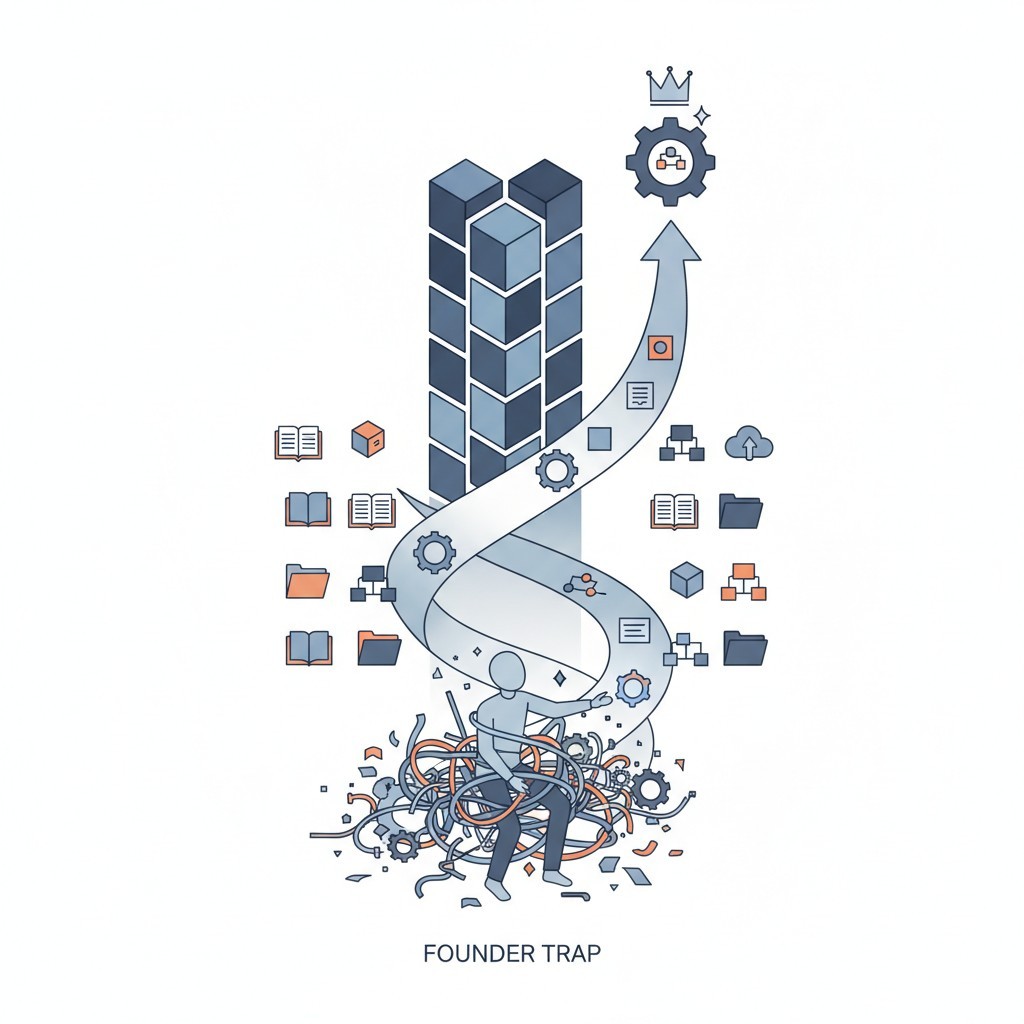
What is an SOP in Business? The Architecture to Escape the Founder Trap

I Built a 6 Million Dollar Company That Couldn't Run Without Me

How to Build a Business That Works (Hint: Systems!)

Employee Onboarding and Training: A Practical Guide for Small and Medium Businesses

How to Write Standard Operating Procedures for Manufacturing: A Field-Proven Blueprint

Essential Quality Control Practices for Operational Excellence

How Standardized Processes Drive Operational Efficiency and Growth