Identifying Common Operational Challenges in Small Businesses (And How to Fix Them)
Listen to this article

Ryan Pease
FOLLOW

Every small business owner has experienced that sinking feeling: a client complaint lands in the inbox, a key employee calls in sick and suddenly nobody knows how to handle their responsibilities, or a simple task takes three times longer than it should because nobody documented how it was supposed to be done. These are not random bad days. They are symptoms of a deeper pattern that affects almost every founder-led service business at some point in its growth journey.
Common operational challenges do not show up all at once. They creep in gradually, disguised as personality clashes, hiring problems, or client churn. But when you look closely, most of them trace back to the same root cause: the business is running on informal systems, tribal knowledge, and the founder's constant involvement. This guide breaks down the most significant small business operational issues, explains why they happen, and maps each one to a practical, SOP-based solution.
What Are Operational Challenges (and Why SMBs Feel Them Most)
An operational challenge is any recurring friction that slows down how a business delivers value, manages its team, or sustains quality over time. For large corporations, these challenges are often managed by dedicated operations teams, compliance departments, and enterprise-grade software. For small and medium-sized businesses, especially those in the $1 million to $10 million revenue range, the same challenges hit harder because there is no safety net.
Founder-led service businesses are particularly vulnerable. In the early years, the founder IS the operating system. They know the clients, they set the standards, and they fill every gap personally. That works fine at ten employees. It becomes a serious liability at twenty-five. When processes exist only in someone's head, every operational challenge is amplified. Inconsistencies multiply. Bottlenecks form around key people. Growth stalls because the business cannot replicate what made it good in the first place.
Standard operating procedures (SOPs) are the practical fix that threads through every challenge on this list. Not because documentation is a magic wand, but because most operational problems are fundamentally problems of undocumented, people-dependent processes.
Inconsistent Delivery and Declining Quality
When ten different team members handle the same task ten different ways, the result is unpredictable quality. One client gets a polished deliverable. Another gets something rushed. A third gets something that misses the brief entirely. This is not a talent problem. It is a process problem.
Inconsistent delivery is one of the most costly small business operational issues because the damage compounds. Rework eats into margins. Client complaints erode trust. Refunds and scope disputes drain time and energy. Referrals dry up. And because the inconsistency is invisible until something goes wrong, it can persist for months before anyone connects the dots.
The fix is process standardization: documenting the steps, standards, and checkpoints for every repeatable deliverable so that any qualified team member can produce a consistent outcome. SOPs do not eliminate creativity or judgment. They define the baseline so the team is not starting from scratch every time.
Founder and Key-Person Dependency
Ask most founder-led businesses what happens when the owner goes on vacation, and the honest answer is: things slow down, get delayed, or fall apart. That is not a leadership failure. It is a structural one. When critical knowledge lives in one person's head, that person becomes a bottleneck by default.
Key-person dependency is not limited to founders. It shows up whenever an experienced employee holds the institutional knowledge for a critical process. When that person leaves, the business scrambles. When they are out sick, work stalls. When they are stretched thin, quality drops.
Extracting that knowledge into documented procedures is how businesses break this cycle. An SOP for client onboarding, project handoffs, or quality review means the process belongs to the business, not the person. Delegation becomes possible. The founder can step back from daily execution. The business can scale without the owner being the bottleneck in every decision.
Inefficient Workflows and Repetitive Tasks
Process waste is one of the most common yet hardest-to-see business inefficiencies. When workflows are undocumented, teams invent their own methods. Steps get duplicated. Handoffs get missed. Someone spends forty-five minutes recreating a document that already exists somewhere in a shared drive nobody organized properly.
Ad-hoc execution creates unpredictable timelines. Projects that should take a week take three. Simple client requests require multiple rounds of back-and-forth because nobody is clear on who owns which step. The cumulative time cost across a team of twenty people is enormous, even if no single inefficiency feels dramatic on its own.
Workflow optimization starts with mapping what actually happens, not what is supposed to happen. Documented workflows expose redundant steps, clarify ownership, and create predictable timelines. When handoffs are written down and assigned, things stop falling through the cracks.
Communication Breakdowns and Team Misalignment
A surprising amount of team communication is not strategic. It is compensatory. People ask questions because processes are unclear. Managers repeat instructions because nothing is written down. Meetings happen to coordinate work that documented systems would handle automatically.
Communication breakdowns in small businesses almost always have a process documentation problem underneath them. When roles are ambiguous and procedures are informal, team members fill the gaps with assumptions. Those assumptions diverge. Errors follow. The manager gets pulled in to resolve what should have been prevented by a clear procedure.
SOPs reduce communication overhead by answering the most common questions before they are asked. When a new team member knows exactly what to do, in what order, and to what standard, they do not need to interrupt a senior employee every hour. Role clarity improves. Cross-team coordination improves. The team can execute without constant manager intervention.
Scaling Pains: Growing Too Fast Without Systems
Growth is supposed to be the reward for building something good. But for businesses without documented systems, growth is often the thing that breaks them. Every undocumented process that was manageable at ten employees becomes a crisis at thirty.
Rapid hiring without an operating system means new employees learn from whoever is available, which means they learn inconsistently. Culture erodes because there is no shared standard of how things are done. Quality drops because the informal knowledge that kept things working does not transfer at speed. The founder ends up more involved than ever, not less, because the team cannot operate independently.
Installing an operating system before scaling headcount is the prerequisite for sustainable growth. That means documenting the core delivery processes, onboarding procedures, and quality standards before the next hiring wave, not after the next crisis.
Employee Onboarding, Retention, and Training Gaps
The average small business significantly underestimates the cost of slow onboarding. When a new hire takes three months to reach full productivity because they are learning by shadowing and trial and error, that is a direct cost to the business. Multiply it across several hires per year, and the number becomes material.
Tribal knowledge is a retention risk masquerading as a strength. When experienced employees are the only ones who know how things work, they become indispensable, but they also become frustrated. They spend their time answering the same questions repeatedly instead of doing the work they were hired to do. When they eventually leave, they take the operating knowledge with them.
Documented SOPs compress onboarding timelines by giving new hires a structured learning path. They reduce the burden on experienced team members. And they preserve institutional knowledge so that a single departure does not leave a gaping hole in the business's ability to function.
Operational Challenges Unique to Founder-Led Service Businesses
Most generic business advice about identifying business inefficiencies is written for large organizations with dedicated operations teams. It does not translate cleanly to a fifteen-person marketing agency or a thirty-person IT managed services firm where the founder is still involved in sales, delivery, and client relationships simultaneously.
Founder-led service businesses face a specific set of compounding challenges that generic advice misses:
The founder is both the ceiling and the floor. They set the quality standard, but because they are the standard, the business cannot grow beyond their personal capacity.
Delivery knowledge is relational, not procedural. Service businesses often believe their work is too nuanced to document. This is almost never true, but it is a common reason SOPs get deprioritized.
Informal culture resists formalization. Teams that have operated informally for years can push back on documentation efforts, seeing them as bureaucracy rather than infrastructure.
Client relationships mask process gaps. Strong client relationships can paper over inconsistent delivery for a while, until the team grows and the founder can no longer personally manage every relationship.
Growth creates urgency that crowds out systems work. When revenue is growing, it feels wrong to slow down and document. But the longer documentation is deferred, the more expensive the catch-up becomes.
Addressing these challenges requires an approach built specifically for founder-led service businesses, not a framework borrowed from enterprise operations management.
Why Most Operational Challenges Share One Root Cause
Here is what most articles about common operational challenges get wrong: they treat each challenge as a separate problem requiring a separate solution. Hire better. Communicate more. Use a project management tool. Improve culture.
These recommendations are not wrong, but they are treating symptoms. The root cause connecting most operational challenges in small businesses is undocumented, people-dependent processes. When processes are not documented:
Quality depends on who is doing the work, not on what the process requires.
Knowledge concentrates in individuals rather than in the business.
Onboarding is slow because there is nothing to onboard people into.
Communication is constant because written clarity does not exist.
Scaling is dangerous because there is no operating system to replicate.
Fix the documentation gap, and most of the downstream challenges either disappear or become dramatically more manageable. That is not an oversimplification. It is a recognition that operational infrastructure is the foundation everything else sits on.
Which Operational Challenge Is Costing You the Most? A Quick Self-Diagnostic
Before building SOPs, it helps to identify which operational challenge is creating the most friction right now. Use these questions to prioritize:
Signs that inconsistent delivery is your biggest problem
Client complaints vary by team member, not by project complexity.
Rework is a regular part of the delivery cycle.
Quality depends on who is available, not on a defined standard.
Signs that founder or key-person dependency is your biggest problem
Decisions stall when the owner is unavailable.
One or two employees are the only ones who know how critical processes work.
The founder is still involved in tasks that should have been delegated years ago.
Signs that scaling without systems is your biggest problem
Recent growth has created more chaos, not more capacity.
New hires are taking too long to become productive.
Quality has visibly declined as the team has grown.
Signs that onboarding and retention gaps are your biggest problem
Turnover is higher than expected for the industry.
New hires consistently report feeling unsupported in their first ninety days.
Experienced employees are spending significant time training newcomers informally.
Whichever category generates the most "yes" responses is the right place to start building documented procedures. Prioritizing the highest-cost challenge first creates visible results quickly, which builds internal buy-in for broader documentation efforts.
What Unresolved Operational Challenges Actually Cost Your Business
Operational challenges rarely feel urgent because their costs are distributed and invisible. But they are real, and they compound over time.
Consider a fifteen-person service business where onboarding takes three months instead of six weeks because there are no documented procedures. If the business hires six people per year, that is roughly six months of lost productivity annually. At an average fully-loaded cost of $70,000 per employee, the slow onboarding gap alone represents tens of thousands of dollars in productivity loss each year.
Now add the cost of rework from inconsistent delivery. If even five percent of projects require significant rework, and the average project margin is thirty percent, rework is quietly eliminating a meaningful slice of profit on every affected engagement.
Add the cost of founder time spent in operational firefighting instead of business development or strategic work. If the founder spends fifteen hours per week resolving issues that documented systems would prevent, that is over seven hundred hours per year of leadership capacity consumed by avoidable friction.
The financial case for addressing common operational challenges is not about the cost of building SOPs. It is about the cost of not building them. For most businesses in the $1.5 million to $8 million range, the return on a serious operational improvement investment is measurable within the first year.
The SOP Fix: Matching the Right Procedure to Each Operational Challenge
Not every operational problem needs the same type of documentation. Here is a practical mapping of challenge type to SOP priority:
Inconsistent delivery
Start with delivery SOPs: the step-by-step process for producing the core service or deliverable. Include quality checkpoints, output standards, and review criteria. This is the highest-leverage documentation for service businesses.
Founder and key-person dependency
Start with role-specific process documentation for the most critical roles. Interview the founder and key employees to extract their decision-making logic. Convert that logic into documented procedures and decision trees.
Inefficient workflows
Start with workflow maps for the highest-volume processes. Identify handoff points, ownership assignments, and common failure modes. Simplify before documenting, then document the simplified version.
Communication breakdowns
Start with role clarity documents and communication protocols. Define who owns what, who communicates what to whom, and what decisions require escalation versus independent judgment.
Scaling without systems
Start with the core operating system: the five to ten processes that define how the business delivers value. Document these before the next hiring wave, not after.
Onboarding and training gaps
Start with a structured onboarding SOP that gives new hires a clear learning path in their first thirty, sixty, and ninety days. Link to role-specific procedures so training is self-directed rather than dependent on a senior employee's availability.
How to Solve Operational Challenges With Standard Operating Procedures
Building a working operating system for a small business is not about creating a library of documents nobody reads. It is about extracting the way the business actually operates, removing dependency on specific individuals, and installing procedures the team will actually use.
The most effective approach starts with diagnosis: identifying which processes are most critical, most variable, and most dependent on specific people. From there, the work is extraction (capturing how things actually get done), simplification (removing unnecessary steps), documentation (writing procedures in a format the team can follow), and activation (training the team and building the habit of using the documentation).
The result is not a static document library. It is a living operating system that grows with the business, gets updated as processes improve, and gives every team member the clarity they need to do their job well without constant supervision.
Frequently Asked Questions
What are examples of operational challenges in small businesses?
Common examples include inconsistent service delivery, founder dependency bottlenecks, slow or informal employee onboarding, inefficient workflows with missed handoffs, communication breakdowns caused by unclear role expectations, and scaling problems that emerge when headcount grows faster than systems. Most of these trace back to undocumented, people-dependent processes.
What are some common operational issues for growing service businesses?
Growing service businesses most commonly struggle with quality erosion as the team expands, key-person risk when experienced employees hold critical knowledge, onboarding delays that slow new hires' productivity, and the founder getting pulled back into daily execution instead of strategic work. These issues intensify without a documented operating system.
What will be the biggest operational challenge for growing businesses?
For most founder-led service businesses, the biggest operational challenge during growth is scaling without systems. When the business grows faster than its documented processes, quality drops, culture erodes, and the founder ends up more involved than ever. Installing an operating system before scaling headcount is the most effective preventive measure.
How do you solve operational challenges in a service business?
The most effective approach is to identify the highest-cost challenge first, then build standard operating procedures that address the root cause: undocumented, people-dependent processes. Start with delivery SOPs for consistency, role documentation for dependency reduction, and onboarding procedures for training efficiency. Build a living operating system the team actually uses rather than a document library that collects dust.
What is the root cause of most operational challenges?
In founder-led service businesses, most operational challenges share a single root cause: processes that exist in people's heads rather than in documented systems. When knowledge is people-dependent, every challenge, from inconsistent delivery to scaling problems, is amplified. Documenting and systematizing core processes addresses the root cause rather than the symptoms.
Check out other interesting articles here 👇

Why Free Acceptable Use Policy Templates Destroy Enterprise Value
The Hidden Tax: How Operational Chaos is Bleeding Your Business Dry

The Architecture of Operational Freedom: Engineering a Business That Runs Without You

What is an SOP in Business? The Architecture to Escape the Founder Trap
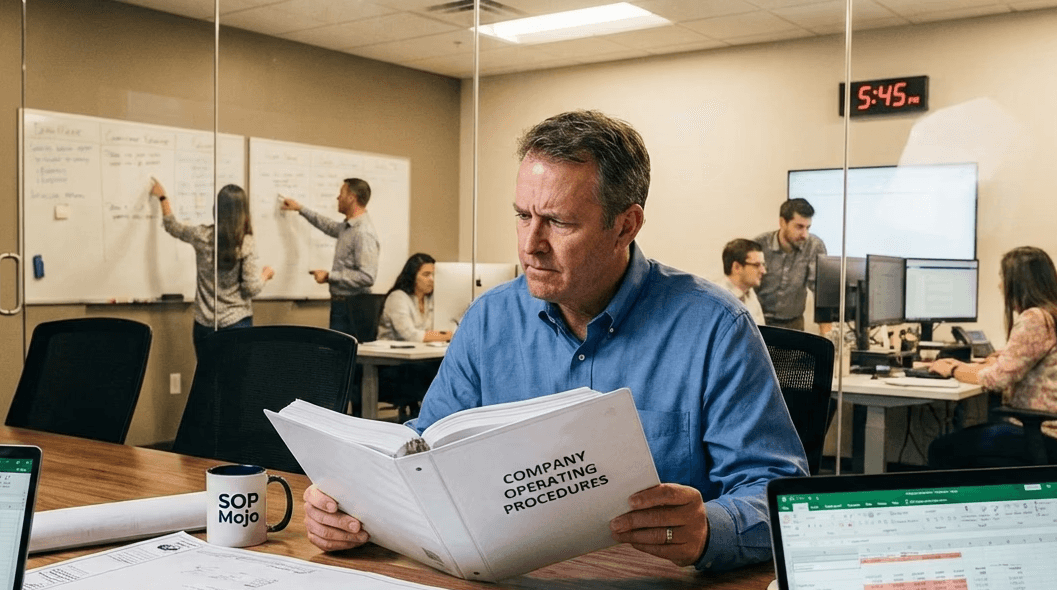
I Built a 6 Million Dollar Company That Couldn't Run Without Me
How to Build a Business That Works (Hint: Systems!)
Employee Onboarding and Training: A Practical Guide for Small and Medium Businesses

How to Write Standard Operating Procedures for Manufacturing: A Field-Proven Blueprint

Essential Quality Control Practices for Operational Excellence

How Standardized Processes Drive Operational Efficiency and Growth