Key Characteristics of a Successful Process-Driven Culture
Listen to this article

Ryan Pease
FOLLOW

Most small and medium-sized business owners have experienced the same painful moment: a key employee leaves, a client project goes sideways, or the founder takes a week off and something important falls through the cracks. The instinct is often to hire better people or work harder. But the real fix is almost always structural. What the business is missing is a process-driven culture, and there is a significant difference between having that culture and simply having a folder of documents nobody reads.
This guide breaks down the core characteristics of a process-driven culture, explains what one actually looks like inside a founder-led service business, and gives SMB owners a practical path to building one from the ground up.
What Is a Process-Driven Culture (and Why It Matters for Growing SMBs)
A process-driven culture is not just about having documented workflows. It is a shared organizational belief that the system guides execution, not the memory of the most experienced person in the room. In a process-driven organization, the way work gets done is defined, accessible, and followed consistently, regardless of who is doing it.
For founder-led businesses in the $1M to $10M revenue range, this distinction is critical. Most businesses at this stage are still running on institutional knowledge. The founder knows how to close a deal. The senior account manager knows how to handle a difficult client. The ops lead knows the quirks of the fulfillment workflow. None of that is written down. When those people are unavailable, busy, or gone, the business slows or breaks.
A process-driven culture replaces that fragility with a system that any trained team member can follow. The culture part matters because documentation alone does not change behavior. Culture is what happens when no one is watching. In a truly process-driven organization, employees reach for the documented process first, not because they are forced to, but because the team has internalized that the system is trustworthy and the right place to start.
The Core Characteristics of a Process-Driven Culture
Understanding the traits of effective process culture helps business owners recognize what they are building toward and what they may currently be missing. Here are the defining characteristics:
1. Documented, Accessible SOPs Are the Operating Backbone
In a process-driven business, standard operating procedures (SOPs) exist for every repeatable, high-impact workflow. They are not buried in a shared drive. They are organized, up to date, and easy to find. Team members know where to look and trust what they find.
2. Accountability Is Tied to Roles, Not Personalities
One of the clearest signs of a process-driven culture is that accountability is role-based. The onboarding checklist belongs to the Client Success role, not to whoever happened to do it last time. This makes responsibilities transferable and visible, which is essential when the business grows or team members change.
3. Continuous Improvement Is Embedded in Daily Habits
Process-driven teams do not treat SOPs as permanent artifacts. They build review cycles into their rhythm. When a workflow breaks or produces a subpar outcome, the team updates the process rather than patching it informally. This iterative improvement mindset is what keeps documentation relevant instead of outdated.
4. Decisions Are Informed by Data, Not Just Instinct
A process-oriented organization tracks outcomes at the process level. Delivery timelines, error rates, client satisfaction scores, and onboarding completion rates are monitored and used to improve workflows. This does not require enterprise software. It requires the habit of measuring what matters.
5. Cross-Functional Consistency Is the Standard
The same client intake process happens whether the account manager is Sarah or James. The same quality check happens on every deliverable regardless of who produced it. Consistency is not accidental in a process-driven culture. It is engineered.
Having SOPs vs. Having a Process-Driven Culture: Why the Difference Matters
This is one of the most important distinctions for SMB owners to understand, and it is almost entirely absent from mainstream content on this topic.
Many businesses have SOPs. Very few have a process-driven culture. The difference is adoption and belief. A binder of procedures sitting on a shelf, or a Google Drive folder nobody opens, is documentation. It is not culture.
Culture is what the team actually does. In businesses where the documentation exists but is ignored, the culture is still people-dependent. Employees rely on whoever trained them, on tribal knowledge, and on asking around. The SOPs are performative, created to satisfy a compliance requirement or a consultant's recommendation, but never integrated into daily operations.
A process-driven culture exists when the team trusts the process more than the workaround. When a new employee follows the SOP and produces the same quality outcome as a five-year veteran. When the founder can step away and the business does not skip a beat. That is the difference between having documentation and having a culture built around it.
How Process-Driven Culture Differs From a People-Dependent Business
In a people-dependent business, knowledge lives in heads. The senior technician knows the client's quirks. The founder knows which vendor to call when there is a problem. The office manager knows the unwritten rules of the billing process. None of it is transferable without that person being physically present.
In a process-driven business, knowledge lives in systems. Onboarding is repeatable because there is a documented sequence. Client handoffs follow a checklist. Delivery workflows are standardized. When a key person is out, the business continues because the process carries the knowledge, not the individual.
This shift also changes how the founder operates. Instead of being the answer to every question, the founder becomes the architect of systems. Instead of being in every delivery conversation, they set standards that the team executes. That is the operational freedom most SMB owners want but rarely achieve without intentional culture-building.
Is Your Business Already Process-Driven? A Quick Self-Assessment
No competitor in this space offers a practical diagnostic, so here is one. Answer yes or no to each question honestly:
Can a new employee complete your most common workflow correctly on their first attempt using only documented resources?
Do your SOPs live somewhere the whole team can access them without asking for the link?
When a process breaks down, does the team update the documentation as a standard response?
Is accountability for recurring tasks tied to a role, not a specific person's name?
Can the business deliver at full quality without the founder or a key employee being involved?
Do new hires reach a productive baseline in a predictable timeframe, regardless of who trains them?
Are your processes reviewed on a set schedule, at least once or twice a year?
Do employees follow documented processes by default, rather than asking colleagues for guidance?
If the answer is yes to six or more, the business has a meaningful process foundation. Four or five suggests partial adoption with real gaps. Fewer than four is a signal that the business is still running on people and habits rather than systems. That is not a criticism. It is the starting point for most SMBs in the $1M to $5M range, and it is entirely fixable.
What a Process-Driven Culture Looks Like at Each Stage of SMB Growth
One of the most useful frames for understanding successful process culture elements is to look at what they look like at different stages of business maturity.
Early Stage (Under $1.5M, Fewer Than 10 Employees)
At this stage, the founder is usually doing most things. A process-driven culture here looks like basic documentation of the two or three most critical workflows: client intake, delivery, and invoicing. The goal is not comprehensiveness. It is capturing enough to bring in a first or second hire without re-inventing the wheel every time.
Scaling Stage ($1.5M to $5M, 10 to 30 Employees)
This is where most of SOP Mojo's core audience sits. At this stage, the business has proven its model but is starting to feel the friction of growth. Inconsistent delivery, onboarding that takes too long, and founders pulled into operational fires daily. A process-driven culture here looks like documented SOPs for all major roles, role-based accountability, and a regular review cadence. The founder is starting to step back from execution and into oversight.
Systematized Stage ($5M to $10M, 30 to 75 Employees)
At this stage, a process-driven culture is the infrastructure that makes everything else possible. Hiring is faster because onboarding is documented. Quality is consistent because delivery standards are defined. The founder can focus on growth strategy because operations run without them in the room. The culture here is self-reinforcing: employees expect processes to exist and contribute to improving them.
Real-World Examples: Process-Driven Culture in Founder-Led Service Businesses
Generic examples do not help SMB owners visualize what this looks like in their world. Here are scenarios drawn from the types of businesses that benefit most from a process-driven culture.
Marketing Agency (15 Employees)
A founder-led marketing agency was struggling with inconsistent client onboarding. New clients had wildly different experiences depending on which account manager handled them. After documenting a standard client onboarding SOP, including kickoff call agendas, asset collection checklists, and 30-day check-in templates, the agency reduced onboarding time by roughly a third and saw client satisfaction scores improve in the first quarter of adoption. The founder stopped being the person clients called when onboarding felt chaotic.
IT Managed Services Provider (22 Employees)
An MSP was losing institutional knowledge every time a senior technician left. New hires took months to reach full productivity because everything was learned on the job. After building documented runbooks for the 20 most common service scenarios, new technicians reached baseline competency in half the time. The culture shifted when leadership started referencing the runbooks publicly in team meetings, signaling that using the documentation was the expected behavior, not a sign of inexperience.
Accounting Firm (12 Employees)
A boutique accounting firm had a founding partner who was the single point of contact for every client relationship. When that partner was out, client calls went unanswered or were handled inconsistently. By documenting client communication protocols, escalation paths, and service delivery standards, the firm was able to distribute relationship management across the team. The founding partner reduced their direct involvement in day-to-day client work by over 40% within six months.
The Business Benefits of Building a Process-Driven Culture
The traits of effective process culture translate directly into measurable business outcomes for SMBs:
Consistent delivery quality: When every team member follows the same workflow, client outcomes become predictable. Errors and rework decrease because the process itself includes quality checkpoints.
Faster onboarding: New hires reach productive output faster when they can follow documented processes rather than shadow experienced employees for weeks.
Reduced founder dependency: The founder stops being the bottleneck when the system carries the knowledge. This is often the most transformative benefit for SMB owners.
Scalability: Adding headcount becomes manageable when there is a system to onboard into. Without documented processes, every new hire multiplies the chaos.
Owner time freedom: Founders who have built a process-driven culture report spending significantly less time in operational firefighting and more time on growth, strategy, and the work they actually want to do.
Common Challenges When Transitioning to a Process-Driven Culture
Building a process-driven culture is not purely a documentation exercise. It is a change management effort, and it comes with predictable resistance.
Experienced employees who "just know": Long-tenured team members often resist documentation because it feels like a challenge to their expertise or an implication that they are replaceable. The reframe that works: documenting their knowledge is how the business protects and scales what they have built. Their expertise becomes an asset to the organization, not just to them personally.
Processes written but never used: This is the most common failure mode. SOPs get created during a consulting engagement or an operational sprint, then sit unused because they were never integrated into daily workflows. The fix is to build processes into the tools people already use, whether that is a project management platform, a CRM, or a shared workspace.
Balancing standardization with flexibility: Some teams resist processes because they fear rigidity. A well-designed process-driven culture does not eliminate judgment. It standardizes the repeatable parts so that human judgment is reserved for the situations that genuinely require it.
How to Implement a Process-Driven Culture in Your Business
Implementation does not start with documenting everything. It starts with identifying the workflows that, if standardized, would create the most immediate operational relief.
Identify the highest-frequency, highest-impact workflows. Client intake, delivery handoffs, and new employee onboarding are almost always the right starting points for service businesses.
Document how the work actually gets done, not how it should get done in theory. Capture the real process from the person who does it best, then refine it.
Get leadership to model SOP use publicly. Culture change requires visible commitment from the top. When the founder references the SOP in a team meeting, it signals that the process is real and expected.
Integrate SOPs into existing workflows. Link them in project management tools, include them in onboarding checklists, and reference them in performance conversations.
Build a review cadence. Assign ownership of each SOP to a role, and schedule quarterly or semi-annual reviews so processes stay current.
What Process-Driven Employees Look Like and How to Develop Them
A process-driven culture requires team members who think in systems. The behavioral signals to look for include: asking "what does the process say?" before improvising, flagging when a documented workflow does not match reality, and contributing improvements rather than workarounds.
These traits can be developed through training, but they are also worth screening for during hiring. Interview questions that reveal process orientation include asking candidates to describe how they have documented or improved a workflow in a previous role, or how they handle a situation where there is no clear procedure to follow.
In SMB environments, the most effective way to develop process-driven behavior is consistent leadership modeling combined with accountability. When managers follow SOPs visibly and reference them in feedback conversations, the team learns that process adherence is a performance expectation, not an optional extra.
Protecting Your Process-Driven Culture During Rapid Hiring and Team Growth
The hiring-growth inflection point is where process-driven culture most commonly breaks down, and no mainstream content on this topic addresses it directly.
When a business grows from 10 to 25 employees in a short period, informal habits re-emerge. New hires learn from whoever trains them, not from the documented process. Existing employees revert to workarounds because they are moving too fast to consult documentation. The culture dilutes because the infrastructure was not built to absorb rapid growth.
The protection strategy has three components. First, make SOP access part of the first day. New hires should be directed to documented processes before they shadow anyone. Second, assign a process owner to every major workflow and hold that person accountable for keeping documentation current during growth phases. Third, build a new-hire feedback loop: ask every new employee at 30 and 60 days whether the documented processes matched what they actually needed to do. Their answers identify gaps before they become cultural habits.
A process-driven culture is not fragile by nature. It becomes fragile when growth outpaces the documentation infrastructure. The businesses that maintain it through rapid hiring are the ones that treat their SOPs as a living system, not a completed project.
Frequently Asked Questions About Process-Driven Culture
What are the key characteristics of a process-driven culture?
The core characteristics include documented and accessible SOPs, role-based accountability, consistent cross-functional execution, a continuous improvement mindset, and data-informed decision-making. In SMB contexts, the most important characteristic is that knowledge lives in the system rather than in specific individuals.
What is the difference between a process-driven and people-driven organization?
In a people-driven organization, execution depends on specific individuals who carry institutional knowledge in their heads. In a process-driven organization, knowledge is captured in documented systems that any trained team member can follow. The business can operate consistently regardless of who is present.
How long does it take to build a process-driven culture?
Meaningful cultural change in an SMB typically takes six to eighteen months, depending on the size of the team and the depth of existing documentation. The documentation itself can be built faster. The cultural adoption, where the team genuinely reaches for the process first, takes consistent reinforcement over time.
Can small teams sustain a process-driven culture?
Absolutely. In fact, small teams often adopt process-driven habits faster because there are fewer layers of resistance. A team of 10 to 15 people with clear SOPs and visible leadership buy-in can build a strong process culture in a matter of months. The key is starting with the workflows that matter most and building from there.
What are the signs that a company lacks a process-driven culture?
Common signs include: the founder is involved in most client or delivery decisions, onboarding takes longer than it should and varies by trainer, errors recur without the underlying process being updated, and employees ask colleagues rather than consulting documentation when they are unsure how to proceed.
Building the Culture That Scales Your Business
A process-driven culture is not a luxury for large organizations. It is the infrastructure that allows a founder-led service business to grow beyond the founder's personal capacity. The characteristics described throughout this guide, from documented SOPs and role-based accountability to continuous improvement habits and consistent onboarding, are the building blocks of a business that can operate, deliver, and scale without the owner being the answer to every question.
The businesses that build this culture intentionally are the ones that give their founders back their time, their team members clear direction, and their clients a consistent experience. That is not a nice-to-have. For any SMB serious about growth, it is the work.
Check out other interesting articles here 👇

Why Free Acceptable Use Policy Templates Destroy Enterprise Value
The Hidden Tax: How Operational Chaos is Bleeding Your Business Dry

The Architecture of Operational Freedom: Engineering a Business That Runs Without You
What is an SOP in Business? The Architecture to Escape the Founder Trap
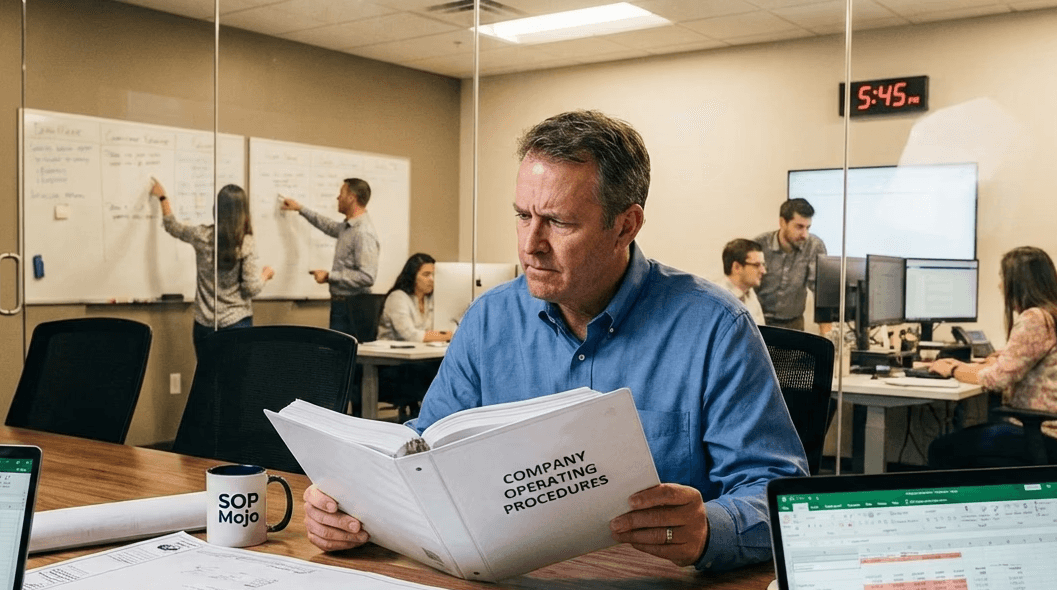
I Built a 6 Million Dollar Company That Couldn't Run Without Me
How to Build a Business That Works (Hint: Systems!)

Employee Onboarding and Training: A Practical Guide for Small and Medium Businesses
How to Write Standard Operating Procedures for Manufacturing: A Field-Proven Blueprint

Essential Quality Control Practices for Operational Excellence

How Standardized Processes Drive Operational Efficiency and Growth