Common Challenges in Change Management and How to Overcome Them
Listen to this article

Ryan Pease
FOLLOW

Most small business owners know the feeling: a new system gets announced, the team nods along in the meeting, and two weeks later everyone has quietly drifted back to doing things the old way. Nothing changed. The initiative stalled. And the founder is left wondering what went wrong.
Change management challenges are not unique to large corporations with hundreds of employees and dedicated HR departments. In fact, the challenges in change management often hit harder in smaller, founder-led businesses precisely because the stakes are higher, the resources are thinner, and the processes are almost entirely informal. When a $5 million service business tries to change how it onboards clients or routes work, there is no enterprise playbook to fall back on. There are just people, habits, and a lot of unwritten rules.
This guide is written specifically for small and mid-sized business owners navigating that reality. It covers the most common change management problems, their root causes, and the practical solutions that actually work at the SMB level, starting with the one tool that most change initiatives are missing: documented processes.
Why Change Management Hits Differently in Small and Mid-Sized Businesses
Most change management content is written for enterprise audiences. It references steering committees, change management offices, and multi-phase rollout frameworks that assume a dedicated project team and a six-figure implementation budget. That content is largely irrelevant to a 20-person marketing agency or a regional specialty contractor trying to scale past $3 million in revenue.
In founder-led SMBs, change management looks completely different. The founder is often the change sponsor, the project manager, the trainer, and the person still doing client work on the side. There is no change management department. There is barely a documented org chart. Processes live in people's heads, in group chats, and in the institutional memory of whoever has been around the longest.
This informal operating environment creates a fragile foundation for any kind of change. When processes are not written down, there is no baseline to change from. Teams cannot tell whether the new way is actually different from the old way, because the old way was never formally defined. Overcoming change management obstacles in this context requires a different starting point than what most frameworks assume.
What Failed Change Actually Costs a Small Business
Before diving into specific challenges, it is worth being direct about what is at stake. Failed change is not just frustrating. It is expensive.
Consider a business at $3 million in annual revenue attempting to implement a new client delivery process. If the rollout fails and the team reverts to the old approach, the costs stack up quickly: rework from inconsistent delivery, client complaints that require founder intervention, employee confusion that slows output, and the time the founder spent leading the initiative instead of selling or serving clients. Add in the possibility that a key employee quits during the disruption, and the cost of a failed change initiative can easily reach tens of thousands of dollars in lost productivity and turnover expense alone.
For businesses in the $1.5 million to $8 million revenue range, that is not an abstract risk. It is the difference between a profitable quarter and a painful one. Understanding the real cost of failed change is the first step toward taking change management seriously enough to do it right.
The Most Common Challenges in Change Management
Employee Resistance and Loss of Tribal Knowledge
Employee resistance is the most frequently cited obstacle in any change initiative, and for good reason. People resist change when they feel uncertain, when they fear their expertise will become irrelevant, or when they simply do not understand why things need to be different. In businesses where roles and expectations have never been formally documented, that uncertainty is amplified. Employees have built their own systems, their own shortcuts, and their own ways of getting things done. A change initiative that ignores that reality will run straight into it.
There is also a subtler problem: when a long-tenured employee holds all the knowledge about how something works, any change that disrupts their role risks losing that knowledge entirely. If they disengage or leave, the business loses its institutional memory along with them.
Communication Gaps Across Small Teams
In small businesses, communication often happens verbally, in real time, through informal channels. That works reasonably well during normal operations, but it falls apart during change. When the plan exists only in the founder's head or in a Slack thread, different team members interpret it differently. Some people get the updated version of the instructions; others are still working from what they heard two weeks ago. The result is misalignment, inconsistency, and a team that appears resistant when it is actually just confused.
Founder Dependency Blocking Adoption
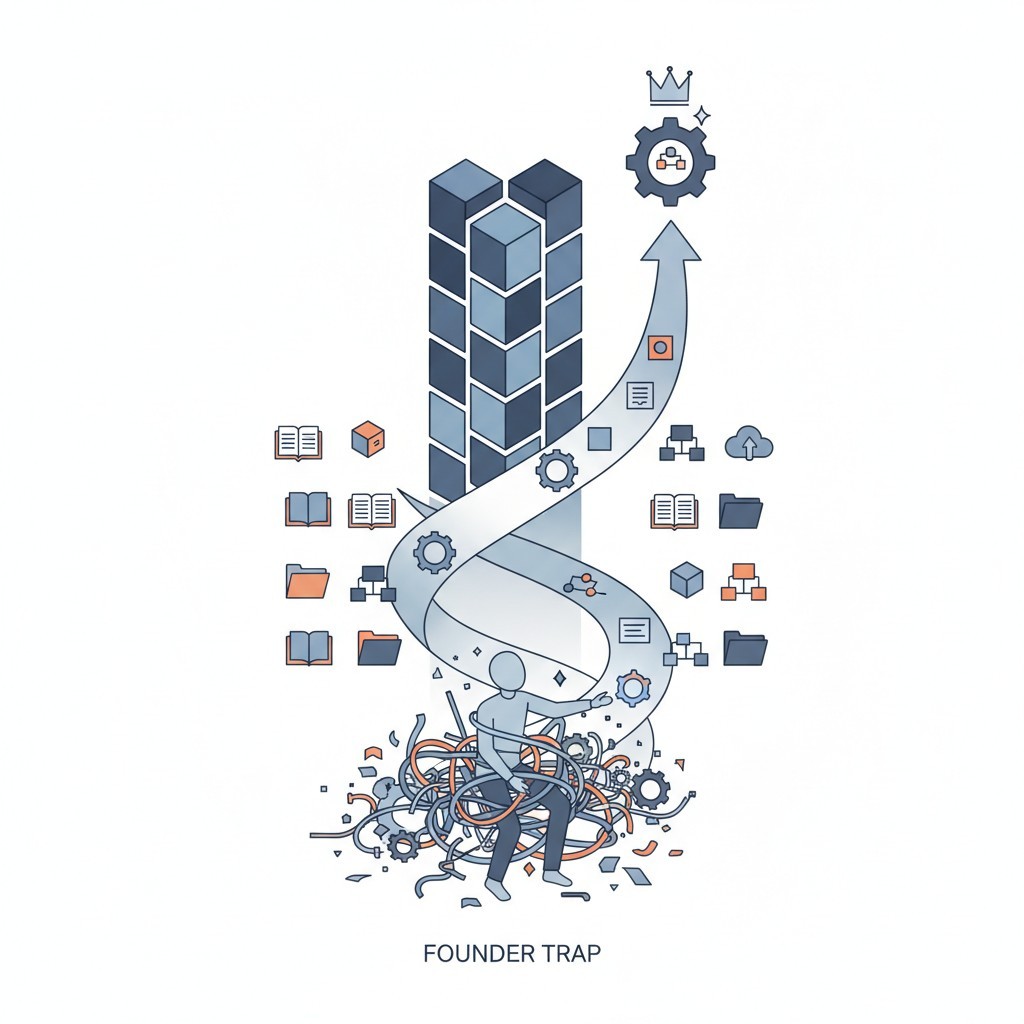
Perhaps the most underappreciated challenge in change management for SMBs is the founder themselves. When the founder is the only person who fully understands the new direction, the change cannot spread beyond them. Every question comes back to the founder. Every exception requires their approval. The change initiative becomes another dependency in a business that already has too many.
The Hidden Challenge: When the Founder Is the Bottleneck
Founder dependency deserves its own section because it is the defining operational problem for growing SMBs, and it is almost never named as a change management challenge in mainstream content.
Here is how it typically plays out: the founder identifies a problem, decides on a new approach, communicates it verbally to the team, and then gets pulled back into client work. The team is left to interpret and implement the change without a clear reference point. When problems arise, they escalate back to the founder. The founder answers the same questions repeatedly, makes exceptions, and gradually the change loses momentum. Within a month, the business is back to the old way of doing things.
This pattern is not a leadership failure. It is a systems failure. The founder never had a mechanism for transferring their knowledge and intent to the team in a durable, accessible format. That mechanism is documentation. When the new process is written down, step by step, with clear ownership and expected outcomes, the founder's knowledge becomes a team asset rather than a personal dependency. Change can move forward even when the founder is not in the room.
Lack of Clear Vision and Defined Process
Vague goals produce vague results. When a change initiative is described as "improving how we handle client communication" without defining what that means in practice, every team member fills in the blanks differently. Some assume it means faster email responses. Others think it means a new CRM. The initiative drifts, scope creeps, and eventually collapses under the weight of its own ambiguity.
Undocumented processes make this problem worse. If the current state is not written down, there is no clear baseline to measure change against. How does anyone know whether the new approach is actually being followed? How does the business track whether the change is working? Without written processes as a reference point, change becomes untrackable, and untrackable change almost always fails.
The fix is to connect every change initiative to a written process. The goal is not just to describe what should happen differently, but to document the new workflow step by step, assign ownership, and establish checkpoints. That is how vision becomes operational reality.
Leadership and Sponsorship Gaps in Owner-Led Businesses
Active leadership sponsorship is one of the most reliable predictors of change success. In enterprise settings, that means executive buy-in. In an SMB context, it means the founder or senior leader visibly championing the change, not just announcing it once and moving on.
Passive sponsorship is one of the most common change management problems in small businesses. The founder introduces a new initiative, answers a few questions, and then disappears into their normal workload. The team interprets this as a signal that the change is not really a priority. Adoption stalls.
Active sponsorship looks different. It means checking in on implementation progress regularly, reinforcing the new approach in team conversations, acknowledging when the transition is hard, and holding the line when people revert to old habits. It also means delegating change ownership explicitly, assigning a specific person to lead implementation and giving them the authority to make decisions without constant escalation. When ownership is clear and leadership is visible, teams are far more likely to follow through.
Communication Failures That Derail Change Initiatives
Over-relying on verbal communication during a change rollout is one of the fastest ways to create misalignment. Instructions get passed from person to person, details get dropped, and within days the team is operating from multiple different versions of the plan.
Written SOPs solve this problem by creating a single source of truth. When the new process is documented and accessible to everyone, there is no ambiguity about what the current standard is. Questions that would otherwise require a conversation with the founder can be answered by referencing the document. Training becomes consistent because everyone is learning from the same material. And when the process needs to be updated, the update happens in one place and propagates to the entire team automatically.
Using documented processes as a communication backbone is not bureaucratic. It is the most practical way to ensure that change messaging reaches every team member in the same form and stays consistent over time.
Resistance to Change: Why Your Team Pushes Back and How to Respond
Understanding the root causes of team resistance is essential for overcoming change management obstacles effectively. Resistance rarely comes from stubbornness. It usually comes from one of three places: fear of the unknown, loss of competence, or lack of involvement.
Fear of the unknown is especially common when roles and expectations have never been formally defined. If employees do not know exactly what their job is today, they cannot tell whether the new system will make their position more or less secure. Clarity reduces fear. When the new process is documented and each person's role within it is explicit, the uncertainty that drives resistance largely disappears.
Loss of competence is a real concern for tenured employees. Someone who has spent five years developing expertise in the old way of doing things may feel threatened by a new system that makes that expertise less relevant. Involving those employees in the process of documenting and designing the new approach is one of the most effective ways to convert resistance into ownership. When people help build the system, they are far more likely to defend and sustain it.
Lack of involvement is the simplest cause and the easiest to address. Teams that are told about change rather than consulted during it will always be less committed to the outcome. Even small gestures of inclusion, such as asking team leads to review a draft SOP before it is finalized, can significantly improve staff buy-in.
Implementing New Technology and Systems Without Chaos
Technology rollouts are among the most common sources of change management failure in SMBs. A new project management tool, a new CRM, or a new invoicing platform gets purchased, a training session gets scheduled, and within three months half the team has stopped using it.
The reason is almost always the same: the technology was implemented before the underlying process was defined. If the team does not have a clear, documented workflow for how work moves through the business, introducing a tool to support that workflow just adds another layer of confusion. People revert to what they know because the new tool does not map to any shared understanding of how things should work.
The correct sequence is process first, then technology. Document how the work actually flows, define the new standard, and then identify the tool that best supports that standard. When team members can see exactly how the tool fits into the documented process, adoption becomes intuitive rather than forced.
Process First, Change Second: How to Sequence Your Change Initiative
Sequencing is one of the most practical and under-discussed aspects of change management for SMBs. Most business owners launch change initiatives and documentation efforts simultaneously, which creates confusion about what the current standard even is.
A more effective approach follows three phases. First, document the current state. Before changing anything, capture how the process actually works today. This gives the team a baseline and surfaces the inefficiencies that need to be addressed. Second, design the new process. Use the current-state documentation as a starting point and build the improved workflow collaboratively with the people who do the work. Third, implement and train from the new documentation. Use the updated SOP as the training material, the communication tool, and the accountability reference from day one of the rollout.
This sequence prevents the common pattern of launching change before anyone agrees on what the starting point is. It also gives the team something concrete to react to, which produces better feedback and faster adoption than a verbal description of the intended change.
How Standard Operating Procedures Solve the Most Common Change Management Challenges
SOPs are not just documentation tools. They are the operating system that makes change stick. Here is how they address each major challenge directly.
Resistance to change: When employees are involved in writing the SOPs that govern their own work, resistance converts to ownership. The documented process becomes theirs, not something imposed on them from above.
Communication gaps: A written SOP is the same for every reader, every time. It eliminates the telephone-game problem of verbal instruction and ensures that every team member is working from the same information.
Founder dependency: SOPs extract the founder's knowledge and make it accessible to the team. The business can operate and adapt without constant founder involvement because the decision-making logic is embedded in the documentation.
Training gaps: New employees can be onboarded to a new process using the SOP as a training guide. Existing employees can reference it when they are unsure. Consistency improves without requiring repeated instruction from management.
Measuring change success: A documented process creates a measurable standard. The business can track whether the new approach is being followed, identify where it is breaking down, and make targeted adjustments rather than guessing.
Sustaining change long-term: Living SOPs, reviewed and updated regularly, prevent the backslide into old habits. When the new way is the documented way, it becomes the default rather than the exception.
Change Management Checklist for Small Business Owners
Use this checklist before, during, and after any significant change initiative to reduce the risk of failure and improve adoption across your team.
Before the Change:
Define the specific outcome the change is meant to achieve, in measurable terms
Document the current process before making any changes
Identify who owns the change initiative and give them explicit authority
Involve key team members in designing the new process
Write the new SOP before communicating the change to the broader team
Identify which roles are most affected and prepare them first
During the Rollout:
Share the written SOP as the primary communication tool for the change
Schedule a structured training session using the SOP as the guide
Set a clear go-live date and hold it
Create a feedback channel for questions and friction points
Check in weekly during the first month to monitor adoption
After Implementation:
Review the SOP after 30 days and update it based on real-world feedback
Measure the defined success metric and share results with the team
Acknowledge and recognize team members who adopted the change effectively
Retire the old process formally so there is no ambiguity about the current standard
Schedule a quarterly SOP review to keep the documentation current
Frequently Asked Questions
What are the 7 challenges of managing change?
The most commonly cited challenges include employee resistance, poor communication, lack of leadership support, undefined change strategy, inadequate training, failure to sustain change over time, and technology implementation problems. In founder-led SMBs, founder dependency is an eighth challenge that deserves equal attention.
What are the most common reasons change management fails?
Change management most commonly fails due to a lack of clear process documentation, passive leadership sponsorship, insufficient team involvement, and no mechanism for sustaining the change after the initial rollout. In small businesses specifically, the absence of written SOPs means there is no shared baseline to change from, which makes any initiative difficult to track or replicate.
How do you overcome employee resistance to change?
The most effective approach is to involve employees in the design of the new process rather than presenting it as a finished directive. When team members contribute to writing or reviewing the SOP that governs their own work, they develop ownership rather than resistance. Addressing the root causes of resistance, including fear of the unknown and loss of competence, through clear documentation and open communication also significantly reduces pushback.
How do small businesses manage organizational change effectively?
Small businesses manage change most effectively when they document the current process first, design the new process collaboratively, and use written SOPs as both the communication tool and the training guide for the rollout. Assigning clear ownership of the change initiative, setting measurable success metrics, and scheduling regular reviews to prevent backsliding are the practical steps that separate successful change from failed attempts.
What are the 5 P's of change management?
The 5 P's of change management are Purpose (why the change is needed), Picture (what success looks like), Plan (how the change will be executed), Part (each person's role in the change), and Pace (the timeline and sequencing of implementation). For SMBs, each of these elements is most effectively communicated through written documentation rather than verbal instruction alone.
What are some examples of problems that can arise in the workplace during change?
Common workplace problems during change include team members reverting to old habits, inconsistent execution across shifts or departments, key employees becoming disengaged, training falling short because the new process was never written down, and the founder getting pulled back into day-to-day decisions because no one else has the information they need to move forward independently.
Check out other interesting articles here 👇

Why Free Acceptable Use Policy Templates Destroy Enterprise Value
The Hidden Tax: How Operational Chaos is Bleeding Your Business Dry

The Architecture of Operational Freedom: Engineering a Business That Runs Without You

What is an SOP in Business? The Architecture to Escape the Founder Trap

I Built a 6 Million Dollar Company That Couldn't Run Without Me

How to Build a Business That Works (Hint: Systems!)

Employee Onboarding and Training: A Practical Guide for Small and Medium Businesses

How to Write Standard Operating Procedures for Manufacturing: A Field-Proven Blueprint

Essential Quality Control Practices for Operational Excellence

How Standardized Processes Drive Operational Efficiency and Growth