
Streamlining Business Process Workflows for Enhanced Productivity
Listen to this article

Ryan Pease
FOLLOW

Most small and mid-sized businesses run on tribal knowledge. The founder knows how to handle a difficult client. The senior employee knows the exact sequence for onboarding a new account. The office manager knows which invoices need a second look before they go out. The problem is not that this knowledge exists. The problem is that it lives entirely in people's heads, and the moment those people are sick, overwhelmed, or gone, the business stumbles.
Business process workflows solve this problem. They take the knowledge that makes a business run well and turn it into something the whole team can follow, repeat, and improve. This guide walks through what workflows actually are, how to build them, where they break down, and how to use them as the operational foundation for a business that can grow without falling apart.
What Is a Business Process Workflow?
A business process workflow is a structured, repeatable sequence of tasks that moves work from a starting trigger to a defined outcome. Every workflow has a clear beginning (something that initiates the work), a series of steps with assigned roles, decision points where the path may branch, and an end state that signals completion.
This is different from an ad-hoc task or an informal habit. When a team member "just knows" what to do next, that is not a workflow. That is undocumented institutional knowledge. A real workflow exists outside of any individual's head. It is written down, assigned, and executable by anyone in the relevant role.
Many SMB owners confuse the idea of having a process with having a workflow. A process is a broader concept: it describes what the business does. A workflow is the execution layer: it describes exactly how the business does it, step by step, with roles and sequences clearly defined.
Business Process vs. Workflow: Key Differences
Understanding the distinction between a business process and a workflow is not just a semantic exercise. Confusing the two creates real operational gaps.
A business process is the strategic overview. It describes the purpose, scope, and desired outcome of a recurring business function. "Client onboarding" is a process. It has a goal (getting a new client set up and ready to receive service) and a general shape, but it does not tell anyone what to do on Tuesday morning.
A workflow is the operational execution layer. It specifies the exact tasks, the sequence in which they happen, who is responsible for each one, and what triggers the next step. "Send the welcome email within 24 hours of contract signature, then schedule the kickoff call, then create the client folder in the project management system" is a workflow.
Growing businesses need both. The process gives the team strategic alignment. The workflow gives them daily direction. When only the process exists, people fill in the gaps with guesswork, and those gaps compound as the team grows.
How Business Processes and Workflows Work Together
Think of a business process as the map and a workflow as the turn-by-turn directions. Both are necessary, and neither is sufficient on its own.
A single business process typically contains multiple workflows. Take client onboarding as an example. The onboarding process might include a sales-to-service handoff workflow, a technical setup workflow, a communication workflow, and a first-30-days check-in workflow. Each of these operates at the task level, with specific owners and sequences, but they all serve the same overarching process goal.
This is where standard operating procedures (SOPs) become critical. SOPs are the connective tissue between a process and its workflows. They capture the detail that makes a workflow executable by anyone, not just the person who designed it. An SOP answers the "how" questions that a workflow map leaves open: what exactly goes in that email, what system to use, what to do when the client does not respond.
How SOPs Connect Business Processes to Executable Workflows
Most workflow resources treat SOPs and workflows as separate topics. They are not. They are two parts of the same operational system, and failing to connect them is one of the most common reasons business workflows fail in practice.
A workflow defines the sequence and the roles. An SOP defines the standards, the context, and the detailed instructions that make the sequence executable without supervision. Together, they form a complete unit of operational documentation.
For a founder-led business, this connection is especially important. The founder often carries the "why" and the "how" for every step in the workflow. When they are not available, the team either stops or improvises. SOPs extract that knowledge and embed it into the workflow itself, so the team can execute consistently whether the founder is in the room or not.
A workflow without an SOP is a skeleton. An SOP without a workflow is a document that no one knows when to use. Together, they create something the team can actually run.
The Hidden Cost of Undocumented Workflows in Founder-Led Businesses
There is a pattern that shows up in nearly every founder-led business between $1 million and $10 million in revenue. The business has grown past the point where the founder can personally oversee everything, but the systems have not grown with it. The workflows still live in the founder's head, or in the heads of two or three key employees who have been around long enough to figure things out.
This creates what is often called key-person dependency, and it is expensive in ways that do not always show up on a balance sheet.
When knowledge is undocumented, onboarding new team members takes longer than it should. Errors happen at handoffs because nobody wrote down who is responsible for what. The founder gets pulled into operational decisions that should not require their involvement. Growth stalls because adding more people does not add more capacity; it just adds more coordination problems.
The cost of undocumented workflows is not just inefficiency. It is the ceiling it puts on the business. A company cannot scale what it cannot repeat, and it cannot repeat what it has not written down.
Why Small and Mid-Sized Businesses Need Documented Workflows
Documented workflows are not a luxury for businesses that have "made it." They are the infrastructure that allows a business to make it in the first place.
For SMBs specifically, the benefits are concrete:
Reduced founder dependency: When workflows are documented, the founder can step back from daily execution without the business losing consistency.
Faster onboarding: New team members have a clear map of how work gets done, which reduces the time it takes to get them productive.
Fewer errors at handoffs: Documented handoff points eliminate the "I thought you were handling that" moments that cause client problems and internal friction.
Consistent delivery: Clients receive the same quality of service regardless of which team member handles their account.
Scalability: The business can grow its team without growing its chaos, because the operating system scales with the headcount.
Where Business Workflows Break Down: The Handoff Problem
If there is one place where business process workflows fail most consistently in service businesses, it is at the handoff. A handoff is any point where responsibility for a task or piece of work transfers from one person or team to another. And in most SMBs, handoffs are handled informally, if they are handled at all.
The symptoms are familiar: a client does not hear from anyone for three days after signing a contract because sales thought operations would reach out, and operations thought sales was still handling it. An invoice goes out late because the project manager did not know the work had been completed. A new employee's equipment is not ready on their first day because nobody owned the setup step.
Every one of these breakdowns happens at a handoff. The solution is not to work harder or communicate more. The solution is to document the handoff explicitly: who hands off to whom, when, what information transfers, and what the receiving party does next. A workflow that does not define its handoffs is a workflow that will break at its seams.
When building or auditing any workflow, the handoff points deserve the most scrutiny. Ask: Is it clear who owns this step? Does the next person know exactly what they are receiving and what they are expected to do with it? Is there a confirmation mechanism that ensures the handoff actually happened?
How to Build a Business Process Workflow: Step-by-Step
Building an effective workflow does not require expensive software or a dedicated process team. It requires clarity, collaboration, and a commitment to writing things down. Here is a practical approach for SMB owners and managers:
Step 1: Choose One Workflow to Start
Do not try to document everything at once. Pick the workflow that causes the most pain, the most errors, or the most founder involvement. Client onboarding and employee onboarding are common starting points because they recur frequently and have high stakes.
Step 2: Map the Current State
Before designing a better workflow, document how the work actually happens today, not how it is supposed to happen. Interview the people who do the work. Walk through a recent example step by step. This surfaces the informal habits, the workarounds, and the undocumented knowledge that the team relies on without realizing it.
Step 3: Identify Roles, Triggers, Tasks, and Decision Points
Every workflow needs four things clearly defined: the trigger that starts it, the tasks that make it up, the roles responsible for each task, and the decision points where the path branches based on a condition. Write these out before worrying about format or tools.
Step 4: Design the Future State
With the current state visible, it becomes easier to see what should change. Remove redundant steps. Clarify ambiguous handoffs. Add missing steps that people currently handle by memory. Design the workflow as it should work, not just as it does work.
Step 5: Document and Attach SOPs
Write the workflow in a format the team can actually use. For each step that requires specific instructions, attach or link an SOP that explains the how. This is where the workflow becomes executable, not just descriptive.
Step 6: Test with the Team
Run the documented workflow through a real example with the people who will use it. Note where the documentation is unclear, where steps are missing, and where the real process still differs from the documented one. Revise accordingly.
Step 7: Assign Ownership and Review Cadence
Every workflow needs an owner who is responsible for keeping it current. Set a review cadence (quarterly is a reasonable starting point) so the documentation evolves as the business does.
Common Business Workflow Types for Service Businesses
While every business has unique workflows, certain workflow categories appear in nearly every service-based SMB:
Client onboarding workflow: The sequence from signed contract to first delivery, including welcome communications, account setup, kickoff meetings, and initial deliverables.
Service fulfillment workflow: The repeatable steps for delivering the core service, from intake through completion and quality check.
Client offboarding workflow: The process for wrapping up an engagement, collecting feedback, and handling final billing and file transfers.
Employee onboarding workflow: Everything from offer acceptance through the first 90 days, including equipment setup, system access, training, and role clarity.
Hiring workflow: The sequence from job posting through offer letter, with defined steps for screening, interviews, and reference checks.
Invoicing and billing workflow: The trigger points, approval steps, and follow-up sequences that ensure revenue is collected consistently.
Escalation workflow: The defined path for handling client complaints, service failures, or internal issues that exceed normal parameters.
Workflow Diagrams, Templates, and Documentation Tools
The best workflow format is the one the team will actually use. Here is a practical comparison of the most common options:
Flowcharts
Flowcharts are useful for visualizing workflows with multiple decision points and branching paths. They help teams see the shape of a workflow quickly, but they can become hard to maintain and are not always practical for step-by-step execution.
Written SOPs
Written SOPs are the most versatile format for SMBs. They combine context, instructions, and standards in a readable format that can be stored in a shared document system and updated easily. They work best when paired with a workflow map that shows the overall sequence.
Checklists
Checklists are ideal for workflows with clear, sequential tasks and low variability. They are easy to use in the moment, reduce errors, and work well for recurring operational tasks like opening procedures, end-of-day routines, or pre-delivery quality checks.
Swimlane Diagrams
Swimlane diagrams show which role is responsible for each step across a horizontal layout. They are particularly useful for cross-functional workflows where handoffs between departments or roles are frequent and need to be visualized clearly.
For most SMBs, a combination of a simple flowchart (for the overview) and written SOPs (for the detail) provides the right balance of clarity and usability without requiring enterprise software.
Why You Must Document Before You Automate
Workflow automation is one of the most discussed topics in business operations right now, and for good reason. Automating repetitive tasks saves time, reduces errors, and frees the team to focus on higher-value work. But there is a critical prerequisite that most automation guides skip entirely: the workflow must be documented and stable before automation is introduced.
Automating an undocumented workflow does not fix the workflow. It accelerates it, including all of its flaws. If the manual process has unclear handoffs, missing steps, or inconsistent inputs, the automated version will produce those same problems faster and at higher volume.
The correct sequence is: document the workflow, test and stabilize it, then automate the repetitive parts. High-ROI automation targets for service businesses typically include email triggers and follow-up sequences, task creation in project management tools, invoice generation and payment reminders, and appointment scheduling. These are all well-defined, high-frequency steps that are easy to automate once the workflow around them is clear.
Automation is a multiplier. Make sure what it is multiplying is worth multiplying.
Business Workflow Audit: A Checklist for SMB Owners
Before building new workflows, it helps to assess the current state of the ones that already exist (or that should exist). Use this checklist to identify where the biggest gaps are:
Can any team member execute this workflow without asking the founder or a senior employee for help?
Is every step in the workflow written down somewhere accessible to the whole team?
Does each step have a clearly assigned role or owner?
Are all handoff points explicitly documented, including what information transfers and to whom?
Does the workflow have a defined trigger and a defined end state?
Has the workflow been tested by someone other than the person who designed it?
Is there a designated owner responsible for keeping the workflow current?
Has the workflow been reviewed in the last six months?
Are there steps in the workflow that rely on a single person's knowledge or availability?
Are there recurring errors or client complaints that trace back to this workflow?
Any "no" answer points to a documentation gap. The workflows with the most "no" answers are the ones to prioritize first.
Using Workflows as an Operating System to Scale Your Team
The most important shift an SMB owner can make is to stop thinking of workflows as individual documents and start thinking of them as an operating system. An operating system is infrastructure. It runs in the background, it enables everything built on top of it, and it scales without requiring constant intervention.
When a business has documented, tested, and maintained workflows across its core functions, something changes. The founder can hire a new team member and point them to the system instead of training them personally. A senior employee can take a vacation without leaving a gap. A client can receive consistent service whether the account is handled by the most experienced person on the team or the newest one.
This is what operational scalability actually looks like. It is not about working harder or hiring faster. It is about building an operating system that the team can run, and that runs the same way every time.
For founder-led businesses in the $1 million to $10 million range, this is often the single highest-leverage investment available. The business already has proven demand. It already has a team. What it needs is the infrastructure to deliver consistently at scale, and documented workflows are that infrastructure.
Frequently Asked Questions About Business Process Workflows
What is a business process workflow?
A business process workflow is a structured, repeatable sequence of tasks with defined roles, triggers, and outcomes that moves work from initiation to completion. It is the operational execution layer of a broader business process.
What are the four types of workflows?
The four most commonly referenced workflow types are sequential workflows (tasks happen in a fixed order), parallel workflows (multiple tasks happen simultaneously), state machine workflows (tasks move between states based on conditions), and rules-driven workflows (the path is determined by defined business rules). For most SMBs, sequential and rules-driven workflows cover the majority of operational needs.
What are the core business processes every SMB needs?
Most service-based SMBs need documented workflows for at least five core areas: client acquisition and onboarding, service delivery and fulfillment, employee hiring and onboarding, financial operations (invoicing, collections, reporting), and quality control or escalation handling.
How do workflows relate to SOPs?
A workflow defines the sequence and roles for a recurring business function. An SOP provides the detailed instructions that make each step in the workflow executable. Workflows and SOPs work together: the workflow is the map, and the SOP is the directions for each leg of the journey.
What are the 7 steps of the business process?
A complete business process typically moves through these stages: define the goal, identify the inputs and outputs, map the current state, identify gaps and inefficiencies, design the improved process, implement and document the new process, and monitor and iterate. For SMBs, the documentation and iteration steps are most often skipped, which is where operational problems compound.
What are the 5 basic business processes?
The five foundational business processes for most SMBs are: lead generation and sales, client onboarding, service delivery, financial management, and team operations (hiring, onboarding, and performance management). Each of these contains multiple workflows that need to be documented and maintained.
Building the Foundation for a Business That Runs Without You
Business process workflows are not paperwork. They are the infrastructure that separates a founder-dependent business from one that can grow, adapt, and deliver consistently at scale. For SMBs that have proven their model and are ready to scale, the question is rarely "do we need workflows?" The question is "where do we start?"
The answer is almost always the same: start with the workflow that causes the most pain, document it thoroughly, test it with the team, and build from there. One workflow at a time, the business accumulates an operating system that the team can run, that new hires can learn from, and that the founder can step back from without the business missing a beat.
That is what operational excellence looks like for a growing business, and it starts with writing things down.
Check out other interesting articles here 👇

Why Free Acceptable Use Policy Templates Destroy Enterprise Value
The Hidden Tax: How Operational Chaos is Bleeding Your Business Dry

The Architecture of Operational Freedom: Engineering a Business That Runs Without You

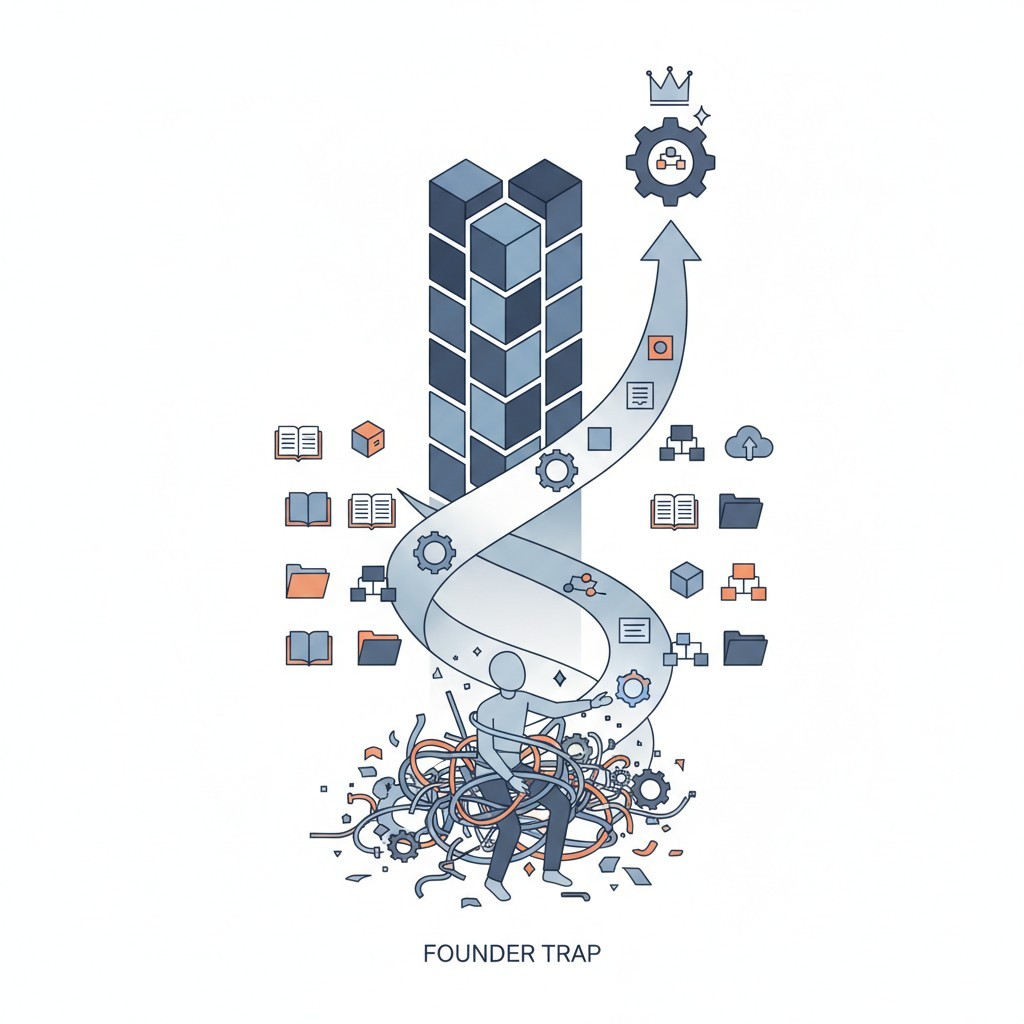
What is an SOP in Business? The Architecture to Escape the Founder Trap

I Built a 6 Million Dollar Company That Couldn't Run Without Me

How to Build a Business That Works (Hint: Systems!)

Employee Onboarding and Training: A Practical Guide for Small and Medium Businesses

How to Write Standard Operating Procedures for Manufacturing: A Field-Proven Blueprint

Essential Quality Control Practices for Operational Excellence

How Standardized Processes Drive Operational Efficiency and Growth