Identifying Barriers to Collaboration and How to Overcome Them
Listen to this article

Ryan Pease
FOLLOW

Most small business owners assume their collaboration problems are a people problem. Someone isn't communicating. A department is being territorial. A key employee won't share what they know. And while those dynamics are real, they're usually symptoms of something deeper: a business that never built the structural scaffolding that makes collaboration possible in the first place.
In founder-led businesses with 10 to 50 employees, collaboration breaks down not because people don't want to work together, but because no one has ever written down how the work actually flows. Roles overlap. Handoffs get dropped. The founder becomes the human operating system, fielding questions that should have answers baked into the business itself. The challenges of teamwork in organizations like these aren't fixed by a team-building retreat or a new project management tool. They're fixed by building systems.
This guide walks through every major barrier to collaboration, explains why they hit small and mid-sized businesses especially hard, and shows how documented processes, specifically standard operating procedures, address the root causes rather than the surface symptoms.
What Are the Most Common Barriers to Collaboration in Small Business Teams?
Collaboration barriers fall into three broad categories: people barriers, process barriers, and structural barriers. Most businesses experience all three, but the mix and severity differ depending on the stage of growth and how the business was built.
People barriers include trust issues, personality clashes, and founder-centric cultures where information flows through one person rather than across a team. Process barriers include undefined handoffs, unclear roles, and workflows that exist only in someone's memory. Structural barriers include missing documentation, no shared systems, and knowledge locked inside the heads of experienced employees who were never asked to write anything down.
What makes SMBs uniquely vulnerable is that all three categories tend to compound at the same time. An enterprise has HR departments, dedicated process teams, and documented onboarding. A 20-person agency or IT firm often has none of that. The founder is still closing deals, the ops manager is still handling client escalations, and no one has had time to document how the business actually runs. That's the real breeding ground for collaboration failure.
Why Founder Dependency Is the Hidden Barrier to Team Collaboration
This is the barrier that almost no one talks about, and it may be the most damaging one in founder-led businesses.
When a business grows around a founder's knowledge, instincts, and relationships, the team learns to route everything through that person. Decisions, approvals, client communications, process questions, and conflict resolution all flow upward. On the surface, it looks like strong leadership. In practice, it creates a structural ceiling on collaboration.
Here's why: when the founder is the de facto operating system, team members have no reliable way to coordinate with each other independently. They can't make decisions without checking in. They can't hand off work cleanly because the process for doing that work was never written down. They can't onboard new people without the founder's direct involvement. The team isn't siloed because people are being difficult. They're siloed because the architecture of the business makes independent collaboration nearly impossible.
Removing founder dependency doesn't mean removing the founder. It means extracting the knowledge, judgment, and process that currently lives in one person's head and building it into the business as a documented, transferable operating system. That's what allows teams to collaborate without constant escalation.
People and Trust Problems That Kill Team Collaboration
Trust is the foundation of any collaborative team, and it erodes faster in small businesses than most leaders realize. When a team is small enough that everyone knows everyone, interpersonal conflict becomes unavoidable and highly visible. A personality clash between two department heads doesn't stay contained. It radiates outward, affecting how information is shared, how decisions get made, and who feels safe speaking up.
Psychological safety, the belief that you can raise concerns, admit mistakes, or share ideas without being penalized, is particularly fragile in founder-centric cultures. When the founder's opinion carries outsized weight, team members often self-censor. They stop flagging problems early. They stop suggesting process improvements. They stop collaborating proactively because the risk of being wrong feels higher than the benefit of being heard.
Building trust in a small team doesn't require a formal HR department. It requires consistency: consistent communication norms, consistent follow-through on commitments, and consistent acknowledgment that good process matters more than individual heroics. When teams see that the business has documented expectations and that those expectations apply to everyone, trust in the system replaces the need for trust in any single personality.
Leadership Gaps That Stall Collaboration Across Departments
Ineffective leadership is one of the most frequently cited barriers to collaboration, but in small businesses, it rarely looks like bad management. It looks like a founder who is stretched too thin, an operations manager who lacks the authority to make real decisions, or a team where no one is quite sure who owns what.
When accountability is unclear, collaboration stalls. People wait for direction instead of moving forward. Tasks fall between roles because no one is sure whose job it is to catch them. Cross-departmental projects go nowhere because there's no clear owner and no documented process for how departments are supposed to work together.
The fix starts with defining decision rights: who can decide what, at what level, without escalating. For most SMBs, this means documenting role responsibilities in enough detail that team members can act independently on routine decisions. It also means giving department leads real authority within their documented scope, rather than having every meaningful decision route back to the founder.
Information Silos and Knowledge Hoarding in Growing Teams
In a 10-person business, information silos often don't feel like silos. They feel like specialization. The sales lead knows the pipeline. The service delivery lead knows the client. The ops person knows the vendor relationships. Everyone is doing their job, and the business is moving forward.
The problem surfaces when the business tries to grow. A new hire joins and has no way to access the institutional knowledge that experienced employees carry. A key person leaves and takes their process knowledge with them. A handoff between sales and delivery fails because the two teams have never had to document how that transition is supposed to work.
Tacit knowledge, the kind that lives in someone's head and gets transmitted through observation or direct instruction, is the enemy of scalable collaboration. It creates information asymmetry that forces constant re-coordination. Teams that should be able to work in parallel end up waiting on each other because no one can access the information they need without asking a specific person.
The solution is knowledge transfer through documentation. When processes, client intake procedures, delivery checklists, and escalation paths are written down and accessible to the whole team, information stops being a bottleneck and starts being a shared resource.
Workflow Mismanagement and Unclear Processes as Collaboration Blockers
Handoff failures are one of the most expensive and least visible collaboration problems in small businesses. Work gets completed by one person or team and then... it stalls. The next person in the chain doesn't know it's their turn. Or they receive the work without enough context to continue. Or they do their part and pass it forward, only to discover later that something critical was missed upstream.
These failures aren't usually caused by carelessness. They're caused by undefined processes. When the workflow exists only in the heads of the people doing the work, every handoff requires a conversation. Every transition is a potential drop point. And when the business is growing and new people are joining, the problem multiplies.
Overcoming collaboration issues at the workflow level means defining the process: what triggers each step, who is responsible, what the output looks like, and what the next step is. When that's documented, handoffs become reliable. Teams can collaborate across roles without needing to coordinate in real time for every routine task.
Organizational Culture and Time Constraints That Discourage Collaboration
Culture is the hardest barrier to name because it's invisible. But in many small businesses, the culture quietly rewards individual heroics over team systems. The person who saves the day gets recognized. The person who quietly maintains a clean, well-documented process gets overlooked. Over time, the team learns what behavior is valued, and they optimize accordingly.
A culture that rewards firefighting over process-building will always struggle with collaboration. People hoard knowledge because it gives them leverage. They resist documentation because it reduces their perceived indispensability. They deprioritize cross-functional work because their individual output is what gets measured.
Time constraints compound this. In a lean team running at capacity, collaboration feels like overhead. Stopping to document a process, align with another department, or give a colleague enough context to take over a task feels like time that could be spent on billable work. This is a false economy, but it's a powerful one. The business keeps operating on informal coordination, the founder keeps filling the gaps, and the capacity ceiling never moves.
Shifting this requires leadership that explicitly values and protects time for process work. It also requires demonstrating, through concrete examples, that documented processes reduce the total coordination burden rather than adding to it.
Remote and Proximity Challenges That Amplify Existing Barriers
For SMBs with distributed or hybrid teams, physical separation turns existing collaboration barriers into larger problems. When a team shares an office, informal coordination fills a lot of gaps. A quick question gets answered in the hallway. A handoff confusion gets resolved in a five-minute conversation. Those micro-corrections happen constantly and invisibly.
Remote work removes that safety net. Without it, every gap in documentation becomes a communication delay. Every undefined process becomes an async back-and-forth. Every ambiguous role boundary becomes a missed deliverable.
The businesses that collaborate effectively across remote and hybrid teams aren't the ones with the best video conferencing tools. They're the ones with the best documentation. Async communication protocols, written processes, and shared operating procedures allow distributed teams to stay aligned without requiring constant real-time coordination.
What Collaboration Barriers Are Actually Costing Your Business
Most SMB owners know collaboration is a problem. Fewer have stopped to calculate what it's costing them.
Consider a 25-person marketing agency where the account management and creative teams operate with no documented handoff process. Every new project requires a kickoff meeting to transfer context that should already be written down. Creative deliverables come back wrong because the brief wasn't standardized. Client feedback loops take longer because no one is sure who owns the revision process. Rework runs at 15 to 20 percent of project hours. That's not a people problem. That's a process problem with a very real dollar figure attached to it.
Or consider an IT managed services provider where the sales team closes a client and hands off to implementation with a verbal summary and a few email threads. The implementation team misses a scope detail. The client is frustrated. The founder gets pulled in to smooth it over. That's three hours of founder time, a damaged client relationship, and a delivery team that still doesn't have a documented intake process to prevent the same thing next month.
Missed handoffs, duplicated work, rework cycles, employee frustration, and client churn are all downstream costs of collaboration barriers. For a business doing $2 million to $5 million annually, even a 10 percent reduction in rework and coordination overhead can represent hundreds of thousands of dollars in recovered capacity and margin.
How Documented SOPs Eliminate the Root Causes of Collaboration Breakdown
Standard operating procedures are often described as a tool for consistency or quality control. That framing undersells what they actually do for collaboration.
SOPs create a shared language across roles and departments. When the sales process, the client intake process, the delivery workflow, and the escalation path are all documented, every team member is working from the same map. They don't need to ask the founder what comes next. They don't need to call a meeting to align on who owns a task. The process itself carries that information.
SOPs also solve the motivation versus structural barrier distinction that most leaders miss. Some collaboration barriers are motivational: people aren't sharing knowledge because they don't want to. Others are structural: people can't share knowledge because there's no system for doing so. SOPs address both. They create the structural infrastructure for knowledge transfer, and they reduce the perceived risk of sharing by making process knowledge a team asset rather than an individual one.
Perhaps most importantly, SOPs reduce coordination overhead. Every time two team members have to stop and figure out how a handoff is supposed to work, that's coordination overhead. Multiply it by dozens of handoffs per week across a 20-person team and the total cost is enormous. Documented processes convert that recurring coordination cost into a one-time documentation investment.
Real-World Example: How a Service Business Broke Its Collaboration Barriers
Consider a commercial cleaning company with 35 employees operating across multiple client sites. The owner was still personally involved in client onboarding, scheduling disputes, and quality complaints. The operations manager and the field supervisors rarely communicated directly. New employees were trained by shadowing experienced ones, which meant training quality varied widely depending on who was available.
Before implementing SOPs, a typical client complaint looked like this: a site supervisor received a complaint, escalated it to the operations manager, who escalated it to the owner, who called the client. Three people involved, one clear outcome, no documented resolution process, and no way to prevent the same issue from repeating.
After documenting the client complaint process, the field escalation protocol, and the quality inspection checklist, the same complaint type was handled by the site supervisor using a documented resolution script. The operations manager received a summary. The owner was notified only if the complaint exceeded a defined severity threshold. The resolution time dropped. Client satisfaction improved. And the owner recovered roughly eight hours per week that had previously been spent on escalations that the team was now equipped to handle independently.
The collaboration barrier in that business wasn't that people didn't want to work together. It was that no one had ever written down how the work was supposed to flow. Once that was documented, collaboration happened naturally because the system made it possible.
A Step-by-Step Framework for Breaking Down Collaboration Barriers
Overcoming collaboration issues requires a sequenced approach, not a simultaneous overhaul. Here's a practical framework for SMB leaders:
Step 1: Identify the barrier type
Determine whether the primary barrier is motivational (people aren't willing to collaborate) or structural (the business doesn't have systems that enable collaboration). Most SMBs have structural barriers masquerading as motivational ones. If the answer to "why aren't they collaborating?" is "because no one ever documented how they should," that's structural.
Step 2: Pick one high-friction collaboration point
Don't try to fix everything at once. Identify the single handoff, process, or knowledge gap that is causing the most visible pain: the most rework, the most escalations, the most founder involvement. Start there.
Step 3: Document the current state
Interview the people doing the work. Map what actually happens, not what's supposed to happen. Capture every step, every decision point, and every handoff. This process often surfaces the exact location of the breakdown.
Step 4: Build the SOP
Write the process in plain language. Assign clear ownership for each step. Define what "done" looks like at each handoff. Make it accessible to everyone who touches that workflow.
Step 5: Test, iterate, and expand
Run the documented process with the team. Collect feedback. Refine it. Then move to the next high-friction point. Collaboration improvement is iterative, not a one-time event.
Collaboration Barrier Diagnostic: Which One Is Slowing Your Team Down?
Before investing time in solutions, SMB owners need to identify which barrier is most active in their business. Use this diagnostic to find your starting point:
Do team members regularly ask the founder or a senior person for information they should already have? If yes, the primary barrier is information silos or knowledge hoarding. The fix is documentation and knowledge transfer.
Do tasks regularly fall through the cracks between roles or departments? If yes, the primary barrier is workflow and handoff failures. The fix is process documentation with clear ownership at each step.
Do team members seem reluctant to share updates, raise problems, or ask for help? If yes, the primary barrier is psychological safety and trust. The fix starts with leadership behavior and is reinforced by documented norms.
Does the founder regularly get pulled into decisions that should be handled at the team level? If yes, the primary barrier is founder dependency and unclear decision rights. The fix is role documentation and delegated authority.
Do new employees take a long time to become productive and independent? If yes, the primary barrier is undocumented processes and informal training. The fix is onboarding SOPs and role-specific process documentation.
Do remote or field team members frequently work out of sync with the central team? If yes, the primary barrier is proximity and async communication gaps. The fix is written protocols and shared process documentation.
Most businesses will check more than one box. That's normal. The goal is to identify the highest-impact barrier and address it first, rather than trying to fix everything simultaneously.
Frequently Asked Questions About Barriers to Collaboration
What are the 5 most common barriers to effective teamwork?
The five most common barriers are: (1) lack of trust and psychological safety, (2) unclear roles and accountability, (3) information silos and undocumented knowledge, (4) workflow and handoff failures, and (5) founder or key-person dependency. In small businesses, the last three are often the most damaging because they're structural rather than interpersonal.
What are the top challenges to team collaboration in small businesses?
Small businesses face unique collaboration challenges because they rarely have the formal systems that larger organizations take for granted. The most common challenges include knowledge trapped in key employees' heads, no documented processes for cross-functional handoffs, founders who remain the de facto decision-maker for too long, and teams that have grown faster than their operating systems.
How do you overcome barriers to collaboration in the workplace?
Start by identifying whether the barrier is structural or motivational. Most SMB collaboration barriers are structural, meaning the fix is documentation and system-building rather than culture change alone. Define roles clearly, document workflows, establish handoff protocols, and give team members the information and authority they need to collaborate without constant escalation.
What are the 5 C's of collaboration?
The 5 C's of collaboration are: Communication, Coordination, Cooperation, Collaboration, and Co-creation. In practice, most small businesses struggle to get past the first two because they lack the documented processes that make consistent communication and coordination possible at scale.
How do SOPs help improve team collaboration?
SOPs create a shared operating language across roles and departments. They document who does what, when, and how, which eliminates the need for constant re-coordination. They transfer knowledge from individuals to the business as a whole, reducing dependency on any single person. And they make onboarding faster, which means new team members can contribute to collaborative workflows sooner.
What is the fastest way to fix collaboration problems in a growing team?
Identify the single highest-friction handoff or process gap in the business and document it. Don't start with a comprehensive process overhaul. Pick the one point where work is most frequently dropping, being duplicated, or requiring founder intervention, and build a clear, written process for it. That single improvement will demonstrate the value of documentation and create momentum for the rest.
Building a Business That Collaborates by Design
The goal isn't a team that collaborates in spite of the business's structure. It's a business whose structure makes collaboration the natural default.
That means extracting the knowledge that currently lives in people's heads and building it into documented systems. It means defining roles clearly enough that team members know what they own and what they can decide without escalating. It means creating handoff protocols that make cross-departmental work reliable rather than hit-or-miss. And it means reducing the founder's role as the human operating system so the team can function, grow, and collaborate independently.
The barriers to collaboration that slow most small businesses down aren't unsolvable. They're undocumented. And documentation, done right, is the most scalable investment a growing business can make.
Check out other interesting articles here 👇

Why Free Acceptable Use Policy Templates Destroy Enterprise Value
The Hidden Tax: How Operational Chaos is Bleeding Your Business Dry

The Architecture of Operational Freedom: Engineering a Business That Runs Without You

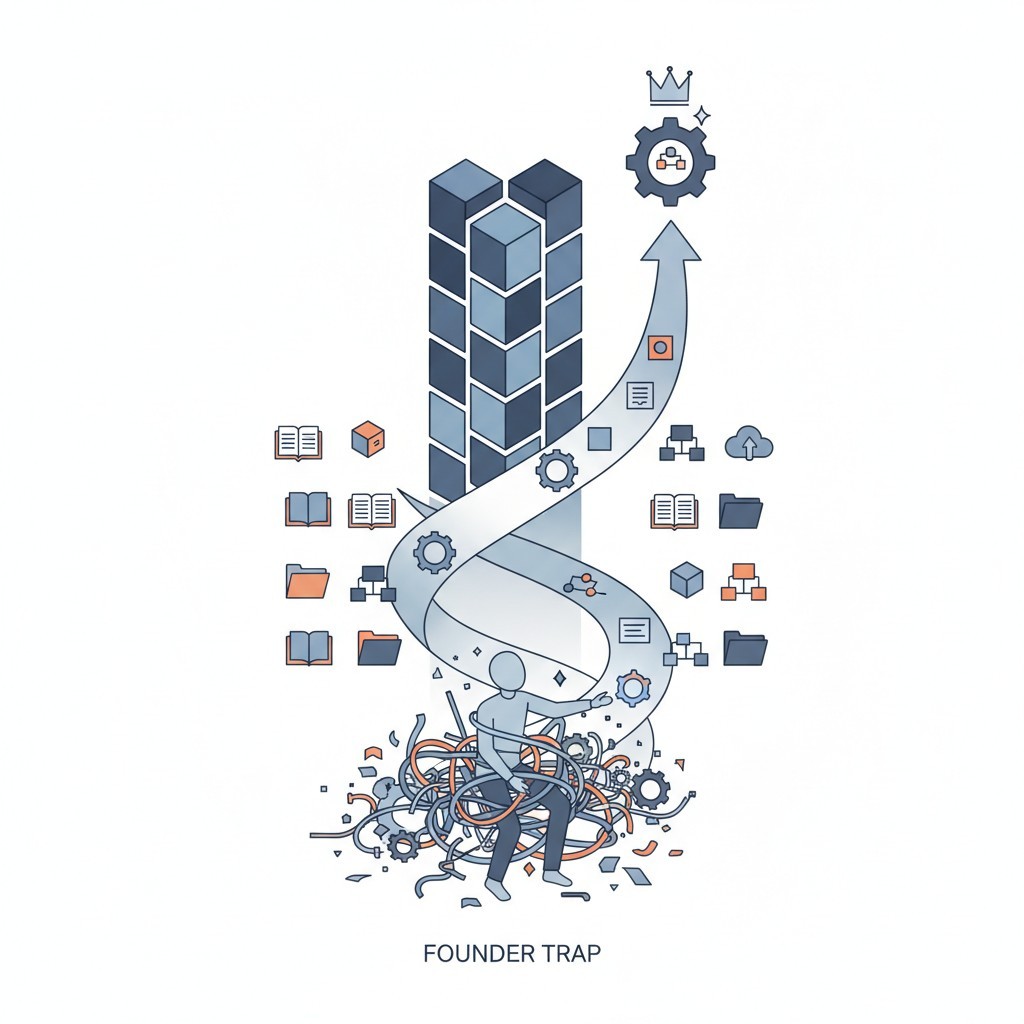
What is an SOP in Business? The Architecture to Escape the Founder Trap

I Built a 6 Million Dollar Company That Couldn't Run Without Me

How to Build a Business That Works (Hint: Systems!)

Employee Onboarding and Training: A Practical Guide for Small and Medium Businesses

How to Write Standard Operating Procedures for Manufacturing: A Field-Proven Blueprint

Essential Quality Control Practices for Operational Excellence

How Standardized Processes Drive Operational Efficiency and Growth